From The Alpha and the Omega - Volume III
by Jim A. Cornwell, Copyright © July 20, 2002, all rights reserved
"Volume III - The Eleventh Month - Constellation Names for Aquarius"
 AQUARIUS
Aquarius, the Water Bearer, the "Pour Fourth of Water," or "Pourer-out-of-Water."
The constellation name for Aquarius:
One view which portrays a (mighty) man or boy spilling water from an (a great) urn, upon his shoulder. The contents are being poured forth as a copious stream flowing both east and west and finally flowing into the mouth or over the body of a fish (Piscis Austrinus).
Others see this as the Water Jar and as the ancient Mesopotamians saw this constellation as a spilling water jar. It was also depicted as a figure (male or female) pouring water out of a jar in two separate streams.
- Latin Aquarius, the pourer forth of water.
- Rolleston, claims "the rising up (Hosea 6:2), and the pouring forth of water (Joel 2:28)."
- Greek Hydrokoeus, the pourer forth of water.
- In Greek literature Aquarius was Udrokhoos, Udrochoeus, Hydrochous, Hydrochoos, meaning Water-Pourer; Chusis Udatos, 'the Pouring Forth of Water'.
- Sumerian a...dé: to pour out water ('water' + 'to pour').
- Sumerian dé: to cry out; to hail; to proclaim; to read aloud; to pour (often with -ni-); to water; to be full (cf., ég).
- Sumerian GU.LA, which means "Great," Aquarius.
- Sumerian gu-la: large, great (cf., gal; gu-ul).
- Sumerian gu-ul: to enlarge; to increase; to make numerous; sometimes = gul, 'to destroy' (cf., gal; gu-la).
- Hebrew gelal (Chaldean), ghel-awl', from a root corresponding to Heb. galal, weight or size (as if rolled) - great.
- Hebrew gadowl, gaw-dole', or gadol, from Heb. gadol, gaw-dal', great (in any sense).
- Hebrew gabar, gaw-bar', a primary root to be strong, prevail, exceed, be great, be mighty.
- Hebrew 'el, ale, shortened, means strength, as adj., mighty, especially the Almighty (but used also of any deity) - God, great, idol, might (-y, one), power.
- Reference to the Hebrew 'elohiym.
- Sumerian UR.GU.LA, "The Lion," Leo, or Ur-gula.
(ur, carnivorous beast + gu-la: great).
- From www.lexiline.com, "The Great God Ea (GULA d.Ea), the Star of Eridu (NUN.(KI), d.Ea." "GULA 'lying down' and represents EA pictured above another heavenly 'reclining' lion both symbols for 'earth,' with rivers springing forth from both sides." "This is related to Sumerian AB.ZU, hole, underground."
- The Babylonian kudurru, boundary stones from the twelfth century B.C., may denote the Earth-goddess Gula, (also Ninmah, goddess of the underworld), where the cosmic serpent begins to rise.
- Some sources call her "The Great Doctoress," because she was the patroness of herbs, healing, life, as her flowered garment shows. She is seen with hands lifted in prayer, with her dog at side, defender of homes, while before her a Scorpion Archer mounts guard at the uttermost bound of the earth (cosmic sea), to defend against demonic powers and protect the rising and setting sun. She was the daughter of Anu, the remote, horned head-dressed, heaven-god of Mesopotamia, or An, Sumerian "overlord of the gods."
- From www.lexline.com, makes a reference to "The star to his right: NIN.MACH."
- Hebrew word for Aquarius.
- Bucket or Pail.
- Hebrew deliy, del-ee', or doliy, dol-ee', from Heb. dalah, daw-law', a primary root probably to dangle, i.e. to let down a bucket (for drawing out water), a pail, jar, bucket.
- Rolleston and in "The Witness of the Stars," by E.W. Bullinger, seen on page 85, "Hebrew, Deli, the water-urn, or bucket (Numbers 24:7); the Arabic (also Syriac) Delu is the same." Another source calls the Hebrew Dali.
- Under Capricornus in the Delphinus constellation section we find the Hebrew Dalaph, "the pouring out of water," Arabic Dalaph, "coming quickly."
- Dropping.
- Hebrew deleph, deh'-lef, from Heb. dalaph, daw-laf', a primary root to drip, by implication to weep, drop through, melt, pour out, thus a dripping, dropping.
- Sumerian dé: to cry out; to hail; to proclaim; to read aloud; to pour (often with -ni-); to water; to be full (cf., ég).
- Rolleston and in "The Witness of the Stars," by E.W. Bullinger, page 82 "The ancient names connected with this constellation are Dalaph (Hebrew), pouring out of water; from dropping - Prov. 19:13."
- Allen states: Aquarius to the Arabians was Al Dalw, the Well-bucket;and Kazwini's Al Sakib al Ma’, the Water-pourer; from the first of which came the Edeleu of Bayer, and the Eldelis of Chilmead.
The Persians knew it as Dol or Dul; In the Persian Bundehesh it is Vahik.
the Hebrews, as Deli (Riccioli's Delle);
the Syrians, as Daulo, like the Latin Dolium;
and the Turks, as Kugha, — all meaning a Water-bucket.
The Arabs knew the familiar quadrangle as Al Dalw, the Water-bucket, the Amphora of some Latin imitator, which generally was used for the Urn in Aquarius.
- Vessel for drawing or holding water.
- Hebrew keliy, kel-ee', from Heb. kalah, kaw-law', a primary root to end, to cease, be finished, perish, complete, prepare, consume, thus something prepared, i.e. any, apparatus (as an implement, utensil, dress, vessel or weapon), tool, vessel, ware, weapon.
- Greek skeuos.
- Babylonian Ka-d (Aquarius) "The Urn."
- Egyptian/Coptic:
- On the Denderah Zodiac, Aquarius is seen as a male figure with the white crown of Egypt on his head. He is seen holding two vials, or urns, one in each hand, which are both pouring out a stream of water onto a fish (Piscis Australis), although some claim that the fish seems to come out of one of them.
- In his work “BABYLONIAN STAR-LORE: An Illustrated Guide to the Star-lore and Constellations of Ancient Babylonia,” by Gavin White gives this image of Aquarius which is seen on page 37 shown here as
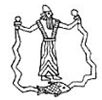 and comments, "The figure known as the Great One, the Babylonian name for our Aquarius, continues the same watery symbolism already seen. I believe that this figure with his overflowing vases is best understood as a seasonal symbol that represents the increased rains and floods of winter and early spring. Along with the constellation of the Field, which represents a plot of arable land, the Great One can be thought of as the 'Irrigator' - as the star's rising marks the season when the ripening barley is regularly irrigated before the springtime harvest."
As you can see for yourself the image for Aquarius above has some correlation with the Round Denderah image  and the Square Denderah image
 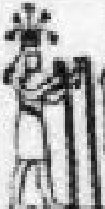 and the hieroglyphic image
  .
.
- In "The Witness of the Stars," by E.W. Bullinger, seen on page 84-85, "In the ancient Zodiac of Denderah it (Aquarius) is the same idea, though the man holds two urns, and the fish below seems to have come out of the urn. The man is called Hupei Tirion, which means the place of him coming down or poured forth."
- Rolleston claims also "Coptic, Hupei Tirion, the station of pouring out."
- Allen states: Aben Ezra called it the Egyptians' Monius, from their muau, or Mo, Water; Kircher said that it was their Upeutherian, Brachium beneficum, the Place of Good Fortune; which Brown, however, limits to its stars, alpha, gamma, zeta, and eta as a Coptic lunar station; and our Serviss writes that "the ancient Egyptians imagined that the setting of Aquarius caused the rising of the Nile, as he sank his huge urn in the river to fill it."
- In Akkadian it is Qu-hasbu, meaning "Streams."
- Watercourse, and Stream, or Streams.
- Sumerian ída, íd, i7: river; main canal; watercourse (éd, 'to issue', + a, 'water').
- Hebrew mowtsa, mo-tsaw', going forth, also see Hebrew te'alah, teh-aw-law'.
- Hebrew 'eshed, eh'-shed, from an unused root meaning to pour, an outpouring, stream.
- Hebrew 'aphiyq, aw-feek', from Heb. 'açaph, aw-saf', a primary root to gather, to receive, take away, thus properly containing, as in a bed of a stream.
- Hebrew nehar (Chald.) neh-har', from a root corresp. to Heb. nahar, naw-har', a primary root to sparkle, or Heb. nahar, naw-hawr', a stream, a river, espec. the Nile and Euphrates, river, stream.
- Hebrew yabal, yaw-bawl', primary root to flow, a stream.
- Water Carrier, or Aquarius as the water carrier.
- The vessel figure which some call the Gu, "Urn," does not reveal any thing unusual.
- Richard H. Allen states: ... and Vergil, calling it frigidus, similarly said that when coincident with the sun it closed the year with moisture:
In Babylonia it was associated with the 11th month Shabatu, the Curse of Rain, January-February; and the Epic of Creation has an account of the Deluge in its 11th book, corresponding to this the 11th constellation; each of its other books numerically coinciding with the other zodiacal signs. In that country its Urn seems to have been known as Gu, a Water-jar overflowing, the Akkadian Ku-ur-ku, the Seat of the Flowing Waters; and it also was Ramman or Rammanu, the God of the Storm, the still earlier Imma, shown pouring water from a vase, the god, however, frequently being omitted. Some assert that Lord of Canals is the signification of the Akkadian word for Aquarius, given to it 15,000 years ago (!), when the sun entered it and the Nile flood was at its height. And while this statement carries the beginnings of astronomy very much farther back than has generally been supposed, or will now be acknowledged, yet for many years we have seen Egyptian and Euphratean history continuously extended into the hitherto dim past; and this theory would easily solve the much discussed question of the origin of the zodiac figures if we are to regard either of those countries as their source, and the seasons and agricultural operations as giving them names.
- Sumerian gu: thread; wool yarn; flax; hemp; net; orig. word for needle.
- Sumerian gú: neck; back of neck = a load = a talent in weight; river bank; edge; front; land; chick pea (cf., gúnu).
- Sumerian gu2,4: (cf., gud(2)).
- Sumerian gù: n., noise, sound; voice; v., to exclaim; to utter a cry (said of an animal).
- Sumerian gu7, kú: n., food, sustenance; v., to eat, swallow, consume; to eat up, finish off; to feed, nurse, benefit (with -ni-).
- Vessel, Urn.
- Sumerian dug: earthen pot; jar; vessel.
- Sumerian dugti-lim-da: a vessel ('lives' + 'thousand' + 'with').
- Sumerian nigin(2): n., enclosure, circle; a large vessel; capacity; whole (cf., kilib); v., to halt, turn away; to turn round; to surround; to assemble; to pen up cattle; to wander about; to circle; to make the rounds (usually nígin[LAGAB] for hamtu form and nigin[LAGAB.LAGAB] for marû form) (ní; ne4, 'fear', + gin, 'to go').
- Sumerian NI-KUŠ-NÍGIN: a vessel.
- Hebrew keliy, kel-ee', from Heb. kalah, kaw-law', a primary root to end, to cease, be finished, perish, complete, prepare, consume, thus something prepared, i.e. any, apparatus (as an implement, utensil, dress, vessel or weapon), tool, vessel, ware, weapon.
- Hebrew nebel, neh'-bel, or nay'-bel, from Heb. nabel, naw-bale', a primary root to wilt, gen. to fall away, fail, to be foolish or wicked, to despise, disgrace; hence a vase, pitcher, vessel.
- Water.
- Sumerian a-bala: drawing of water (a, 'water', + bala, 'turn, duty').
- Sumerian a, e4: n., water; watercourse, canal; seminal fluid; offspring; father; tears; flood; interj., alas!; prep., locative suffix - where; in; when - denotes movement towards or in favor of a person; def. article, nominalizing suffix for a noun or noun clause, denoting 'the'.
- Sumerian á: (cf., áhi).
- Sumerian a5: (cf., aka).
- Hebrew mayim, mah'-yim, dual of a primary noun (but used in a sing. sense), water, also juice, urine, semen, also in the Greek hydor, and is used in the Bible as a symbol of the cleansing of the soul from sin (Ezek. 16:4, 9; 36:25; John 3:5; Eph. 5:26; Hebrews 10:22; 1 John 5:6, 8). Metaphorical usage include the "water of life" in Rev. 21:6 and cleansing with water is also used to depict the process of regeneration (Eph. 5:26).
- Carrier.
- Sumerian íla, íli, íl: n., carrier; v., to lift, carry; to deliver; to carry forward (in accounting); to be high; to shine (íl-i in marû).
- Cupbearer.
- One Greek myth shows Ganymede was abducted by Zeus to be cupbearer.
- Sumerian sagi [SÌLA.ŠU.DU8]: cupbearer.
(sìla, capacity + šu, to pour + du8, open).
- Sumerian sìla, šál: measure of capacity - 0.842 liter in the Neo-Sumerian period; measuring pot (si14, 'a small pot', + lá, 'to weigh'; but cp. also, sal, 'uterus').
- Sumerian šu: n., hand; share, portion, bundle; strength. v., to pour.
- Sumerian šú: (cf., šuš(2)).
- Sumerian šu12: (cf., šùde).
- Sumerian duh, du8: n., residue, by-product; bran. v., to crack, loosen, open; to untie; to caulk a boat; to adorn; to gouge (eyes); to bake bread/bricks.
- Hebrew mashqeh, mash-keh', from Heb. shaqah, shaw-kaw', a primary root to quaff, to irrigate, thus properly causing to drink, drink, a well-watered region, butler, cupbearer, drink, fat pasture, watered.
- One of the twelve simple Hebrew Letters is Tzaddi (KJV Tzaddi, tsaw-day', Ps 119:137, also Tsadey), transliterated as the English sound ts which has a numerical value equal to 18, and an esoteric meaning of "Fishing-Hook."
- Fishhooks, note that in Matthew 17:21 the Lord told Matthew to cast a hook (KJV).
- Hebrew duwgah, doo-gaw', fem. from the same as Heb. davvag, dav-vawg', an orth. var. of Heb. dag, dawg, a fish, thus as a denom. of Heb. dayag, dah-yawg', a fisherman, fisher thus probably fishery, i.e. a hook for fishing, fish [hook].
- Hebrew ciyr, seer, or (fem.) ciyrah, see-raw', or cirah, from a primary root meaning to boil up, a pot, also a thorn (as springing up rapidly, by implication a hook, caldron, fishhook, pan, (wash-) pot, thorn.
- Other names for Aquarius: Al Au'a, Awwa', Al Dalw (Arabian and the Square of Pegasus), Sa'kibal Ma', Deli (Hebrew), Delle, Dol and Dull (Persian), Edeleu', Elde'is.
- Aquarius to the Arabians was Al Dalw, the Well-bucket;
and Kazwini's Al Sakib al Ma’, the Water-pourer; from the first of which came the Edeleu of Bayer, and the Eldelis of Chilmead.
The Persians knew it as Dol or Dul; In the Persian Bundehesh it is Vahik.
the Hebrews, as Deli (Riccioli's Delle);
the Syrians, as Daulo, like the Latin Dolium;
and the Turks, as Kugha, — all meaning a Water-bucket.
Continue to Star Names of Aquarius or return to the Introduction of Aquarius.
This file was updated on July 15, 2008, and March 30, 2010.
Return to the Table of Contents or the Zodiac of Denderah