From The Alpha and the Omega - Volume III
by Jim A. Cornwell, Copyright © July 20, 2002, all rights reserved
"Volume III - The Eighth Month - Constellation Names for Ophiuchus"
In the Eighth Month of Scorpius
Ophiuchus, the Serpent Bearer
The constellation name for Ophiuchus:
- Ophiuchus is located across the celestial equator but is not one of the original twelve zodiacal constellations, but because of its angular spread some try to qualify it for inclusion. So for now it must remain as a Decan of Scorpius.
- Greek Ophiuchus, holder of the serpent [Greek ophiouhous, ophis, serpent + okhos, holder, Greek ekhein, to hold.]. This name has been known since 2000 B.C.
- In the "Gospel of the Stars," by Joseph Seiss, page 47, "Greek Ophiuchus, Serpent-holder, also Arabic Che-leb Afei or Aesculapius."
- Rolleston claims "Greek Ophiuchus, holder of the serpent, and Arabic Che-leb Afei (who holds)+(serpent) or Aesculapius (Esculapios)."
- Richard H. Allen comments: The original title, Ophioukhos, appeared in the earliest Greek astronomy; mogeros, "toiling," being an adjectival appellation in the Phainomena.
Transliterated as in our title it was best known to the Latins, but also as Ophiulchus, Ophiulcus, Ophiultus, and, in the diminutive, Ophiuculus and Ophiulculus; while the classical word plainly shows itself in the Afeichus, Afeichius, and Alpheichius of the 16th and 17th centuries.
- From the 30 stars Tablet from Birs Nimroud (Borsippa).
- Greek Aesculapius, God of Medicine. An ancient Babylonian tablet lists a constellation Nutsirda, "Prince-of-the-Serpent," called in Semitic Namassu, "The Reptile." Nutsirda is also called An-u-gie, "Lord-of-the-Underworld," which is connected to the god Sagimu: the ideographs of his name express "mouth" and "invoke" thus "Lord of Invocation," presiding over dead bodies and disease.
- Euphratean astronomers knew it, or a part of it with Serpens, as Nu-tsir-da; and Brown associates Ophiuchus with the Euphratean Sagimu (Sa-gi-mu), the God of Invocation.
- Arabic Al hay
or Unuk Al Hay, represents a reptile.
- Under Serpends constellation names and its a star is called in Arabic Unukalhai, "the serpent's neck," where Unuk (Heb. 'anak), means encompassing.
- Arabic Al Hay (Arabic) for the reptile. Probably means, "living thing," as in Heb. Chay.
- Living.
- Hebrew chay, khah'ee, from Heb. chayah, khaw-yaw', a primary root to live, thus alive, hence raw (flesh), fresh, strong, life (living thing).
In the Tablet of the 30 stars lists this is seen as Asterism XXV (25) Kakkab Mulu-Bat / / Pa-gar, a-sig: The Asterism Man-of-Death | | The Corpse, The Fever" of the star e (Yed Posterior) and d (Yed Prior) Ophiuchi, the stars in the left hand of the figure, grasping the Serpent.
- Death as to Kakkab Mulu-Bat.
- Sumerian bat: death.
- Hebrew temuwthah, tem-oo-thaw', from Heb. muwth, mooth, a primary root to die, thus execution (as a doom), death, die.
- Corpses as to Pa-gar.
- Hebrew peger, peh'-gher, from Heb. pagar, paw-gar', a primary root to relax, i.e. become exhausted, be faint, thus a carcase (as limp), whether man or beast, fig. an idolatrous image, carcase, corpse, dead body.
- J. Epping (1889) "Astronmisches Aus Babylon," provides the Babylonian and Hassan Al-Saba (Saudia Arabia) provides the Arabic source for the following 28 lunar mansion names listed as:
- Babylonian #25 Kaššudšakatar-pa.
- Under Serpends constellation names is a mention of J or q (theta) (Kashud) Ophiuchi, but the star also has a name of Al'ya, as the tip of the snakes tail.
- (No Arabic comparison is mentioned).
- Fever as to a-sig.
- Sumerian si; su; sa; sa5: v., to fill up; to fill with (with -da-); to survey a field; to inundate; to be full; to be sufficient; to increase; to compensate, repay, replace; to grow weak (probably reduplication class) (cf., sum, sug6, rúg, sig); adj., suitable, fit.
- Hebrew qaddachath, kad-dakh'-ath, from Heb. qadach, kaw-dakh', a primary root to inflame, burn, kindle, thus inflammation, i.e. febrile disease, burning ague, fever.
Hebrew and Arabic Afeichus, "the serpent held."
- Rolleston adds both "Afeichus, the serpent held," and "Affalius, serpent holder."
Arabic Ras al Hagos, "the head of him who holds" or Ras Alhague, Rasalhague, "head of the serpent collector."
- In "The Witness of the Stars," by E.W. Bullinger, page 56 "a (in the head) is called Ras al Hagus (Arabic), the head of him who holds."
- Rolleston also claims "Ras al Hagus, and also Ras al Awa, as in Hercules."
- Richard H. Allen states: The Arabians translated the Greek name into Al Hawwa’, which Assemani repeated as Alhava, Collector_serpentum; but it appeared on the globes as Al Haur, turned by the Moors into Al Hague, and by early astronomical writers into Alangue, Hasalangue, and Alange; the Turks having the similar Yilange. It has been suggested, however, that these may have come from the Latin Anguis, a word that the astronomical Arabians and Moors well knew.
Egyptian/Coptic:
- On the Denderah Zodiac above Scorpius and behind Libra, Ophiuchus is seen as a hawk-headed male figure, with a sun disk crown, and seated on a throne with a scepter, positioned on a serpent.
- Some sources claim him to be known as Coptic Api-bau, "the chief who cometh."
- In "The Witness of the Stars," by E.W. Bullinger, page 58 "In the Zodiac of Denderah we have (Ophiuchus) a throned human figure, called Api-bau, the chief who cometh. He has a hawk's head to show that he is the enemy of the serpent, which is called Khu, and means ruled or enemy."
- In his work “BABYLONIAN STAR-LORE: An Illustrated Guide to the Star-lore and Constellations of Ancient Babylonia,” by Gavin White in his reference to Ophiuchus he gives this image of the Ophiuchus which is seen on page 30 shown here as
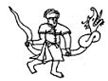 compared to the Round Denderah image
  and the Square Denderah image
 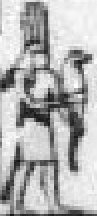 , which White claims, "The Serpent-bearer (Ophiuchus) is represented on the Greek star-map as a hero wrestling with a huge serpent. In the section of the Sitting Gods I argue that this heroic figure could well be based on a Babylonian god called Nirah, who was envisioned as a man with a huge serpent replacing his legs."
This man with a huge serpent replacing his legs looks like  .
.
Latin or Roman Aesculapius was a god of medicine and healing. Latin and Greek Asklepios.
Other names for Ophiuchus: Al Haur, Al Hague', Alhara, Hasalan'gue, Al Hawwa' (Arabic) Haw'wa (title).
- Richard H. Allen states: The Arabians translated the Greek name into Al Hawwa’, which Assemani repeated as Alhava, Collector_serpentum; but it appeared on the globes as Al Haur, turned by the Moors into Al Hague, and by early astronomical writers into Alangue, Hasalangue, and Alange; the Turks having the similar Yilange. It has been suggested, however, that these may have come from the Latin Anguis, a word that the astronomical Arabians and Moors well knew.
- Seen as Ofiuco with the Italians, Schlangentrager (Snake Bearer) with the Germans, and Serpentaire with the French.
See Star Names for Ophiuchus.
This file last updated on July 15, 2008, and March 30, 2010.
Return to the Table of Contents or the Zodiac of Denderah