From The Alpha and the Omega - Volume III
by Jim A. Cornwell, Copyright © July 20, 2002, all rights reserved
"Volume III - The Fifth Month - Constellation Names for Corvus"
In the Fifth Month - Leo.
Corvus, the Crow or Raven.
The constellation name for Corvus:
- Latin corvus, raven.
- Corvus is on the Meridian on May 10, and is identified with both:
- Crow (the scientific name of the crow genus is Corvus).
- Raven, a bird sacred to Apollo.
- A Raven is a large bird (Corvus corax) having black plumage and a croaking cry, usually black and shiny: raven tresses [Middle English, from Old English hroefn].
- Corvus is shown either on or near the back of Hydra, the Water Serpent, and next to Crater, the Cup. The Serpent, Crater and Corvus are all in the outer darkness.
- To the Arabs these stars were a tent.
- As can be seen in the star names for Corvus is a Alchiba
is the Arabic name for the whole group is "tent."
Richard H. Allen comments: The Raven of Rome and Greece became Al Ghurab in Arabia; but in earlier days four of its stars were Al ‘Arsh al Simak al Azal, the Throne of the Unarmed One, referring to the star Spica. These naturally have been considered beta (Kraz), gamma (Gienah), delta (Algorab), and eta; but Firuzabadi, as interpreted by Lach, said that they were theta, kappa, psi, and g; and the same stars were Al ‘Ajz al Asad, the Rump of the ancient Lion (Leo). Other early titles for the whole were Al Ajmal the Camel, and Al Hiba’, the Tent; this last generally qualified by Yamaniyyah, the Southern, to distinguish it from that in Auriga. Instead of Ajmal, Hyde quoted, from the Mudjisat, Ahmal, or Hamal, the Ram, but this does not seem probable here.
Allen comments in his Corona Australia section: Al Sufi is our authority for the Arabs' Al Kubbah, literally the Tortoise, but secondarily the Woman's Tent, or traveling apartment, from its form; and it was Al Hiba', the Tent, and Kazwini's Al Udha al Na'am, the Ostrich's Nest, for the same reason; the birds themselves being close by in what now are the Archer and the Eagle.
Mariners sometimes called them "the Sail," for they resemble a gaff-rigged sail, where others think it resembles a kite.
One source claims that in the Lunar mansion whose patron god was known as:
- Im-dugud-khu, "The Great Storm-Bird," is associated with mist and tempest, and closely connected to Hydra, the Storm-and-Darkness Serpent.
- Sumerian anzud(2), anzu(2)-(d)[dIM.MI/DUGUDmušen]: a mythical giant bird; vulture, eagle.
- Sumerian imi, im, em: wind; direction; weather; storm; cloud; rain (cf., tumu).
- Sumerian hu: bird (earlier word than mušen).
- Allen comments: Nor is the reason for the association of Corvus with Hydra evident, although there is a Euphratean myth, from far back of classical days, making it one of the monster ravens of the brood of Tiamat that Hydra represented; and upon a tablet appears a title that may be for Corvus as the The Great Storm-Bird, or Bird of the Desert, to which Tiamat gave sustenance: just as Aratos described Korae; pecking the folds of the Hydra. The prominent stars of Corvus have otherwise been identified with the Akkadian; Kurra, the Horse.
Sumerian UGA(.MUSHEN), Akkadian aribu, "The Raven," d star name in Arabic Algorab, raven's wing, also called Minchir al Gorab, The Raven's Piercing or Tearing To Pieces, in Corvus.
- From www.lexiline.com, "The Raven UGA.(MUSHEN), the star of d.Adad."
- Sumerian uga: raven.
- Sumerian buru4,5mušen: crow ?; sparrow ?; locust, grasshopper.
- Sumerian mušen: bird (muš, 'reptile', + an, 'sky').
- Sumerian mušen-dů: fowler ('bird' + 'to mould').
- Sumerian hu: bird (earlier word than mušen).
- Sumerian nam-RI-HU: bird breeder (?) (abstract prefix + 'to tend' + 'bird'). RI-HU: bird breeder (?) ('to tend' + 'birds').
- Sumerian anzud(2), anzu(2)-(d)[dIM.MI/DUGUDmušen]: a mythical giant bird; vulture, eagle.
- Sumerian urin, ůri: eagle; standard, emblem, banner; blood.
- Sumerian u5: n., male bird, cock; totality. v., to mount (in intercourse); to be on top of; to ride; to steer, conduct. adj., (raised) high.
- Some sources claim that the Akkadian isu, phonetic syllable of gish; Akkadian is-su-ru, bird, derived from the syllable is.
The Raven from the Holy Bible
- Raven a bird of prey.
- Hebrew 'oreb, o-rabe', or 'owreb, from Heb. 'arab, aw-rab', a primary root (through the idea of covering with a texture), to grow dusky at sundown, be darkened, (toward) evening, thus a raven (from its dusky hue).
- In "The Witness of the Stars," by E.W. Bullinger, page 168 "Oreb, the Raven."
- In the "Gospel of the Stars," by Joseph Seiss, page 137 "Minchir al Gorab, the Raven tearing to pieces."
- Allen comments in his Corvus section: The Raven of Rome and Greece became Al Ghurab in Arabia; but in earlier days four of its stars were Al ‘Arsh al Simak al Azal, the Throne of the Unarmed One, referring to the star Spica.
- Allen comments in his Aquila section: Al Achsasi, however, mentioned it as Al Ghurab, the Crow, or Raven, probably a late Arabian name, and the only instance that I have seen of its application to the stars of our Aquila.
- Greek korax, kor'-ax, perhaps from Gr. korennumi, kor-en'-noo-mee, a primary verb to cram, i.e. glut or sate, eat enough, full, thus a crow (from its voracity), raven. (Corvus corax)
- Noah sent a raven from the ark to ascertain if a land fall might be made (Gen. 8:7), apparently forgetting that as the raven was a bird of prey, it was unlikely to return, given the abundance of carrion exposed by the receding waters. Nor did the raven have the homing instinct of the dove that subsequently carried out Noah's errand.
- The record of Noah's dispatch of the raven and its apparent disloyalty, together with the bird's deep hoarse croak accounts for some old beliefs.
- Proverbs 30:17 declares that anyone who mocked their fathers might expect to have their eye pecked out by the ravens of the valley.
- In 1 Kings 17:4 ravens were used by God to feed Elijah; ravens were themselves fed by the Lord (Job 38:41), and ravens would nest in the ruins of Edom, together with other birds of desolation (Isa. 34:11).
The Fowl from the Holy Bible.
- Hebrew 'owph, ofe, from Heb. 'uwph, oof, to cover, to fly, thus a bird (as covered with feathers, or rather as covering with wings), often collectively: bird, that flieth, flying, fowl.
- In Revelation 19 we see these as dark fowls of the air coming in their final destruction.
- Revelation 19:17,18 "And I saw an angel standing in the sun; and he cried with a loud voice, saying to all the fowls that fly in the midst of heaven, Come and gather yourselves together unto the supper of the great God; That ye may eat flesh of kings, and the flesh of captains, and the flesh of mighty men, and the flesh of horses, and of them that sit on them, and the flesh of all men, both free and bond, both small and great."
- The great picture of the battle of Armageddon.
- Note: There may be a connection here with Pegasus its opposite.
- Revelation 19:21 "And the remnant were slain with the sword of him [Christ] that sat upon the horse, which sword proceeded out of his mouth: and the fowls were filled with their flesh." Those who followed the beast and believed his lie.
Egyptian/Coptic:
- On Denderah Zodiac below the rear end of Leo, Corvus is named in Egyptian as Her-na, "the enemy broken (breaking up)."
- In "The Witness of the Stars," by E.W. Bullinger, page 168-169 "... now we have Oreb, the Raven. Her-na is its (Corvus) name in the Denderah Zodiac. Her, means the enemy; and Na, means breaking up or failing. That is to say, this scene represents the breaking up of the enemy."
- In the "Gospel of the Stars," by Joseph Seiss, page 137 "Corvus - Raven in Egypt, Her-na, the Enemy broken."
- On the Denderah Zodiac we see Leo, with Coma at its tail, Hydra the serpent is at its feet with Corvus, the crone at the end of its tail. This bird of prey is trying to devour him.
- As to Corvus one source states, "The compressed serpent tells us that the virtuous experience was not received by wandering in the wilderness, it was received as stories told by the 'Old Crow" earlier in the cycle of life. This matriarchal story teller is shown as the Crone below the back feet of Leo in the Denderah."
- In "The Witness of the Stars," by E.W. Bullinger, page 163-164 "The Denderah picture exhibits all four in one. The Lion is presented treading down the Serpent. The Bird of prey is also perched upon it, while below is a plumed female figure holding out two cups, answering to Crater, the cup of wrath."
- Actually on the Denderah Zodiac, Corvus is an image below Leo of a woman seated on a chair, holding up a child in her left hand and imparting with her right hand some kind of knowledge. Some sources claim, as noted that it (Corvus) has 9 stars representing apostasy, but in actuality it contains only 6 stars.
- In his work “BABYLONIAN STAR-LORE: An Illustrated Guide to the Star-lore and Constellations of Ancient Babylonia,” by Gavin White in his exerts claims, "Moving on to the next Dendera figure, we see another enthroned goddess, this time nurturing a young child.
On the Babylonian star-map the constellation of Ninmah is located behind the Star of Eridu. Ninmah, the ‘Exalted Lady’, is closely associated with mankind in general and with children in particular. She appears in creation mythology where she is involved in creating mankind and setting his destiny. For these reasons she is known as one of the Mother Goddesses. Several other references demonstrate her close affinity to children and babies – an incantation dedicated to her asks her to protect newborn infants and in a Sumerian poem she laments the loss of her own child. Even though we have no information on the appearance of Ninmah’s constellation from Babylonian sources the Dendera image of a goddess nurturing a child has got to be a convincing candidate."
White's image of enthroned goddess nurturing a young child is seen on page 51 shown here 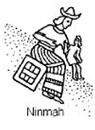 compared to the Round Denderah image
  and the Square image which was damaged.
As to the Raven, White presents on page 44 this image 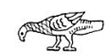 compared to the Round Denderah image
  which has the Raven at the back of Leo perched on Hydra. White claims, "The Raven is sacred to Adad, the god of rain and storm; and its omens appropriately predict the nature of the coming rains. On the star-map the Raven is positioned sitting at the end of the Serpent's tail - in effect waiting for the summertime drought to come to an end."
Other names for Corvus: Al Ajmal', Ahmal', 'Arsh al Simak al A'zal (stars), 'Ajz al A'sad, Al Ha'mal, Al Ma'laf, Al Hiba' al Yamaniy'yah.
- Richard H. Allen comments: The Raven of Rome and Greece became Al Ghurab in Arabia; but in earlier days four of its stars were Al ‘Arsh al Simak al Azal, the Throne of the Unarmed One, referring to the star Spica. These naturally have been considered beta (Kraz), gamma (Gienah), delta (Algorab), and eta; but Firuzabadi, as interpreted by Lach, said that they were theta, kappa, psi, and g; and the same stars were Al ‘Ajz al Asad, the Rump of the ancient Lion (Leo). Other early titles for the whole were Al Ajmal the Camel, and Al Hiba’, the Tent; this last generally qualified by Yamaniyyah, the Southern, to distinguish it from that in Auriga. Instead of Ajmal, Hyde quoted, from the Mudjisat, Ahmal, or Hamal, the Ram, but this does not seem probable here.
- Allen under his Crater section: In early Arabia it was Al Ma’laf, the Stall, — a later title there for the Praesaepe of Cancer; but when the astronomy of the Desert came under Greek influence it was Al Batiyah, the Persian Badiye, and the Al Batinah of Al Achsasi, all signifying an earthen vessel for storing wine.
- Seen as the Raven in Chaucer's time, and the Germans still have Rabe; but the French follow the Latins in Corbeau, as the Italians do in Corvo, and we in the Crow.
See Star Names of Corvus.
This file was updated on July 15, 2008, and March 30, 2010.
Return to the Table of Contents or the Zodiac of Denderah