From The Alpha and the Omega - Volume III
by Jim A. Cornwell, Copyright © July 20, 2002, all rights reserved
"Volume III - The Third Month - Constellation Names for Lepus"
In the Third Month of Gemini
Lepus, the Hare or Rabbit
The constellation name for Lepus:
- The name of the constellation in Arabic is Arnebeth.
- In the "Gospel of the Stars," by Joseph Seiss, page 116, "Arnebeth, Arabic for the Enemy of the Coming."
- Under the Star Names of Lepus we see:
- a Arneb is an Arabic word for "hare."
, "The hare."
- Allen states: The Arabians adopted the classical title in their Al-Arnab, which degenerated into Alarnebet, Elarneb, and Harneb.
Another spelling shows Arnebo, which means "The Enemy of Him That Cometh." Orion is the one that cometh. Orion's star Betelgeuse means "The Branch Coming." Since Orion is above Lepus, it signals the coming of Orion.
- Hebrew 'ar or 'uwr, enemy + ne, of Him + bow', cometh, thus arnebo, "the enemy of Him that cometh."
Sumerian ur, enemy + ni + du, come, thus uncertain as Sumerian ur-ni-du, "enemy of Him that comes."
- enemy:
- Hebrew 'ar, awr, from Heb. 'uwr, oor, stir up or be bare, thus a foe, enemy.
- Sumerian ur: n., dog; carnivorous beast; servant; young man, warrior; enemy. v., to tremble. adj., humble.
- The one, Him
- Hebrew ne.
- Sumerian ni; na: he, she; that one. Sumerian ní: self; body. Sumerian nì: (cf., ní ). Sumerian ne: this (one).
- cometh:
- Hebrew bow', bo, a primary root, to go or come.
- Sumerian du: to walk; to go; to come (sing. marú, cf., gin, re7, súb).
In "The Witness of the Stars," by E.W. Bullinger, page 141 "a (in the body), has a Hebrew name, Arnebo, which means the enemy of Him that cometh."
The Arabic, Arnebeth, means the same as Arnebo.
One source claims that the Sumerian god Ea is associated with the constellation Orion, based on a cylinder seal, which shows him stepping up on the throne with the constellation of Lepus the Hare at his feet. He also has a fanning pair of wings, representing the constellation of Eridanus.
Hare:
- Hebrew 'arnebeth, ar-neh'-beth, of uncertain der., the hare.
- Greek lagos or Latin lagus, means hare.
In the "Gospel of the Stars," by Joseph Seiss, page 116, "In Persia and Egypt (Lepus) was a serpent."
Egyptian/Coptic:
- In "The Witness of the Stars," by E.W. Bullinger, page 141 "In the Persian planisphere the first constellation was pictured by a serpent. In the Denderah (Egyptian) Zodiac it (Lepus) is an unclean bird standing on the serpent, which is under the feet of Orion. Its name there is given as Bashti-beka. Bashti means confounded, and Beki means failing."
- In the "Gospel of the Stars," by Joseph Seiss, page 116, "Bashti-Beki, the Offender confounded." The enemy trodden under foot. The name Bashti-beki means falling confounded. Aratus says 'chased eternally'."
- On the Denderah Zodiac (Lepus) is below Gemini, as a hawk figure with the Horus crown of upper and lower Egypt and the curly object on its head, and it is perched upon an object that is either an Egyptian candleholder or axis, or a mace.
- In the "Gospel of the Stars," page 116 Joseph Seiss claims "In the Denderah Zodiac the figure is the Eagle or Hawk, the particular enemy of the Serpent, having on his head a double mark of crownings with power and majesty, and standing on top of a great mace as the triumphant royal Breaker and Bruiser of the powers of evil."
- In his work “BABYLONIAN STAR-LORE: An Illustrated Guide to the Star-lore and Constellations of Ancient Babylonia,” by Gavin White gives this image of Lepus which is seen on page 41 shown here as
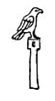 and comments, "The summer solstice itself is represented on the star-map in the form of a bird seated on a high-perch. The solstice not only marks the longest day of the year but also the time when the sun is highest in the skies. In the section on the Arrow I suggest that the bird seated on a high perch thus represents the solar-bird at the highest point of its annual ascent in to the heavens."
As you can see for yourself the image for Lepus above has some correlation with the Round Denderah image  and the Square Denderah image
 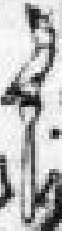 , but see the Denderah Decan information for more detail.
Other Information of Lepus:
- Sugia "The Deceiver," as one source claims as seen in Isaiah 63:3, 4.
- Rakis "The Bound" in Arabic it means "Bound, as with a chain."
- Also Rakis means "the Caught."
- Under Sagittarius under Draco is the star named m Arrakis or Alrakis, also El or Al Rakis, meaning "dancer," opposite its Gemini counterpart.
Other names for Lepus: Alarne'bet, Al Ar'nab, Ar'nebeth, 'Arsh al Jau'zah, Elar'neb, Har'neb, Kursi'yy al Jab'bar.
- Richard H. Allen states: The Arabians adopted the classical title in their Al Arnab, which degenerated into Alarnebet, Elarneb, and Harneb; and the Hebrews are said to have known it as Arnebeth; but the early Arabs designated the principal stars — alpha, beta, gamma, and delta — as Al Kursiyy al Jabbar and Al ‘Arsh al Jauzah, the Chair of the Giant (Orion) and the Throne of the Jauzah (Orion). Kazwini, repeating this, added, in Ideler's rendering, Gott weiss wie sonst noch, which Smyth assumed to be Ideler's comment thereon; but it was merely his translation of Kazwini's Arabic formula, God is the Omniscient, used when a writer did not wish to come to a decision.
- The German Hase, the Portuguese lebre, the Italian Lepre, and the French Lievre.
- Chinese knew it as Tsih, a Shed.
See Star names for Lepus.
This page updated on September 15, 2004, July 15, 2008, and March 30, 2010.
Return to the Table of Contents or the Zodiac of Denderah