I n t r o d u c t i o n
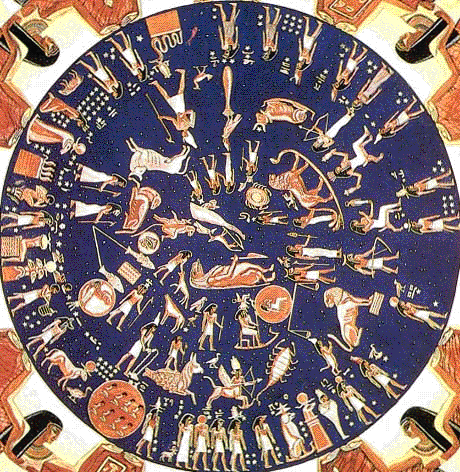
Zodiac viewed at bottom starting at 0 Degrees, Decan 0 the Circle of Eight, and then left to right Decan 1 through 12
As presented by the Egyptians the center of the Zodiac is what the Sumerians called the MUL.MUL, stars.
The Man (Aquarius) is seen to its North, the lower left-hand quadrant
- Winter Solstice, i Aquarii.
The Eagle (Scorpius) is seen to its West, the lower right-hand quadrant
- Autumnal, b Scorpii (Girtab).
The Lion (Leo) is seen to its South, the upper right-hand quadrant
- Summer Solstice, a Leonis (Regulus).
The Bull (Taurus) is seen to its East, the upper left-hand quadrant
- Vernal Equinox, h Taurii (Alcyone), of the Pleiades.
Comments from individuals who have provided information on this subject.
"Mazzaroth: or the Constellations," by Miss Frances Rolleston of Keswick.
-
Preface: "Unknown, as to the signs; Necepsos, king of Egypt (B.C. 900), is said to have introduced the decans into Egypt."
-
Part II, pg 60, 61 "The decans, as far as ascertained from Oriental traditions, accord with the signs in which they were found, and for this reason were so formed and allotted."
-
"The Gospel of the Stars," by Dr. Joseph A. Seiss, of Philadelphia, written in 1892.
-
pg 169 "no champion or defender of the current theories respecting the origin and meaning of the constellations."
-
pg 179 "Seldom informs us that in later Jewish writings Mazzaloth are the signs of the Zodiac, and the singular Mazzal is used to denote signs singly. Mazzaloth is the same in the later Hebrew that Mazzaroth was in the more ancient forms."
-
"The Witness of the Stars," by Ethelbert W. Bullinger, written in 1967.
-
pg 9 "Indeed, the Zodiacs in the Temples of Denderah and Esneh, in Egypt, are doubtless copies of Zodiacs still more ancient which, from internal evidence, must be placed nearly 4,000 B.C., when the summer solstices was in Leo."
-
pg 15 "Zodiac, Gr. Zodiacao, Hebrew Sodi, in Sanscrit means 'a way.' Its etymology has no connection with living creatures, but denotes a way, or step, and is used of the way or path in which the sun appears to move amongst the stars in the course of the year."
-
Albumazer, an Arab astronomer to the Caliphs of Grennada in A.D. 850.
Ulugh Beigh, Tartar prince and astronomer A.D. 1450 with a Table from ancient Arab astronomy.
"Hamlet's Mill" by Giorgio de Santillana and Hertha von Dechend, Gambit Inc. 1969
-
pg 64 "The Greeks derived their mathematics from astronomy ... which drove them to create the beginnings of our science. But soon after Aristotle, the Stoics reverted to the original pattern and reinstalled astrology."
-
pg 73 "Take ... hieroglyphic language, embodied in the imposing Egyptian dictionary of Erman-Grapow. For our simple word 'heaven' it shows 37 terms whose nuances are left to the translator and used according to his lights."
-
pg 120 "S. Schott, dealing with early starlist of Egypt, points to the perplexity of later generations concerning the names of constellations, even those of the 'greatest gods of the Decans,' Orion and Sothis, who in Ancient Egypt are called by the names of old hieroglyphs, without anybody knowing, in historical times, what these hieroglyphs had meant, once upon a time. During the whole long history of these names we meet attempts at interpretation."
-
pg 416 "... a squatting baboon indicates the equinoxes ... a sitting dog represents the Tropics."
-
In "The Dawn of Astronomy" a study of the temple-worship and mythology of the Ancient Egyptians by J. Norman Lockyer, New York, The McMillian Company 1897
-
pg 133-134 "... and even our most distinquished Scholars do not know what Mazzaroth means. I wrote to Professor Robertson Smith to ask him to give me the benefit of his great knowledge, and he tells me that Mazzaroth is probably that band of stars round the ecliptic or round the equator to which I have referred, but he will only comment himself to the statement that it is a probable enough conjecture; other people believe that it was a reference to the Milky Way ."
-
pg 407-408 "I have already referred to the Egyptian decans, that is, the list of stars rising of intervals of ten days. The lists will be found in Lepsius and in Brugsch's work, but the stars have not been made out."
-
In "Star Names: Their Lore and Meaning" by Richard Hinkley Allen, Dover Publications, Revised edition (June 1, 1963) original release in 1895
- Richard Hinkley Allen shares with us his research into the ancient names carried by our stars and the etymologies of stars and constellations. He does great detail about each constellation in the sky, zodiacal or otherwise bringing reference to many of the names of mythology and folklore from the Chinese, Arabs, Greeks, Romans, Egyptians, Old Norse, Hebrews, Celts, many Native American peoples, and Assyrians, which many of us would never have time to dwell into.
- A note of interest in Richard H. Allen's work:
The Jewish Nisan, our March-April, was associated with Aries, for Josephus said that it was when the sun was here in this month that his people were released from the bondage of Egypt; and so was the same month Nisanu of Assyria, where Aries represented the Altar and the Sacrifice, a ram usually being the victim. Hence the prominence given to this sign in antiquity even before its stars became the leaders of the rest; although Berossos and Macrobius attributed this to the ancient belief that the earth was created when the sun was within its boundaries; and Albumasar, of the 9th century [This author, known also as 'Abu Ma'shar and Ja'phar, was from Balh' in Turkestan, celebrated as an astrologer and quoted by Al Biruni, but with the caution that he was a very incorrect astronomer.
The Lenox Library of New York has a copy of his Opus introductorii in astronomia Albumazaris abalachi, Idus Februarii, 1489, published at Venice with illustrations. Its similarity to the Hyginus of the preceding year would indicate that they issued from the same press.], in his devolution of Years wrote of the Creation as having taken place when "the seven planets" — the Sun, Moon, Mercury, Venus, Mars, Jupiter, and Saturn — were in conjunction here, and foretold the destruction of the world when they should be in the same position in the last degree of Pisces.
Astronomy of the Bible by E. Walter Maunder, Published by Kessinger Publishing, 2003, ISBN 0766135403, 9780766135406, 436 pages, Chapter VIII, MAZZAROTH
(Page 243) We have no assistance from any cuneiform inscriptions as to the astronimcal significance of "Ayish, Kimah, and Kesil, but the case is different when we come to Mazzaroth. In the fifth tablet of the Babylonian Creation epic we read--
- "1. He (Marduk) made the stations for the great gods;
- 2. The stars, their images, as the stars of the zodiac, he fixed.
- 3. He ordained the year, and into sections (mizrata) he divided it;
- 4. For the twelve months he fixed three stars.
- 5. After he had [. . .] the days of the year [. . .] images
- 6. He founded the station of Nibir to determine their bounds;
- 7. That none might err or go astray.
- 8. He set the station of Bel and Ea along with him."
The foregoing extract from the fifth tablet of Creation (page 244) has no small astronomical interest. Merodach is represented as setting in order the heavenly bodies. First of all he allots their stations to the great gods, dividing to them the constellations of the zodiac, and the months of the year; so that arrangement by which every month had its tutelary deity or deities, is here said to be his work. Next, he divides up the constellations of the zodiac; not merely arranging the actual stars, but appropriating to each constellation its specical design or "image." Third, he divides up the year to correspond with the zodiac, making twelve months with three "stars" or constellations to each. In other words, he carries the division of the zodiac a step further, and divides each sign into three equal parts, the "decans" of the astrologers, each containing 10 degrees (deka) of the ecliptic.
The statement made in line 4 refers to an important development of atronomy. The constellations of the zodiac, that is, the groups made up of the actual stars, are very unequal in size and irregular shape. The numerous theories, ancient and modern, in which the constellations are supposed to owe their origin to the distinctive weather of the successive months, each constellation figure being a sort of hieroglyph for its particular month, are therefore all manifestly erroneous, for there never could have been any real fixed or steady correlation between the constellations and the months. Similarly, the theories which claim that the ancinet names for the months were derived from the constellations are equally untenable. Some writers have even held both classes of (Page 245) theory, overlooking the fact that they mutually contradict each other.
But there came a time when the inconvenience of the unequal division of the zodiac by the constellations was felt to be an evil, and it was remedied by dividing the ecliptic into twelve equal parts, each part being called after the constellation with which it corresponded most nearly at the time such division was made. These equal divisons have been called the Signs of the zodiac. It must be clearly understood that they have always and at all times been imaginary divisions of the heavens, that they were never associated with real stars. They were simply a picturesque mode of expressing celestial longitude; the distance of a star from the place of the sun at the spring equinox, as measured along the ecliptic,--the sun's apparent path during the year.
The Signs once arranged, the next step was an easy one. Each sign was equivalent to 30 degrees of longitude. A third of a sign, a "decan," was 10 degrees longitude, corresponding to the "week" of ten days used in Egypt and in Greece.
This change from constellations to the Signs cannot have taken place very early. The place of the spring equinox travels backwards amongst the stars at the rate of very little more than a degree in 72 years. When the change was made the spring equinox was somewhere in the constellation Aries, the Ram, and therefore Aries was then adopted as the first Sign, and must always remain such, since the Signs move amongst the stars with the equinox.
(Page 246) We cannot fix when this change was made within a few years, but it cannot have been before the time when the sun at the spring equinox was situated just below Hamal, the brightest star of the Ram. This was about 700 B.C. The equal division of the zodiac must have taken place not earlier than this, and with it, the Bull must have been deposed from the position it had always held up to that time, of leader of the zodiac. It is probable that some direct method of determining the equinox itself was introduced much about the same time. This new system involved nothing short of a revolution in astronomy, but the Babylonian Creation story (Page 248) this retrogression it covers the breadth of one "decan"= ten degrees.
The Babylonian Creation epic is therefore quite late, for it introduces astronomical ideas not current earlier than 700 B.C. in Babylonia or anywhere else. This new development of astronomy enables us also to roughly date the origin of the different orders of systematic astrolgy.
Astrology, like astronomy, has passed through successive stages. It began at zero. An unexpected event in the heavens was accounted portentous, because it was unexpected, and it was interpreted in a good or bad sense according to the state of mind of the beholder. There can have been at first no system, no order, no linking up of one specific kind of prediction with one kind of astronomical event. It can have been originally nothing but a crude jumble of omens, just on a level with the superstitions of some of our peasantry as to seeing hares, or cats, or magpies; and the earliest astrological tablets from Mesopotamia are precisely of this character.
But the official fortune-tellers at the courts of the kings of Nineveh or Babylon must speedily have learned the necessity of arranging some systems of prediction for their own protection--systems definite enough to give the astrologer a groundwork for a prediction which he could claim was dependent simply upon the heavenly bodies, and hence for which the astrologer could not be held personally responsible, and at the same time elastic enough to enable him to shape his prediction to fit in with his patron's wishes. The astrology of to-day shows the same essential features.A clay tablet shows proof of the Bibles history.
A 2" wide clay tablet was unearthed in the 1870's near Baghdad, Iraq.
In 2007, Michael Jursa, a professor at the University of Vienna, in Austria recognized the name Nebo-sarsechim (Nabu-sharrussu-ukin Babyl. form), a Babylonian official mentioned in Jeremiah 39:3.
"Samgar-nebo, sarsechim, Rabsaris" NW should be "Samgar; Nebo-sarsechim the Rabsaris (or, the Chief Court Official)," as seen on the cuneiform tablet.
Nebu-chadnezzars commanders at the destruction of Jerusalem in 607 B.C. and according to the tablet, he is called "the chief eunuch," a title held by only one man at any given time. So he matches the Bible.
The tablet records a gold delivery that Nebo-sarsechim made to the temple of Marduk, or Merocach, the chief god of Babylon, whose name is also in the Bible. (Jeremiah 50:2) The date 10th year, 11th month, and 18th day of Nebuchadnessar's reign.
Isaiah 39:6-7 foretold of the sack of Jerusalem.
One source claims that the Hebrew QEVI'A is equal to KHUFU (i.e. CHEOPS), in the context as meaning "calendric fixing" dating 2340 B.C.
-
Hebrew keviyah, kev-ee-yaw', from Heb. kavah, kaw-vaw', prick, penetrate, burn, thus a branding, burning.
-
Hebrew qabal, kaw-bal', a primary root to admit, i.e. take (lit. or fig.), choose, (take) hold, recieve, a word representing the term Kabbalah.
-
Hebrew qav, kav, from Heb. qavah, kaw-vaw', a primary root to bind togenter, also compared to Heb. qaveh, kaw-veh', a (measuring) cord (as if binding), line, thus a cord (as connecting), especially for measuring, fig. a rule.
-
Mazzaroth is mentioned in the following verses.
-
Job 38:32 "Canst thou bring forth Mazzaroth in his season? or canst thou guide Arcturus with his sons?"
-
Isaiah 40:26 "Lift up your eyes on high, and behold who hath created these things, that bringeth out their host by number: he calleth them all by names by the greatness of his might, for that he is strong in power; not one faileth."
-
Psalm 147:4 "He telleth the number of the stars; he calleth them all by their names."
-