Evidence Of Early Humans.
This file created on July 10, 2003 is a Volume III continuation of the original website at http://www.mazzaroth.com/ChapterOne/GenesisDayThreeScorpius.htm regarding the subject of Evidence Of Early Humans.
My Comments: As I had stated in my earlier work that modern science can prove or maybe better stated believes it can prove that man was on earth for hundreds of thousands of years before the Bible was written. This file continues with what I still contend, that we should view Genesis as the beginning of a specific type of mankind. It is obvious that the natural evolution of this world, had already populated the earth with a wretched specimen or even still a product of civilizations destroyed by cataclysms. I have provided the following information in context with what I previously promoted as information to those interested in the age old argument of the age of mankind between the evolutionist and the creationist. As more and more countries allow access to archaeological sites and try to define the results without prejudice, we will probably find that it will just add to the confused state it is already in. It will be your decision as to whether the evidence is strong enough to sway one to a specific viewpoint of any theory. I myself would like to stay with what the Bible states.
Evolution Theory.
by Times-Post News Service
April 19, 1999.
One of the longest-running debates in the history of humanity has been exactly where on Earth modern humans first evolved. Most experts believe this occurred in what is now Africa and that early humans spread around the globe from there. But new evidence is challenging this theory, suggesting instead that humanity's earlier ancestors left Africa and then evolved separately in different parts of the world.
Eugene E. Harris and Jody Hey of Rutgers University in New Jersey analyzed the same segment of the X chromosome from 16 modern-day Africans and 19 non-Africans from four European and Asian populations. The researchers found a specific genetic mutation in all of the non-African individuals but none of the Africans.
Based on that finding, the researchers calculated that the division between African and non-African populations began about 200,000 years ago. Since modern human fossils date to only 100,000 to 130,000 years ago, the findings suggest that separate populations already existed when modern humans evolved.
"The extent to which this is true and the details of such a process are issues that lie at the heart of some debates on the origins of modern humans," the researchers said in the Proceedings of the National Academy of Sciences.
Evolution of the Creationists.
by Ellen Goodman, Boston Globe-Washington Post
August 20, 1999.
Boston -- The majority of religious conservatives on the Board of Education decided to delete nearly every reference to evolution from the science curriculum. Removing evolution from a required science curriculum is a bit like removing verbs from the English curriculum. Evolution can still be taught, but it's no longer required, it won't be tested, and it will be discouraged. The board just plain dropped the central theory about the origin of species and -- what the heck -- while they were at it, deleted any references to the big-bang theory of the universe. This gives preference to theology over biology.
Let's go back to the origin of this species. In the beginning, people who believe in a literal interpretation of the Bible wanted to bar the teaching of evolution in the public schools altogether. The only science book they found acceptable was Genesis. In 1925, creationists dragged a young biology teacher, John Scopes, to the courtroom for the infamous "Monkey Trial." It wasn't until 1968 that the Supreme Court finally ruled that states couldn't ban the teaching of evolution.
What did the creationists do then? They evolved. In their second form, fundamentalists legislated equal time for religion and science, the Bible and evolution. The courts, however took an equally dim view of teaching religion in public school.
So the creationists evolved again.
This time they invented "scientific creationism," which paleontologist Stephen Jay Gould once called "the old wolf of Genesis literalism, lightly clothed in a wooly patina of supposed empirical verification."
Two states - Arkansas and Louisiana -- actually mandated equal time for "creation science and "evolution science," but in 1987 the Supreme Court saw through that wool.
Most of us thought that creationists would become extinct. But lo and behold - we have yet another, ever more complicated evolved form.
The same religious conservatives talking nationally about giving up politics, are talking locally about taking over school boards. If they can't dump Darwin, they'll downgrade him.
Now Kansas, along with dozens of other school boards, labels evolution as "just a theory." In Alabama, biology textbooks even come with a little warning label: "No one was present when life first appeared on Earth. Therefore, any statement about life's origins should be considered as theory, not fact."
Evolution is supported by anatomy, fossils, carbon-dating, genetic evidence, the ages of rocks. Creationism is supported by the Bible as text.
Study suggests second route out of Africa for ancient humans.
by Joseph B. Verrengia, Associated Press
December 1, 1999.
Scientists examining hereditary material in cells suggest that modern humans followed a migration wave from Africa to Asia more than 50,000 years ago after an earlier exodus to the Mediterranean and Greece.
Blood samples of people from east Africa and India showed close genetic similarities that indicate a common African ancestor, according to a research team from the University of Padua in Italy.
The researchers examined mitochondria, units outside of the cell's nucleus that act as a cell's energy source. They have their own genetic material -- passed only by the mother from generation to generation - which lets scientists trace ancestry between geographically distant human populations. They found closely related genetic sequences in high frequency in blood samples from people in Ethiopia, the Arabian Peninsula and India. The same genetic markers were not found in blood samples from Middle East populations.
The first, and older, human migration route out of Africa is believed to have extended northward around the eastern Mediterranean and Greece more than 100,000 years ago.
Mitochondrial DNA clues were reported in the mid-1980s as scientists speculated on the existence of an African "Eve", from who modern humans descended. Since then, the older, northern migration route has been bolstered by fossil discoveries of modern humans bones from the same time period in the Middle East.
DNA study supports idea of modern man evolving in Africa, then spreading.
by Associated Press
December 7, 2000.
A study published in the journal Nature and carried out by Swedish and German researchers have compared the DNA or genetic material inside the mitochondria within the cells of 53 people of various nationalities, ethnic groups and races around the world. This has yielded what could be the best evidence yet that modern man evolved in Africa and scattered to populate the planet as recently as 50,000 years ago. Other theorist have put it at 100,000 years ago. Geneticist Ulf Gyllensten, the study's chief researcher at the University of Uppsala, in Sweden, says they also found that about 38,000 years ago the population of modern humans began exploding, "There was probably a fairly small group that migrated out of Africa and that population probably spread in several directions and grew quickly.".
Such a view suggests that the first Homo sapiens held such dramatic evolutionary advantages -- perhaps stronger powers of reasoning -- that they replaced other early humans with virtually no interbreeding.
This is the longest strand of DNA ever analyzed and examined for a human lineage study. The findings strongly favor the "out-of-Africa theory of modern human origin. Advocates of the rival multiregional theory say modern humans evoloved simultaneously in Africa, Europe and Asia from multiple early humans, maybe including Neanderthals and Homo erectus who left Africa in a much earlier wave.
Some believe that the latest findings could allow for a theory that merges both models: a core of modern humans from Africa later mating in limited numbers with other early humans in distant places.
Skull found in Kenya may be human ancestor.
Scientists say the creature belongs to a new species.
by William McCall Associated Press
March 22, 2001.
A 3.5 million-year old skull has been found in Kenya in 1998-99 and scientists and researcher Meave Leakey of the National Museums of Kenya might evict the Ethiopian fossil nicknamed "Lucy" from the line of direct human ancestry. The skull dates to about the same time as Lucy, whose bones represent the species Australopithecus afarensis discovered in 1974 in Ethiopia. But the scientists say the skull belongs to a different creature, which they named Kenyanthropus platyops, which Andrew Hill, a Yale anthropologist, said the skull has the unusual combination of a large flat face and small teeth and a different facial structure than Lucy. The difference in teeth and jaw structure suggest a different diet led to evolutionary changes and environmental adaptation to different regions.
Tim White, a Berkeley anthropologist, said it's difficult to tell whether the skull represents a subcategory of Lucy's species or a different species within the same "genus" category, Australopithecus or as claimed a controversial separate genus altogether. This adds to the confusion about the human evolutionary tree, but it also adds to the evidence that there were several human-like species between 3.5 million and 2 million years ago that adapted well to different environments.
Old Asian civilization found.
May 13, 2001.
With the end of the Cold War, Russian and American archaeologists, such as Fredrik T. Hiebert, of University of Pennsylvania, say they have discovered an ancient civilization that thrived in Central Asia, what is now the republics of Turkmenistan and Uzbekistan, more than 4,000 years ago. Hiebert has uncovered a small stone object engraved with four or five symbols or letters in red that apparently bear no resemblance to any other writing system of the time, when the pyramids of Egypt had been standing for three centuries and the Chinese had yet to develop writing. These people may have indeed had writing, or at least were experimenting with a form of proto-writing around 2,300 B.C. They say, these people built oasis settlements with imposing mud-brick buildings and fortifications. They herded sheep and goats and grew wheat and barley in irrigated fields. They had bronze axes, fine ceramics, alabaster and bone carvings and jewelry of gold and semiprecious stones. They left luxury goods in the graves of an elite class.
New evidence found of ancient people.
by Associated Press
June 11, 2001.
Archaeologists and field director Robert Wegener have found evidence of an ancient native Southwestern culture that doesn't fit those already known and may be a new and separate type. Tucson-based Statistical Research Inc. has been excavating a site about 30 miles southeast of Tucson as part of the Arizona Department of Transportation's revamping of an Interstate 10 interchange. The site is at the cultural nexus of three major Southwestern groups - the Hohokam, the Mogollon, the Chihuahuan. Thousand of artifacts have been unearthed and preliminary research indicates the site was in use off and on from about 2,000 B.C. to A.D. 1450.
Human ancestors depended on fish.
by The Washington Post
June 18, 2001.
Early human ancestors apparaently ate diets rich in fish and seafood, which might have given them an edge over the ill-fated Neanderthals, according to new research. Erik Trinkaus of Washington University in St. Louis and colleagues analyzed the carbon and nitrogen content of bones of nine early humans dating back 20,000 to 28,000 years of Late Pleistocene Europe, which were found in the Czech Republic, Russia and Britain. The analysis indicated the bones came from individuals who ate diets rich in fish and seafood as compared to a previous analysis of bones from Neanderthal in the same areas, whose diets consisted mainly of red meat. They believe that the diverse diet of early humans may have made them more resilent to natural pressures of their environment.
Mass extinctions blamed on mankind.
by The Washington Post
June 25, 2001.
Until about 12,000 years ago, huge saber-toothed tigers, woolly bison and other giant mammals roamed North America. Similarly, until about 46,000 years ago, a claw-footed kangaroo, a flightless ostrich-like creature and other big animals thrived in Australia. Scientists have long debated what caused this wide variety of giant mammals to go extinct. John Alroy of the University of California at Santa Barbara used a computer model to simulate the impact of human hunters on 41 large mammals, and he concludes that hunting led to the North American extinction, thus pointing the finger at early humans. Richard G. Roberts of the University of Melbourne and colleagues used advance techniques to date fossilized remains of large mammals from Australia and New Guinea. They found that the remains were buried at about the time humans were spreading across the continent.
Markings On Stones Indicate Earlier Modern Human Behavior.
by Paul Recer a writer with The Associated Press
January 14, 2002.
Engravings on two stones found in a cave and dated at 77,000 years suggest ancient humans in Africa developed complex behavior and abstract thought thousands of years earlier than cave painters in Europe.
Pieces of crafted ochre, a stone used for carving and for making pigment powder, were unearthed from a seaside cave in South Africa.
Whoever engraved the stones had "crossed the line" between earlier homo sapiens -- who had not yet learned to use their large brains to plan, reflect and reason -- and modern human beings, capable of abstract, symbolic thought, even an appreciation of beauty, scientist said.
The find pushes back by some 35,000 years the earliest time when biologically modern humans were known to have developed modern behavior, said Chrisopher Henshilwood, first author of a study that appears on Sciencexpress, the online version of the journal Science.
"The theory up until now has been that modern human behavior started only around 40,000 years ago," said Henshilwood, a researcher at State University of New York, Stony Brook and at the Iziko Museum of Cape Town, South Africa.
"When I saw the first pictures of the find, it made my hair stand on end," said Alison Brooks, anthropologist at George Washington University. "It is clearly somebody's attempt to communicate something. Whoever did this had crossed the line."
Until now, it was believed that such behavior appeared in Europe, where cave paintings and other artifacts showing advanced thought processes have been uncovered at a number of sites.
Henshilwood said discoveries in the Blombos Cave east of Cape Town on the Indian Ocean show that modern human behavior developed in Africa earlier. He said the cave contains thousands of pieces of worked ochre, along with polished bone tools and many bones from fish -- all signs of modern behavior.
"The whole of South Africa was occupied by a biologically modern people who had evolved about 150,000 years ago," Henshilwood said. Now, he said, "there is no doubt that the people in southern Africa were behaviorally modern 70,000 years ago."
The engraved stone artifacts found in the cave include two pieces of red ochre that had been rubbed on one side to make a flat, smooth surface. Ancient craftsmen then carved geometric patterns, cross hatching, diamonds and lines that went through and around the stone.
"The engraving itself is quite a complex geometric pattern. There is a system to the patterns," Henshilwood said. "We don't know what they mean, but they are symbols that I think could have been interpreted by those people as having meaning that would have been understood by others."
Steve Kuhn, a University of Arizona scientist who specializes in research on ancient people believes more evidence of engraved stones must be found many times in different places before the research community accepts Henshilwood's conclusions.
Henshilwood said more than 8,000 other pieces of ochre were found in the cave, many of which had been rubbed smooth as if to make pigment powder. "We think the powder was mixed with animal fat and applied to their bodies as a decoration or to artifacts such as skin bags," Henshilwood said as used by many Ancient people.
Very few sites where ancient modern people may have lived in Africa have been excavated, he said, but believes that eventually more evidence will be found to confirm the level of civilized practices on that continent 70,000 years ago.
This is in contrast to Europe where thousands of ancient sites have been excavated and there is a rich collection of artifacts proving that modern behavior first existed there about 40,000 years ago, he said.
Two separate scientific teams chemically dated the artifacts from the African cave, confirming that the artifacts were left in deposits that were about 77,000 years old.
Early dairy farming found in Britain.
by Associated Press
February 17, 2003.
Dairy farming became widespread in Britain as early as the new stone age -- around 4,000 B.C. -- a team of researchers at England's University of Bristol reports. Mark Copley, an archaeological chemist, said evidence of milk fats was found on broken pieces of pottery at several ancient sites in southern England. Using new methods of analysis, scientists have learned to differentiate between ancient residue from milk fat and other fats and oils in recent years, Copley and his team reported in Proceedings of the National Academy of Science. Their findings provide evidence of "the earliest farming communities in Britain, though obviously there were earlier ones in the Near East, Copley said. They could not determine how the milk was being used, but surmises they most likely were making butter, cheese or yogart ... which actually keeps a long time.
Evolutionary skull found in Java.
by The Los Angeles Times
March 10, 2003.
A new Homo erectus skull found in the Solo River in Sambungmacan on the island of Java indicates that the human ancestor called "Java man" lived on the island for nearly a million years, isolated from other Asian populations. The surrounding sediments cannot be dated acurately, but its features suggest that it is probably 750,000 to 1 million years old. The first Homo erectus skull was found on Java in 1891, and many others have been identified since.
Origin of Humans.
by Nicholas Wade writer with The New York Times
March 10, 2003.
New Dates from an important archaeological site in Austalia have removed a serious challenge to a theory about the origin of modern humans.
The site is Lake Mungo, in southeastern Australia, which holds the remains of an adult man who was sprinkled with copius amounts of red ocher in a burial ritual common among early humans. The grave is testimony to the remarkable journey taken by the first modern people to leave the ancestral human birthplace in Africa.
But the Lake Mungo grave also has posed a problem. Dated in 1998 as being 62,000 years old, it is hard to reconcile with the fact that the first modern humans did not reach Europe, which is much closer to Africa, until about 40,000 years ago.
It also challeged a view held by some archaeologists and geneticists that modern humans acquired the ability to move out of Africa 50,000 years ago.
A new survey of the Lake Mungo site has now revised the date of the burial to 42,000 years ago. Nearby rock flakes, which seem to be human artifacts, occur in layer of sand dated 46,000 to 50,000 years ago. This makes the date more consistent with the "out of Africa" event that occurs around 50,000 years ago. This new date implies a quite rapid journey from Africa to Australia, leaving a mystery because of no intermediate site on the journey has yet been found. Although, during the Ice Age more landmass was available for this travel, which in modern times is submerged under 250 feet of water. Some sources believe that bands of Homo erectus, the archaic humans similar to the Neanderthals who inhabited Europe, may have deterred the African migration from venturing inland, forcing them to move eastward along the coast. In time the new generation of the growing population may have turned west and displaced the Neanderthal from Europe, starting around 40,000 years ago. Later, another group ventured through Siberia and across to Alaska, populating North and South America.
Scientist Uncover 350,000-Year-Old Tracks.
by Rick Callahan writer with The Associated Press
March 24, 2003.
Scientists in southern Italy's rugged Roccamonfina volcano complex, north of present-day Naples have discovered 350,000-year-old tracks that may be the oldest known footprints made by Stone Age man. The prints were made by three early, upright-walking humans as they descended the treacherous side of a volcano -- perhaps to escape an eruption, researchers reported this month in the journal Nature. Footprints of far older human ancestors have been found, such as the prehuman species Austalopithecus afarensis, in 1977 in Tanzania, imprinted in volcanic mud 3.6 million years old.
Who left these newly discovered 56 footprints is not clear, but it was suggested either late Homo erectus or Homo heidelbergensis -- two early human species found in Europe during the Paleolithic era, also known as the Stone Age. The tracks were dated between 325,000 and 385,000 years old, the individuals were just under 5 feet tall.
Discovery may link ancestors of Americans to Arctic Siberia.
by Pail Recer, Associated Press
January 3, 2004.
Washington - a people who may have been ancestors of the first Americans lived in Arctic Siberia, enduring one of the most unforgiving environments on Earth at the height of the Ice Age, according to researchers who discovered the oldest evidence yet of humans living near the frigid gateway to the New World.
Russian scientists uncovered a 30,000-year-old site where ancient hunters lived on the Yana River in Siberia, some 300 miles north of the Arctic Circle and not far from the Bering land bridge that then connected Asia with North America.
"Although a direct connection remains tenuous, the Yana ... site indicates that humans extended deep into the Arctic during colder (Ice Age) times," the authors wrote in a study appearing in the journal Science.
The researchers found stone tools, ivory weapons and the butchered bones of mammoths, bison, bear, lion and hare, all animals that would have been available to hunters during that Ice Age period.
Using a dating technique that measures the ratio of carbon, the researchers determined the artifacts were deposited at the site about 30,000 years before the present. That would be about twice as old as Monte Verde in Chile, the most ancient human life known in the American continents.
Donald Grayson, a paleoanthropologist at the University of Washington in Seattle, said the discovery is very significant because it is so much earlier than any other proven evidence of people living in the frigid lands of Siberia that formed the gateway to the Americas.
"Until this site was reported, the earliest site in Bering land bridge area was dated at about 11,000 years ago," Grayson said. "Every other site that had been thought to have been early enough to have something to do with peopling of the New World has been shown not to be so."
At the time of the Yana occupation, much of the high latitudes on the Earth were in the grip of an ice age that sent glaciers creeping over much of what is now Europe, Canada and the northern United States.
But the Yana River area was ice free, a dry flood plain without glaciers. It was home to mammoth, horse, musk ox and other animals that provided food for the human hunters who braved Arctic blasts to live there.
Finding evidence of human habitation at the Yana site "make it plausible that the first peopling of the Americas occurred prior to the last glacial maximum," Daniel Mann of the University of Alaska, Fairbanks, said in Science. The last glacial maximum was 20,000 to 25,000 years ago.
Fossilized Teeth May Belong To Prehuman Primate.
by The Associated Press
March 19, 2004.
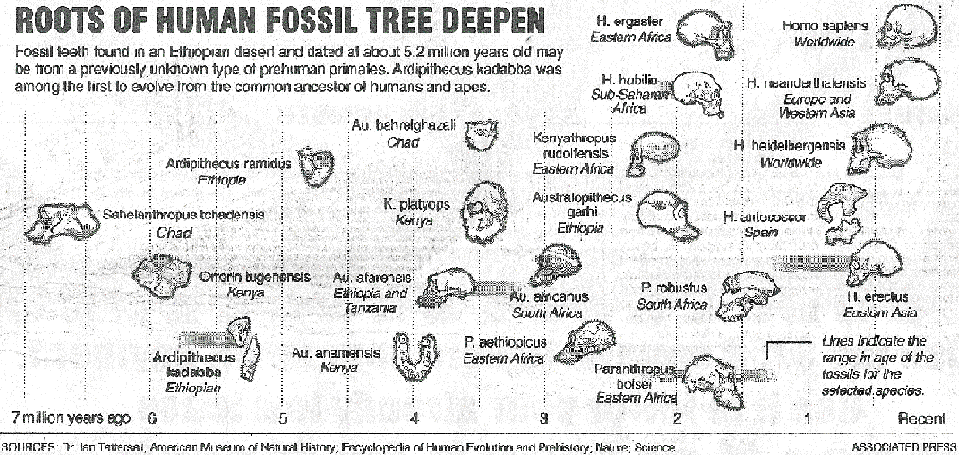
Six Fossil teeth found in an Ethiopian desert and dated at about 5.2 million years may be from a previously unknown type of prehuman primate that was among the first to evolve from the common ancestor of humans and apes, a study suggests. The teeth have distinctive features that are thought to have existed among the first hominids to emerge after the ape and human lineages evolved apart some six to eight million years ago. The research was led by Yahoos Haile-Selassie of the Cleveland Museum of Natural History, say that the teeth come from a hominid known as Ardipithecus kadabba, one of the earliest known human ancestors.
David R. Begun, an anthropologist at the University of Toronto, questions this interpretation in a commentary in Science. Begun said there are too many uncertainties for three groups of prehuman primates for them to be placed in the same genus. He said the issue can only be resolved with the discovery of more fossils.
Ornaments are earliest evidence of symbolism.
by Randolph E. Schmid, Associated Press
April 16, 2004.
Washington - Some 75,000 years ago, in a Stone Age cave overlooking the ocean, someone collected shells and bored holes in them, producing the oldest known evidence that humans had fashioned an ornament. Discovery of the set of beads pushes back by some 30,000 years the first indications of the ability to make and use such symbolic materials.
"Evidence for an early origin of modern human behavior has long remained elusive, said Christopher Henshilwood of the Centre for Development Studies, University of Bergen, Norway.
The find at Blombos cave on South Africa's Indian Ocean coast provides well-dated evidence of humans using symbolic items, "an umambiguous marker of modern human behavior, said Henshilwood.
The previously oldest known human ornaments are perforated teeth and eggshell beads from Bulgaria and Turkey, dated 41,000- to 43,000-years-old, and 40,000-year-old ostrich-shell beads from Kenya.
The 41 Blombos cave beads were made from mollusk shells, with less than a half-inch holes bored in them.
Last year, the same cave yielded two pieces of 77,000-year-old ocher cut with abstract patterns.
There is a great argument over the degree to which humans engaged in symbolic activity before the migration from Africa to the Middle East and Europe.
Consumption of grains dates back 23,000 years.
by The New York TImes
August 23, 2004.
Evidence from archeological sites on the Sea of Galilee shows that the history of consumption of ground and cooked grain dates to about 23,000 years ago, scientists report in the journal Nature.
Dr. Dolores R. Piperno of the Smithsonian Tropical Research Institute in Panama and three colleagues identified starch grains on grinding stones and an arrangement of burned stones that suggested a hearth. No baked goods were preserved, but the researchers suspect that since no burned grains were found, dough was probably being roasted.
The researchers say this represents the earliest evidence of human beings processing grains -- barley and wheat in this case -- to get those easily digestable carbohydrates that are now so scorned. It occurred 12,000 years before the domestication of grains and seems to have been a prelude to see storage and agriculture.
Ancient burial site.
by Oesterreichische Akademie der Wissenschaften, Associated Press
October 3, 2005.
Archaeologists recently uncovered the remains of two newborns -- possibly twins - dating back 27,000 years while excavating a hillside in northern Austria.
The find near the Danube River city of Krems is important because the newborns were buried beneath mammoth bones and with a string of 31 beads - suggesting that the internment involved some sort of ritual, said Christine Neugebauer-Maresch, the project's leader at the Austrian Academy of Sciences.
Discovery could rewrite human evolution history - Small species lived on remote island.
by Associated Press
October 28, 2004.
In a discovery that could rewrite the history of human evolution, scientists say they have found the skeleton of a new human species, a dwarf, marooned for eons in a tropical "lost world" while modern man rapidly colonized the rest of the planet.
The finding on a remote Indonesian island has stunned anthropologists.
The 3-foot-tall adult female skeleton found in a cave is believed 18,000 years old. It smashes the long-cherished scientific belief that our species, Homo sapiens, systematically crowded out other upright-walking human cousins beginning 160,000 years ago and that we've had Earth to ourselves for tens of thousands of years.
Instead, it suggests recent evolution was more complex than previously thought.
The find is the best example of a trove of fragmented bones that account for as many as seven of these primitive individuals that lived on the equatorial island of Flores. The mostly intact female skeleton was found in 2003.
Scientists have named the extinct species Homo floresiensis, or Flores Man, and details appear in the journal Nature.
The specimens' ages range from 95,000 to 12,000 years old, meaning they lived until the threshold of recorded human history and perhaps crossed paths with the ancestors of today's islanders.
In comparison the skulls of early Homo erectus is large compared to modern Homo sapein, which is much larger than the skull of Homo floresiensis.
Scientists marvel at discovery of tiny, prehistoric hunter - Ancient human may have grown smaller.
by Guy Gugliotta, The Washington Post
October 28, 2004.
Scientists have discovered a tiny species of ancient human that lived 18,000 years ago on an isolated island east of the Java Sea - a prehistoric hunter in a "lost world" of giant lizards and miniature elephants.
These "little people" stood about 3 feet tall and had heads the size of grapefruit. They coexisted with modern humans for thousands of years yet appear to be more closely akin to a long-extinct human ancestor.
Researchers suspect the earlier ancestor may have migrated to the island and evolved into a smaller dwarf species as it adapted to the island's limited resources. This phenomenon, known as the "island rule," is common in the animal world but had never been seen before in human evolution.
"Not even in primates," said paleoanthropologist Peter Brown, of Australia's University of New England, a member of the multinational team reporting on the find in the journal Nature.
Colleagues marveled at the find as an evolutionary aberration - an archaic human that survived to a time in the fossil record when Neanderthals -- which had been thought to be the last pre-modern species to share the planet with modern humans -- had probably been extinct for more than 10,000 years.
"This is a great fossil find that speaks mounds about evolutionary experiments and the variation they caused," said paleoanthropologist Ken Mowbray, of the American Museum of Natural History.
The research team discovered the new species in a limestone cave on Flores Island, in the Indonesian archipelago east of Java. They describe the remains - a fairly complete skull, the jawbone and much of the skeleton - as those of a 30-year-old woman. They named her Homo floresiensis.
The new find is certain to influence a flourishing debate over the human presence both in Indonesia and on Flores, which lies immediately east of the so-called "Wallace Line" dividing those islands that were once connected to Australia or Asia, and those, like Flores, that have been surrounded by water for the past 2.6 million years.
Generally speaking, islands west of the Wallace line, like Java, display a full range of mainland animals. On the isolated, ecologically limited eastern islands, however, animals often evolved in conformity with the island rule: animals smaller than rabbits get larger; animals larger than rabbits get smaller.
Flores, with a limited food supply and no predators, was a prime example of this mechanism. At the time when the Flores woman lived, the island hosted both Komodo dragon lizards 3 feet long and a dwarf variation of Stegodon, a prehistoric elephant.
Flores project leader Michael J. Morwood, a University of New England archaeologist, in 1998 reported discovering stone tools on Flores that were 840,000 years old, a controversial find that did not immediately win broad acceptance. That site had no human remains.
Even more controversial is a dispute over bones found in Java. Some scientists say they are 300,000 years old, but others date them as recently as 27,000 years ago. The later date now "seems more plausible" in light of the new discovery, said Rick Potts, director of the Smithsonian Intitution's Human Origin program, because Flore's little people may be an evolutionary offshoot of the earlier species.
The team found hunting devices, but had no answer to the question of how the little people got to Flores island. "The humans couldn't have swum," Brown said. "The popular notion is that they or their ancestors either intentionally or accidently rafted in."
U.S. court to hear case on evolution - Disclaimer added to textbooks.
by Kristina Torres, Cox News Service
November 8, 2004.
Atlanta -- Cobb County, Ga., schools needed new biology books.
The textbook selection committee chose books recommended by the state. The books included concepts about evolution, a widely accepted scientific theory. A parent Marjorie Rogers got 2,300 signatures on a petition decrying "Darwinism, unchallenged" prompted the school system to put evolution disclaimers on the inside front covers of the science books used in middle and high schools, which led to other groups of parents to file a federal suit with potentially national implications, involving American Civil Liberties Union claiming the disclaimer restricts the teaching of evolution, promotes and requires the teaching of creationism and intelligent design and discriminates against particular religions.
The trial on this raised the question: Is "intelligent design," a leading alternative theory espoused by many opponents of evolution, religious? Intelligent design holds that the variety of life on Earth results from a purposeful design rather than random mutation and that a higher intelligence guides the process.
This lead to whether this was a violation of the separation between church and state.
The disclaimer reads, "This textbook contains material on evolution. Evolution is a theory, not a fact, regarding the origin of living things. This material should be approached with an open mind, studied carefully and critically considered."
The theory of evolution - that all living things developed from earlier forms through slight variations over time and that natural selection determines which species survive - was developed by Charles Darwin in 1859.
.
Ancient ape's remains found.
by Associated Press
November 29, 2004.
Spanish researchers say they have found the remains of an extinct species of great ape that may have been the last ancestor humans shared with gorillas, chimpanzees and orangutans.
Pierolapithecus catalaunicus ate mostly fruit, climbed trees in an upright posture and, at 77 pounds, was a little smaller than a chimpanzee.
Salvadore Moya-Sola and colleagues at the Miguel Crusafont Institute of Paleontolgy in Barcelona say the creature's ancestors probably came from Africa, where primates most likely originated.
Archaeologists were digging near Barcelona last year when they uncovered one of the most complete skeletons ever found of a male primate that lived about 13 million years ago, including parts of a skull, rib cage, spine, hands and feet.
The world's great apes are thought to have evolved along with humans from a single ancestor that diverged from lesser apes, such as gibbons, millions of years ago. Modern humans didn't emerge until 100,000 years ago.
'Intelligent design' theory enters public schools.
by Charles C. Haynes, Gannet News Service
December 12, 2004.
Is Darwin winning the battle, but losing the war?
As soon as one challenge to the teaching of evolution is beaten in the courts, another emerges to take its place.
The current contender is "intelligent design," a theory that, according to advocates at the Discovery Institute, "makes no religious claims, but says that the best natural evidence for life's origin points to design rather than a process of random mutation and natural selection."
Having failed twice to persuade the U.S. Supreme Court that "creationism" is a legitimate scientific theory, anti-evolutionists have seized on intelligent design as the next great hope for getting an alternative to Darwinism into the science classroom.
Thirteen states have challenged evolution this year, and even the Dover, Pa., school board voted to include the teaching of intelligent design in science instruction.
A Gallup Poll conducted in November claims that 35 percent of us believe that Darwin's theory is supported by evidence. Another 35 percent say evolution isn't supported by evidence and 29 percent don't know enough to say.
The evolutionist have lost the war of public opinion, and blame it on "religious fundamentalists," and dismiss intelligent design as a creationist wolf in designer clothing. The same Gallup Poll reveals that 45 percent of Americans believe that "God created man in present form," while 38 percent believe "man developed with God guiding." Only 13 percent say "man developed with no help from God."
So the question is whether shutting down debate isn't good for academic freedom or critical thinking, and to learn about the conflicts and controversies surrounding those theories.
Judge orders school to drop evolution warning.
by Doug Gross, Associated Press
January 14, 2005.
Atlanta - A federal judge ordered the Atlanta school system to remove stickers in its biology textbooks that called evolution "a theory, not fact," saying the disclaimers were an unconstitutional endorsement of religion, which appears to be endorsing the well-known prevailing alternative theory, creationism or variations thereof.
Michael Manely, the attorney for the parents who sued over the stickers stated, "They're going to be permitted to learn science unadulterated by religious dogma." Last year, Georgia's education cheif proposed a science curriculum that dropped the word "evolution" in favor of "changes over time," which was dropped amid protests by teachers.
Homo sapien fossils date to 195,000 years, called oldest remains of modern human species.
by Malcolm Ritter, Associated Press
February 17, 2005.
New York -- Bones discovered in 1967 nearly 40 years ago near the Omo River in southwestern Ethiopia now appear to be the oldest know fossils of modern-looking humans from around the dawn of the species around 195,000 years old.
Previously, the oldest known fossils of Homo sapiens were Ethiopian skulls dated to about 160,000 years ago. Genetic studies estimate that Homo sapiens arose about 200,000 years ago. Although Omo I includes part of a skull plus skeletal bones and Omo II has more of a skull but no skeletal bones, neither has a complete face.
John Fleagle of Stony Brook University in New York revisited the site and analyzed the geology by testing rock samples with more modern dating techniques reevaluating that both specimens are 195,000 years old, give or take 5,000 years. The volcanic rock lying just below the sediment that contained the fossils was about 196,000 years old.
Rick Potts, director of the Human Origins Program at the Smithsonian Institution's National Museum of Natural History suggests that "we're right on the cusp of where the genetic evidence says the origin of modern humans should be." G. Philip Rightmire, a paleoanthropoligist at Binghamton University in New York claims the find appears to represent the aftermath of the birth of Homo sapiens, when it was still living alongside its ancestral species.
Seminary site to explore cosmic designer concept - Scholar contends Darwin was wrong.
by Peter Smith, The Courier-Journal
February 20, 2005.
William Dembski was raised by a father who taught biology in a local college, and had a religious conversion while in college and earn a doctorate in mathematics in 1988, and began using statistical methods to argue that Darwin was wrong, since the odds were too astronomical against complex life forms evolving gradually from simpler forms. He is among a handful of scholars of the "Intelligent Design" movement. His arguments is that a complex pattern can not be explained by natural law or sheer chance, and assumes a designer is involved.
The evolutionist claim the evidence is overwhelming and verified in fields ranging from geology to genetics and the ID movement is just the latest approach by creationists to get Christian fundamentalism taught in schools.
Dembski is winning admirers among conservative Christians who believe in a creator God, and those who think it was space aliens, or those who push a creator who uses eveolution, but he says ID does not explicity say the designer is God.
Brown University biology professor Kenneth Miller, who debates with Dembski, is a Catholic who says evolution is consistent with religion in that God used the method of evolution to create humans, while also giving them spiritual natures.
A November Gallup poll shows of 1,016 American adults show that 45 percent believe God created humans in their present form within 10,000 years or so, 38 percent believe human beings developed over millions of years from less advanced forms of life, but God guided this process. Only 13 percent believe that God had no part in this process.
Dembski himself believes God created humans but says some parts of Genesis should be read figuratively, and believes humans have existed longer than 10,000 years.
Biologist Michael Behe of Lehigh University, argues that some organs have "irreducible complexity" meaning they only work if all the parts are in place. The eye for example, could not have evolved through step-by-step mutations because an animal with only part of a working eye would not have any advantage in the battle for survival. The only explanation is that someone designed it whole, which Dembski has built his work on, using a mathematical model he calls the "explanatory filter." In essence, it says that if you observe a highly complex, logical pattern, and the odds against it occurring by chance are astronomical, you can conclude that an intelligence of some sort is behind it. Others dispute this that complex organs are jerry-rigged versions of more primitive organs, in the case of the eye which is a gradual outgrowth of the brain, with each mutation offering its own survival advantages along the way.
Tiny ancestor had sophisticated brain - They lived on island 18,000 years ago.
by Guy Gugliotta, The Wahington Post
March 6, 2005.
It's not the size of the brain that matters. It's the way it's arranged, from the conclusion of researchers studying the skull of a tiny human ancestor who lived on a remote Indonesian island 18,000 years ago. The grapefruit sized brain (25-cubic-inches) comparable to primitive human ancestors who lived 2.5 million to 3 million years ago, had sophisticated characteristics found only in the brains of modern humans furthering evidence that the tiny hunter was a unique primitive species that coexisted with modern humans long after its contemporaries were believed to have died out. Many skeptics believe it was afflicted with a deformity known as microcephaly - a small head and brain. The tools and artifacts found with the skull "were made by (fully competent) modern humans," paleoanthropologist John Phillips, of the University of Illinois and Chicago's Field Museum stated that this individual could not mentally have made them.
What astounded anthropologists were the sophisticated stone points and barbs found with the remains. Evolutionary orthodoxy holds that advances in human skills like tool-making come with increases in brain size, and such weapons had never appeared before the advent of modern humans.
Scientists recover bit of soft tissue from dinosaur - Specimen may include blood vessels and cells.
by Randolph E. Schmid, Associated Press
March 25, 2005.
Washington - For more than a century, the study of dinosaurs has been limited to fossilized bones until now as researchers have recovered 70-million-year-old soft tissue, including what may be blood vessels and cells from a Tyrannosaurus rex.
Whether they can isolate dinosaur DNA from the soft tissues recovered from the thighbone of an 18 year old T.rex, known as MOR 1125, found in a sandstone formation in Montana is still in process.
Researchers see one African migration - Earlier findings had suggested two.
by Nicholas Wade, The New York Times
May 15, 2005.
By studying the DNA of the Orang Asli (original men) people of Malaysia, a team of geneticists say they have found many aspects of how humans migrated from Africa. The team led by Dr. Vincent Macaulay of the University of Glasgow using analysis of mitochondrial DNA, a type of genetic material inherited only through the female line, who everyone is from some 200,000 years ago. The Orang Asli appear to be directly descended from the first emigrants from Africa, and they concluded that there was only one migration out of Africa; that it took a southern route to India, Sotheast Asia and Australia as a single band of hunter gatherers during the last Ice Age, when Europe was at first too cold for human habitation. They concluded that Europe was populated later as an offshoot of the southern migration.
Even with genetic drift and the help of mutations that have built up on the one surviving copy, geneticists can arrange people in lineages and estimate the time of origin of each lineage. With this approach the team calculated that the emigration from Africa took place around 65,000 years ago, pushed along the coastlines of India and Sotheast Asia and reached Australia by 50,000 years ago. The Orang Asli were determined to be descendents of this first migration.
Some archaeologists believe Europe was colonized by a second migration that traveled north out of Africa, but the team claims there could only have been one migration because the lineages converge at the same time to the same common ancestors.
Museum aims to put forward creationist view - Project being built in Boone County.
by Associate Press
May 23, 2005.
Petersburg, Ky. - Ken Ham has spent 11 years working on a museum that poses the big question: When and how did life begin? He is still in process on his $25 million Creation Museum, which is two years away from opening to offer the view that God created the world in six 24-hour days and that the planet is just 6,000 years old, based on tracing biblical genealogies.
Poll: Most want both evolution, creationism taught in schools.
by Will Lester, Associated Press
September 1, 2005.
Washington - Americans are divided over whether humans and other living things evolved over time or have existed in their present form since the beginning of time, according to a new poll of 2,000 adults in July. Nearly two-thirds of those taking part in a Pew Research Center poll, 64 percent believe "creationism" should be taught alongside "evolution," and possibly the more recent concept of "intelligent design," in order for people to hear both sides. The sentiment is that the evolution theory cannot fully explain either how life originated or how extremely complex life forms emerged, and they contend an undefined "intellignece" must have been involved.
Brain's evolution may be ongoing - Suggestion based on study of genes.
by Lauran Neergaard, Associated Press
September 9, 2005.
Washington -- The human brain may still be evoloving from reserch that tracked changes in two genes thought to regulate brain growth, changes that appeared well after the rise of modern humans 200,000 years ago. Our large brains continued to evolve as recently as 5,800 years ago with cultural achievments, written language and the development of cities and may be doing so today. Bruce Lahn, a University of Chicago geneticist and colleagues examined two genes, named microcephalin and ASPM, that are connected to brain size, with DNA samples from ethnically diverse populations and identified a collection of variations in each gene that occurred with unusually high frequency. The variations were so common they could not be accidental mutations but were probably due to natural selection, where genetic changes that are favorable to a species quickly gain a foothold and begin to spread.
For the microcephalin gene, the variation arose about 37,000 years ago (optional at 14,000 to 60,000 years ago), about the time when music and tool-making were emerging. For ASPM, the variation arose about 5,800 years ago (optional from 500 to 14,000 years ago), correlating with the development of written language and cities.
Kansas takes major step in science thrust - Plan backs 'intelligent design'.
by Jodi Wilgoren, The New York Times
November 9, 2005.
Topeka, Kan. -- The Kansas State Board of Education voted to adopt new science standards that are the most far-reaching in the nation in requiring Darwin's theory of evolution be challenged in the classroom. The vote was victory for the emerging movement of intelligent design in challenging the santicy of evolution, already it has already gone through some 20 states this year. The standards will not take effect till 2007, in that it does not require or prohibit discussion of intelligent design, but just allows mentioning gaps in the fossil record, a lack of evidence and the mystery of the Cambrian explosion as things students should consider.
Vatican aide: 'intelligent design' isn't science.
Vatican City
November 19, 2005.
The Vatican's chief astronomer Rev. George Coyne, the Jesuit director of the Vatican Observatory, said that "intellignet design doesn't belong in the science classrooms, the latest high-ranking Roman Catholic official to enter the evolution debate in the United States.
Tools show humans in England far earlier than thought.
by Associated Press
December 15, 2005.
London - Ancient tools found in Britain show that humans lived in Northern Europe 200,000 years earlier than was previously known, at a time when England's climate was warm enough to be the home of lions, elephants and saber-tooth tigers, scientists announced.
The 32 black flint artifacts, found in river sediments in Pakefield in eastern England, date back 700,000 years and represent the earliest evidence for human presence north of the Alps, the scientists said.
The finding dashes the longheld theory that humans did not migrate north from the relatively warm climates of the Mediterranean region until 500,000 years ago, the scientists said.
"The discovery that early humans could have existed this far north this long ago was startling," said Chris Stringer, a paleontologist at the Natural History Museum, one of four British scientists who took part in the study. Their discovery is detailed in the scientific journal Nature.
"Now that we know this, we can search for the remains of these people, knowing we may find them," he said.
Jim Rose, a professor at the University of London who also was involved in the study, said that 700,000 years ago England was still connected to the European mainland and enjoyed periods of balmy weather between the time that massive glaciers swept through, freezing and reforming the landscapes.
During such thaws, he said, early humans would have been able to migrate from the Mediterranean to England, where there were mild winters, flat landscapes and major rivers.
Mutation could explain white skin - Change occurred during migration.
by Rick Weiss, The Washington Post
December 18, 2005.
Washington - Scientists said that they has discovered a tiny genetic mutation that largely explains the first appearance of white skin in humans between 20,000 and 50,000 years ago.
The work suggests that the skin-whitening mutation occurred by chance in a single individual after the first human exodus from Africa, when all people were brown-skinned. That person's offspring apparently thrived as humans moved northward into what is now Europe, helping to give rise to the lightest of the world's races.
Leaders of the study, at Penn State University, warned against interpreting the finding as a discovery of "the race gene." Race is a vaguely defined biological, social and political concept, they said, and skin color is only part of what defines race.
The newly found mutation involves a change of just one letter of DNA code out of the 3.1 billion letters in the human genome -- the complete instructions for making a human being.
The work raises a raft of new questions - not least of which is why white skin caught on so thoroughly in northern climes once it arose. Some scientists suggest that lighter skin offered a strong survival advantage for people who migrated out of Africa by boosting their levels of bone-strengthening vitamin D; others have posited that its novelty and showiness simply made it more attractive to those seeking mates.
The work also reveals for the first time that Asians owe their relatively light skin to different mutations. That means that light skin arose independently at least twice in human evolution.
Several sociologists and others said they feared that such revelations might wrongly overshadow the prevailing finding of genetics over the past 10 years: that the number of DNA differences between races is tiny compared with the range of genetic diversity found within any single racial group.
The discovery, describe in the issue of the journal Science, was an unexpected out-growth of studies that leader Keith Cheng and his colleagues were conducting on inch-long zebrafish, which are popular research tools for geneticists and developmental biologists.
Having identified a gene that, when mutated, interferes with its ability to make its characteristic black stripes, the team scanned human DNA databases to see if a similar gene resides in people.
To their surprise, they found virtually identical pigment-building genes in humans, chicken, dogs, cows and many other species, an indication of its biological value.
They got a bigger surprise when they looked in a new database comparing the genomes of four of the world's major racial groups. That showed that whites with Northern and Western European ancestry have a mutated version of the gene.
Skin color is a reflection of the amount and distribution of the pigment melanin, which in humans protects against damaging ultraviolet rays but in other species also is used for camouflage or other purposes.
The mutation that deprives zebrafish of their stripes blocks the creation of a protein whose job is to move charged atoms across cell membranes, an obscure process that is crucial to the accumulation of melanin inside cells.
Humans of European descent, Cheng's team found, bear a slightly different mutation that hobbles the same protein with similar effect. The defect does not affect melanin deposition in other parts of the body, including the hair and eyes, whose tints are under the control of other genes.
Fletcher creation remark debated - Some educators, others fear suits.
by Nancy C. Rodriquez, Chris Kenning and Peter Smith, The Courier-Journal
January 11, 2006.
Every year in biology class, students learn about Charles Darwin, adaptation and natural selection. They also learn about other explanations for life on Earth - from African, Chinese and American Indian accounts of creation to the Bible's book of Genesis. Many people feel threatened when taught the theory of evolution. For 16 years Kentucky law has allowed educators to teach evolution and creationism, and now the newer concept of intelligent design - side by side, even quoting Bible passages, but no one does. None ever teach Intelligent Design, as with evolution just to avoid the controversy.
Gov. Ernie Fletcher has encouraged schools to teach intelligent design as a foundation of democracy, and as self-evident truth, to give students the opportunity to compare it with evolution. It must be taught on a scientific level rather than a religious to survive the legal challenge.
Vatican newspaper article states 'intelligent design' is not science.
by Associated Press
January 19, 2006.
Vatican City - The Vatican newspaper has published an article saying "intelligent design" is not science and that teaching it alongside evolutionary theory in school classrooms only creates confusion. The author of the article, Fiorenzo Facchini, a professor of evolutionary biology at the University of Bologna, laid out the scientific rationale for Darwin's theory of evolution, saying that in the scientific world, biological evolution "represents the interpretative key of the history of life on Earth." He believes that the American "creationists" arguments were not science but ideology.
Was the Earth ever completely frozen?.
by Bill Pitzer and Earle Holland, The New York Times
January 30, 2006.
For more than a decade some scientists have proposed the radical idea that, at one point in its history, the Earth was frozen solid from pole to pole. That may have changed with the analysis of three cores drilled from a copper mine deep under the African nations of Zambia and the Democratic Republic of the Congo. The researchers were looking for an obscure element called iridium.
The 77th element on the periodic table, iridium continually falls to Earth from outer space, but the amount of iridium raining down is small. Scientists reasoned that, if the Earth had frozen, iridium would have been trapped in the ice and, once the ice melted, would have formed a layer in sediments around the globe. The thickness of such a layer would give researchers an idea of how long the element had accumulated in the ice.
The cores showed distinct iridium layers in the sediment from the African mines. Based on the current rate of iridium buildup, the analysis suggests that, before 635 million years ago, the planet was a snowball for perhaps 12 million years, give or take 3 million.
160 million years ago .. the crowned DRAGON roamed the Earth - T. Rex's oldest known ancestor found in China's badlands.
by Malcolm Ritter, Associated Press
February 20, 2006.
New York - While digging near Chinese badlands scientists have found the oldest known tyrannosaur, a primitive ancestor of Tyrannosaurus rex. The two skeletons they unearthed shed light on the lineage that produced the fearsome T.rex, revealing a creature that lived some 160 million years ago. The two-legged meat-eater with a puzzling unusually large crest on its head, the beast was far smaller than T.rex, measuring about 10 feet from its snout to the tip of its tail and standing about 3 feet tall at the hip. It sported long three-fingered arms, rather than the two-fingered stubby arms T.rex had. Scientists suspect it had feathers because related dinosaurs did. They named the creature Guanlong wucaii, from the Chinese words for "crown" and "dragon."
Ancient skull might be missing link.
by Dagnachew Teklu, Associated Press
March 26, 2006.
Addis Ababa, Ethiopia - Scientists in northeastern Ethiopia (Gawis, Afar region) said that five weeks ago they discovered the skull of a small human ancestor that could be a missing link between the extinct Homo erectus and modern humans. The cranium - found in two pieces and believed to be between 500,000 and 250,000 years old - "is very close to the appearance of the anatomically modern human," said Sileshi Semaw, director of the Gona Paleoanthropological Research Project, based at Indiana University. Homo erectus, is thought to have died out 100,000 to 200,000 years ago.
Changing date for ants.
by Associated Press
April 17, 2006.
A genetic analysis by Harvard and Florida State researches has revised thinking about when ants arose. Previous fossil studies had pegged the date at about 125 million years ago, but the new work, moves it back 15 million to 45 million years. Researchers looked at genetic differences among species representing all the subfamilies of ants. The found that ants did not begin to diversify until about 100 milliom years ago, which corresponds to the rise of flowering plants.
Human chimp breakup messy - DNA research finds unusual split.
by Matt Crenson, Associated Press
May 18, 2006.
New York - One of the most detailed comparisons yet of human and chimp DNA shows that the split between the two species was a long, messy affair that may even have featured an unusual evolutionary version of breakup sex. Previous genetic research claims the split may have occurred about 7 million years ago. The new study looked at 800 times as much DNA as earlier, and they now theorize that the breakup came around 10 million years ago. Then, after evolving in different directions for about 4 million years, they got back together for a brief fling that produced a third, hybrid population with characteristics of both lines.
That genetic collaboration then gave rise to two separate branches - one leading to humans and the other to chimps, they say.
[My comment]: So from their point of view our ancestors were monkeying around. One wonders is gorillas more closely resemble humans than chimpanzees do, why do scientist thinks humans are closer to chimps? Comparing humans and modern apes is not easy since all have changed alot in the millions of years since the species diverged. Molecular genetic material is good for showing patterns of branching. There assumption is that gorillas branched off before the split between chimps and humans, who then each continued to evolve independently for at least 6 million years. They do not know what they looked like, just that the evolved states were based on types of diets and the environment they lived in.
Ancient cave in western France contains rare human skeleton, drawing of a face.
by Pierre Sauvey, Associated Press
June 3, 2006.
Vilhonneur, France -- A 27,000-year-old human skeleton laid out in a room decorated with ancient art and a crude representation of a face are among the rare finds in a cave in western France, officials said.
The state took over ownership of the cave in the Vilhonneur forest on May 12, the French Culture Ministry said in a statement.
It was only the second time that a huiman body is known to have been placed in a decorated cave from the Upper Paleolithic Period, the ministry said.
A single face drawn in the cave could be among the world's oldest known graphic representations of a human face, said Jean-Yves Baratin, archaeology curator for the Poitou-Charentes region.
The face is "represented in the most elementary way," Baratin said.
He said two pieces of calcite that split were used to form the hair with two black horizontal strokes depicting the eyes. A vertical stroke formed the nose and another horizontal stroke the mouth.
Cavers exploring part of the grotto once used to dispose of animal carcasses discovered the cave in December. The find was announced in February but it was not until yesterday that information about what it contained was disclosed.
The famed Lascauz Cave in Montignac, in southwest Dordogne region, has long been considered one of the finest examples of cave paintings. However, that art dates to 13,000 years, making Vilhonneur art much older. Another cave, Chauvet, discovered in the mid-1990s in southwest France, features some 300 examples of Paleolithic animal art, some dating back 31,000 years.
Fossil called missing link of bird evolution.
by Randolph E. Schmid, Associated Press
June 16, 2006.
Washington - The first detailed look at the ancestor of modern birds - a waterbird that would look normal even today - came from scientists who discovered fossil remains in a lake bed in China. What they found is being called the missing link in the evolution of birds, a creature that lived in northwest China and is the earliest example of modern birds, called Ornithrae, and dates to more than a 110 million years ago. They now have dozens of nearly complete fossils of Ganus yumenensis, which led to modern birds and is a link to the primitive ones. Most of the ancestors of birds from the age of dinosaurs are members of groups that died out and left no modern descendants. Ganus was about the size of a modern pigeon, but similar to loons or diving ducks, and did have webbed feet.
Scientists want to map Neanderthals' DNA code.
by Associated Press
July 21, 2006.
Berlin - U.S. and German scientists launched a two-year project to decipher the genetic code of the Neanderthal, a feat they hope will help deepen understanding of how modern humans' brains evolved. Neanderthals, which lived in Europe and western Asia from more than 200,000 years ago to about 30,000 years ago, are believed to have been relatively sophisticated but lacking in higher reasoning functions.
Are there ancient pyramids in Bosnia?.
by Bill Pitzer and Earle Holland, The New York Times
August 21, 2006.
A strikingly shaped hill about 18 miles northwest of Sarajevo has many researchers convinced that it covers an ancient European pyramid. The 700-foot hill has four apparently equal sides, sloped at 45 degrees, with corners that point north, south, east and west.
Researchers from around the globe have descended on the site outside the town of Visoko. Initial excavations have unearthed huge stone blocks that appear to have been shaped by human hands. The blocks are believed to form the base of the pyramid's smooth sides. Several tunnels have reportedly been uncovered that may connect the pyramid to two other valleys.
If the theory proves true, it will rewrite history, adding Bosnia to South America and Egypt as home to ancient pyramids. The Bosnian pyramid has smooth sides, like those found in Egypt, but a flat top, similar to ones in South America. And it is about one-third taller than the Great Pyramid of Giza, the world's largest known pyramid.
Speculation on the origin of the Bosnian mound is that it was built by the Illyrians (ancestors of modern Albanians) about 12,000 years ago. Some researchers dispute that claim, saying that no known civilization in the region could have built such a structure. Other researchers doubt that there is a pyramid under the hill at all, and believe that its shape is simply a natural phenomenon.
Excavations are set to continue through the summer.
[My comment]: In June in Sao Paulo, Brazil, archeologists found a grouping of 127 granite blocks (9 feet tall) spaced along an Amazon hilltop at intervals like a crown 100 feet in diameter. On the shortest day of the year, the winter solstice - Dec. 21 - the shadow of one of the blocks, which is set at an angle, disappears. This is from the remnants of a sophisticated culture, pre-Columbian Indians using it as an astronomical observatory. One source thinks is was inhabited by the ancestors of the Palikur Indians, and at present carbon dating has not been done, just pottery shards are up to 2,000 years old.
In May, archaeologist discovered on a hill north of Lima, Peru, the oldest astronomical observatory in the Western Hemisphere - giant stone carvings, apparently 4,200 years old, that align with sunrise and sunset on Dec. 21. The circlular structure has been dubbed the "tropical Stonehenge."
My point here is that there is a lot that we do not know about humans and what they were doing in pre-modern times.
Neanderthal time line extended - 2,000 years added to previous range.
by Malcolm Ritter, Associated Press
September 14, 2006.
New York - Were these the last Neanderthal?
Small bands of them took refuge in a cave near the southern tip of Spain. Charcoal from their fires indicate that Neanderthals were still alive at least 2,000 years later than scientist had established before. Clive Finlayson of The Gibraltar Museum believes these are last ones, as reported on the Web site of the journal Nature. The paper says the charoal samples are between 24,000 and 28,000 years old.
Neanderthals were stocky, muscular hunters in Europe and western Asia who appeared more than 200,000 years ago. They died out after anatomically modern humans arrived in Europe 35,000 to 40,000 years ago and spread into Neanderthal territory. They were doomed because they could not compete with the encroaching modern humans for resources, or because they caught new germs from the moderns, or because of climate change. It has been assumed that more than 5,000 years separated the last traces of the Neanderthals from the earliest evidence of modern humans. It is still not sure whether the two groups ever came into contact or just used the same space at various times.
Eric Delson of Lehman College in the Bronx and the American Museum of Natural History said the paper's 28,000-year-old date seems secure but that its case for Neanderthal presence after that is shaky.
Other experts are less convinced. Paul Mellars, a professor of prehistory and human evolution at Cambridge University, said he believes the range of radiocarbon-dating evidence in the paper suggests ages more like 31,000 or 32,000 years for the charcoal. Contamination by younger material might have skewed some radiocarbon results toward more recent dates, he said.
Eventhough the find represents one of the last Neanderthal occupations in Europe.
Paleoanthropologist Richard Klein of Stanford University said it's questionable whether the fragments reflect a Neanderthal presence, because their artifacts are sparsely distributed and their spatial relationship to the charcoal needs to be specified more clearly.
Skeleton sheds light on ape-man species - Young female's fossil 3.3. million years old.
by Malcolm Ritter, Associated Press
September 21, 2006.
New York - In a discovery sure to fuel an old debate about human's evolutionary history, scientists have found a remarkably complete skeleton of a 3-year-old female from the ape-man species represented by "Lucy."
The remains, found in Ethiopia, are 3.3 million years old, making this the oldest known skelton of such a youthful human ancestor. This new evidence will fuel the debate about whether this species, which walked upright, also climbed and moved through trees easily. The species is Australopithecus afarensis, which lived in Africa between about 4 million to 3 million years ago. The most famous afarensis is Lucy, discovered in Ethiopia in 1974, a creature that lived about 100,000 years after the newfound specimen.
The new find reported in the journal Nature by Zeresenay Alemseged of the Max Planck Institute for Evolutionary Anthropology in Leipzig, Germany; Fred Spoor, professor of evolutionary anatomy at University College London; and others.
The skelton was discovered in 2,000 in northwestern Ethiopia, after five years of removing the bones from sandstone, and still in process. The skelton has been nicknamed "Selam," which means "peace" in several Ethiopian languages. Most believe that afarensis stood upright and walked on two feet, but argue about whether it had ape-like agility in trees. This of course requires long arms and this find had arms just above the knees. The find includes the complete skull, including an impression of the brain and the lower jaw, all the vertebrae from the neck to just below the torso, all the ribs, both shoulder blades and both collarbones, the right elbow and part of a hand, both knees and much of both shin and thigh bones. One foot is almost complete, providing the first time scientist have found an afarensis foot with the bones still positioned as they were in life. The skeleton and body was quickly buried by sediment in a flood.
Bones unearthed of ancient giant camel.
by Associated Press
October 9, 2006.
Damascus, Syria - The bones of a giant camel dating back 100,000 years has been unearthed in the Syrian desert, at the site of al-Hemel in the Palmyra region, about 155 miles northeast of Damasus. The discovery revealed that the Syrian desert may be the first origin of the camel, who was about 13 feet tall, double the size of a modern day camel.
Antarctica has fossils - dinosaurs and more.
by C. Claiborne Ray, The New York Times
October 31, 2006.
A considerable number of fossils have been found in Antarctica, including some of dinosaurs, and scientists expect to find even more if global warming continues to expose rocky ares that are usually under ice. Most of what has been found there are from two warmer periods 200 million years ago and 75 million years ago.
More evidence of African origins for humans.
by AP
January 22, 2007.
The 36,000-year-old skull of a human who lived in what is now South Africa bears striking similarities to skulls from the same period found in Europe and western Asia - giving support to the "Out of Africa" hypothesis that says modern humans came fully developed out of sub-Saharan Africa.
The skull, from the town of Hofmeyr, was uncovered 50 years ago, and recently discovered the fossil's age by researchers from Stony Brook University in New York. They found a significant void in the human fossil record in Africa in the period 70,000 to 15,000 years ago -- by measuring the radiation that had been absorbed by sand grains that filled the braincase. Based on that information, they concluded that the South African skull is similar to skulls of humans from the same Later Stone Age period in Europe, when anatomically modern people first appeared there but were different from aboriginal people now in southern Africa. This supports the thesis that ancient Eurasian humans migrated north from sub-Saharan Africa.
Ancient homes discovered near Stonehenge - English monument likely a burial site.
by Marc Kaufman, The Washington Post,
January 31, 2007.
New excavations near the mysterious circle at Stonehenge in South England have uncovered dozens of homes where hundreds of people lived - at roughly the same time the giant stone slabs were being erected 4,600 years ago.
The finding suggest that the monument and the settlement were a center for ceremonies, with Stonehenge likely a burial site, while other nearby circular earthen "henges" were for feasts and festivals.
The houses found buried beneath the grounds of the Stonehenge World Heritage Site are the first of their kind from that late Stone Age period in Britain, suggesting a surprising level of social gathering and ceremonial behavior, in addition to impressive engineering.
The excavators believe this find clarifies the site's true purpose, and that Stonehenge itself was just half of a larger complex used by indigenous Britons whose beliefs centered on ancestor and sun worship.
The roughly 90 original Stonehenge slabs were placed to align with the rising and setting sun during the summer and winter solstices. A larger circle Darrington Walls, about two miles from Stonehenge had wooden poles aligned to mark the solstice in reverse and was in line with sunset at summer solstice, while Stonehenge was aligned with the sunrise on that day. They also uncovered an avenue 100 feet wide that led from the second circle down to the River Avon. Stonehenge also has similar, but longer, wide path which may mean the two are connected.
Recent carbon dating has fixed the time of Stonehenge's construction at 2,640 to 2,480 B.C.
Prehistoric pair found in eternal hug.
by Ariel David, AP
February 8, 2007.
Rome - Two prehistoric skeletons found locked in an embrace near the city where Shakespeare set "Romeo and Juliet" have sparked theories that the remains of a far more ancient love story have been found during construction work for a factory. Archaeologists unearthed the skeletons dating to the late Neolithic period outside Mantua, 25 miles south of Verona, buried between 5,000 and 6,000 years ago.
Archaeologists unveil 3,000-year-old tombs.
by AP
February 21, 2007.
Saqqara, Egypt - Archaeologists unveiled the tombs of a butler and a scribe that have been buried for 3,000 years. Egypt has been excavated for more than 150 years, but some think only one-third of what lies underground in Saqqara, site of the country's most ancient pyramid and burial sites, has been uncovered.
Creation Museum changing lives of workers - N. Kentucky site set to open May 28.
by Ryan Clark, The Cincinnati Enquirer
April 23, 2007.
Petersburg, Ky. - Amid the construction and painting, workers at the Answers in Genesis Creation Museum say they are completing something special and believe they owe a lot for the chance to do this and bring themselves closer to God. All permanent emplyees must sign a statement saying they believe the teachings of the ministry. They must write out their beliefs and turn that in with their resume and references. The $27 million project of the Creation Museum in Boone County is scheduled to open May 28 and is a nonprofit organization paid for entirely with private money. The 217 staff members in the ministry believe that God created the world in six 24-hour days on a planet just 6,000 years old -- even though accepted scientific theory says Earth and its life forms evolved over billions of years. They believe the Grand Canyon was formed not by erosion over millions of years, but by floodwaters from the biblical Great Flood in a matter of days or weeks.
Ancient burial site found during work at development.
by Sheldon S. Shafer, The Courier-Journal
April 25, 2007.
A burial site with the remains of at least 33 American Indians who probably lived around 3,000 B.C. has been unearthed at the construction site of RiverPark Place residential development off River Road near Towhead Island. The discovery was not surprising, according to the Army Corps of Engineers or AMEC Earth & Environmental, and the relocation of the remains will not delay construction of the $200 million project. Four skulls with partially disintegrated skeletons and primitive artifacts will be taken to the University of Kentucky or Louisville for analysis and storage.
Educators: Creation Museum lacks scientific evidence.
by AP
May 21, 2007.
The Creation Museum where Adam and Eve share exhibit space with dinosaurs is drawing criticism from groups of science educators as it nears completion for trying to inject creationist teachings into science education. The museum includes a 200-seat special effects theater; a 40-foot-tall depiction of Noah's Ark; and robotic, roaring dinosaurs. The educators are concerned about the museum misleading young people. The museum is located within a day's drive of two-thirds of the U.S. Population. Will there be a vast migration of humanity, hungry for a look at the museum's giant robotic dinosaurs, who will then return home having abandoned all belief in modern science?
Creation Museum opens - Thousands pay visit, including protesters.
by Chris Kenning, The Courier-Journal
May 29, 2007.
Petersburg, Ky. -- Amid 100 protesters and television cameras, several thousand visitors lined up yesterday for the oepning of the Creation Museum. Visitors watched high-tech animatronic dinosaurs wag their tails next to playing children in a diorama. They examined fossils and skulls, walked through a lush Garden of Eden and watched robotic men hammer on Noah's Ark in advance of God's retribution. They were told that the Grand Canyon was created in the biblical flood; that Noah's animals repopulated continents by floating across oceans on uprooted trees; that the earth is 6,000 years old, not billions, and that poison dart frogs were harmless before Adam's sin. Some visitors said the biblical theme park reinforced their views that evolution and the Big Bang are wrong despite scientific consensus to the contrary. This is a foothold for Christians who feel they have been beat down in battles over abortion, gay marriage and the display of the Ten Commandments in public places
The cost was $19.95 for adults ages 13-59, $14.95 for seniors and $9.95 for children 5-12.
Where is the town beneath the sea?.
by Bill Pitzer, New York Times Syndicate
June 4, 2007.
While they are now at the bottom of the North Sea, the lands between present-day Great Britain and the European mainland formed a land bridge uniting the regions during the last ice age. Small villages and settlements must have dotted the region, which is now open ocean.
Modern technology, in the form of computer reconstructions and undersea archaeology, is offering a clearer picture of what life was like when this part of the world began thawing.
A team of divers from the Submerged Prehistoric Landscapes Project at the University of Newcastle Upon Tyne has discovered the sites of at least two ancient settlements, one dating to the late Mesolithic period (8,500 to 5,000 years ago [6,500-3,000 B.C.]) and the other to the early Mesolithic (10,000 to 8,500 years ago [8,000-6,500 B.C.]). Both sites were flooded as sea levels rose after the Ice Age. Researchers have found microliths which were glued onto shafts to make arrows, and probably used by hunters to catch fish.
A separate research team from the University of Birmingham is using data first gathered by engineers seeking undersea oil deposits to construct three-dimensional visions of how these Mesolithic villages may have looked.
Researchers hope that these new surveys will point them to likely archaeological sites that once flourished but are deep underwater.
Lost Kingdom - Archaeologists are studying the ancient city of Kush before Nile covers it.
by John Noble Wilford, The New York Times
July 2, 2007.
There was once a land known as Kush. Overshadowed by Egypt, to the north, it was a place of uncharted breadth and depth far up the Nile, a mystery verging on myth. One thing the Egyptians did know and record -- Kush had gold.
Scholars have come to know that for five centuries in the second millennium B.C., the kingdom of Kush flourished with the political and military prowess to maintain some control over a wide territory in Africa.
It has been asked how such a complex society could exist without a writing system, an extensive bureaucracy or major urban centers, none of which Kush had. Because of a new dam in northern Sudan they have been able to uncover ancient settlements, cemeteries and gold-processing centers and have found evidence that the kingdom of Kush from 2,000 B.C. to 1,500 B.C. controlled at least a 750-mile stretch of the Nile Valley (First cataract to the fourth one). This would also be in the area known in antiquity as Nubia.
The archaeologists discovered artifacts of Kushite gold processing, a source of their wealth with trade to Egypt, along with ceramics in the style and period of Kush's dating to 1,750 B.C. to 1,550 B.C.
What was found in Kents Cavern?
by Bill Pitzer, New York Times
July 9, 2007.
A jawbone and three teeth, possibly from an ancient Neanderthal, may hold clues about how early humans migrated across Europe. The remains were first unearthed in 1927 at Kents Cavern, a cave system located in Torquay, England.
Radiocarbon tests of the bone and teeth, performed 80 years ago, indicated that they were from a Cro-Magnon man who lived in the region 31,000 years earlier. But recent testing of sediments, taken above and below the layer where the items had been excavated, indicate that they are 40,000 years old, suggesting it is remains of a Neanderthal. DNA testing is underway to confirm a match, and if valid this would be the first evidence that Neanderthals lived in England, thus showing that ancient humans spread across Europe much earlier than previously thought.
U of L scientist in origins debate - Modern mammals' beginnings at issue.
by Britney Tabor, The Courier-Journal
July 23, 2007.
A U of L professor and paleontologist, Guillermo Rougier, and colleagues returned to Central Asia in hopes of finding more evidence to validate his claims that modern-day mammals started developing after the extinction of dinosaurs. He had found a fossil in Mongolia that he believes is an original ancestor to modern-day placental mammals which dated 65 million years. it was a shrew-like fossil they dubbed "Maelestes gobiensis," found in the Gobi Desert. Other researchers claim the first mammal existed about 35 million years before the date that Rougier has determined.
Fossil finds tilt theories on human ancestors - Co-existence of species surprises researchers.
by John Noble Wilford, The New York Times
August 8, 2007.
Two fossils found in Kenya have shaken the human family tree, possibly rearranging major branches previously thought to be in a straight ancestral line to Homo sapiens.
Scientists who dated and analyzed the specimens - a 1.44 million-year-old Homo erectus -- said their findings challenged the conventional view that these species evolved one after the other. Instead, they apaprently lived side by side in eastern Africa for almost half a million years leaving the genus Homo in more mystery than before. It means that both habilis and erectus must have originated from a common ancestor between 2 million and 3 million years ago, a time when fossil hunters had drawn a virtual blank.
The findings do not change the relationship of Homo erectus as a direct ancestor of Homo sapiens, but implies that this species was not as humanlike as once thought, and suggests the early transition from more apelike to more humanlike was still poorly understood. So a search for fossils from the critical period at the still unknown dawn of our own genus, Homo is now necessary.
The fossils were found east of Lake Turkana in Kenya in 2000 and took years to prepare for study and identification. The most recent fossils of the habilis species known before now were 1.65 million years old or older possibly 2.33 million years. Recent findings have hinted at possible overlap between the habilis and erectus species. And now we have confirmed that both co-occurred in eastern Africa for nearly half a million years and erectus did not evolve from habilis. Thus a contradiction of human evolution from a single line. .
Scientists might have solved the mystery of our appendix.
by Seth Borenstein, Associated Press
October 6, 2007.
Washington - Scientists think they have figured out the real job of the useless appendix: It produces and protects good germs for your gut. Doctors figured it had no function and was removed if it became inflamed, because it can turn deadly. They believe it is related to the massive amount of bacteria populating the human digestive system. When certain disease purge the gut of useful bacteria, the appendix's job is to reboot the digestive system. So it is a bacteria factory, cultivating good germs.
Its functions are not needed as much in a modern industrialized populated society, where it is easy to pick up germs from other people.
Museum turnout beats expectations.
by Chris Kenning, The Courier-Journal
November 2, 2007.
Each day near Petersburg, Ky., 1,500 to 4,000 visitors including busloads from Christian schools and churches, stand in line for as long as an hour to wander 60,000 square feet of animatronic exhibits presenting the Bible's creation story as fact. It's been six months since the Creation Museum opened to crowds and protests, and the controversial attraction has proven more popular than even organizers had predicted. It has already surpassed its projected yearlong attendance goal of 250,000, which changes estimates to 400,000 year. It has attracted visitors from France, Brazil, Japan and Hong Kong.
Minister binds Bible, evolution - Author Dowd addresses high school students.
by Peter Smith, The Courier-Journal
November 7, 2007.
Rev. Michael Dowd the "evolutionary evangelist" and author of a new book "Thank God for Evolution," seeks to ignite students' enthusiasm for the belief that science could be reconciled with religious creation stories. All cultures hang on to their creation stories passionately, and some would even die for them, because it gives them a sense of meaning, and morals and ethics. Individual people believe creation has been revealed to them by God. Science involves facts that can be analyzed by all. The literal reading of the Bible's creation story contradicts the claims that life evolved gradually and that the universe is billions of years old.
Dowd disagrees with that view, but he said creation stories often reflect profound truths, such as "original sin," which is science of learning about behavior, overindulgence, things developed in ancient humans to keep their species alive.
Mayan World still lives in Yucatan Peninsula.
by Betsa Marsh, The Cincinnati Enquirer
November 11, 2007.
In the Yucantan Peninsula we can see the ceremonial stones that the Maya erected and carved in their long hegemony, about 3,000 B.C.-900 A.D., then the Toltecs built on top of them.
They have found winged figures flanking the elaborate tomb of King Ukit Kan Le'k Tok in the Acropolis. So did the Maya have angels?
The deciphered glyph of the Black Jaguar known as Ek Balam is near the colonial city of Valladolid.
In 1562 Franciscan Friar Diego de Landa ordered the Maya books and codices of complex mathematical and astronomical treatises burned in a town square. Since then, linguists have been working to decode their 900-symbol language, using three surviving codices in Madrid, Paris and Dresden. The Ek Balam glyph, looking much like an Egyptian cartouche, is one of the success stories.
Maya is one of humankind's four original languages, along with Egyptian, Sumerian and Chinese. Chinese and Maya, now in 26 dialects, are still spoken. Maya is still used in Unahil, a small hamlet near Ek Balam.
The great Mayan mathematicians set the Mayan creation date at Aug. 13, 3114 B.C., on our Gregorian calendar.
Scientists ID 'Mesozoic cow' - Long-necked dinos more like bovines than giraffes.
by David Brown, The Washington Post
November 16, 2007.
Washington - Could an elephant-sized dinosaur with a skull so thin that a karate chop would have split it in two, teeth that only lasted a month, and a brain that was the size of a walnut, ever be considered one of evolution's success stories?
Paul Sereno a paleonotolgist of the University of Chicago thinks so and unveiled Nigersaurus taqueti, a strange creature that's helping rewrite theories about how long-necked, plant eating dinosaurs looked and behaved. Nigersaurus had its head in a hang-dog position, using a broad, tooth-filled mouth, to graze on ferns and horsetails on the ground only. He also believes the Diplodocus probably behave similarly. It took an extreme dinosaur to open our eyes to this cow-like behavior, and were not giraffe-like.
Nigersaurus was discovered in the Sahara in the northwest country of Niger in 1997 by Sereno. .
Jawbone sheds light on split of humans and apes.
November 19, 2007.
It is thought that humans and chimpanzees split 6 million to 7 million years ago, and humans and gorillas a couple of million years before that. But almost no ape fossils from this period -- the Late Miocene -- have been found in Africa.
So some scientists suggest that an interloper of sorts, an ancient ape from Eurasia, returned 10 million or 11 million years ago to Africa and became the last common ancestor of humans and the African great apes.
The discovery of a 10-million-year-old jawbone with teeth, in deposits of volcanic mud in Nakali, Kenya, may help put such thoughts to rest. Yutaka Kunimatsu of Kyoto University in Japan said that the fossil, the first of such vintage to be found in the region since 1982, represents a new genus of great ape, named Nekalipithecus nakayamai. This suggest that there were at least some large apes in East Africa preceding the human-gorilla divergence and conclude that apes were dispersing out of Africa, not the other way around.
Human changes coming quickly.
by USA TODAY
December 11, 2007.
The pace of evolution is quickening with the passing generations, a team of researchers said after tracking the footprints of change along the human genome. They are making an effort to understand human biology and unravel the mysteries of evolution in an exploding population for genetic trial and error, and they discovered that we're not who we used to be. Changes were forced on early humans by shifting conditions, including waves of infectious diseases, the move to an agricultural diet and migrations to colder climates.
Just 10,000 years ago fewer people carried the gene for an enzyme called lactase, which allows humans to digest cow's milk. A larger proportion of people had the dark skin of our African ancestors, and no one had blue eyes.
"Blue eyes are new," said lead author John Hawks of the University of Wisconsin, just one of changes since the first human-like creatures appeared 7 million years ago. There has been a ton of biological changes in the past 10,000 years.
Report stresses teaching evolution.
by AP
January 4, 2008.
Scientific advisers to the government of the National Academy of Sciences and its Institute of Medicine in a report emphasized the importance of teaching evolution in public schools, which included recently discovered evidence supporting evolution due to an important fossil find. The report also takes swipes at creationism and other anti-evolution theories stating, "Despite the lack of scientific evidence for creationist positions, some advocates continue to demand that various forms of creationism be taught together with or in place of evolution in science classes." Of course they did elaborate on the fossil find.
Book ties Darwin to racism.
by Dylan T. Lovan, AP
February 10, 2008.
The founder of a Kentucky Christian Creation Museum, Ken Ham, who rejects evolution says in a new book, "Darwin's Plantation: Evolution's Racist Roots" that Darwin's theory fuels racism and genocide. The book claims the theory inspired the Nazi belief in racial superiorty and the murderous policies of Soviet dictator Josef Stalin, even Mao, and resulted in scientific justification for separation of races. Thus stating that the theory of natural selection puts some races higher on the evolutionary scale and others closer to the apes, which fanned the flames of "ethnic superiority." Critics claimed that Hilter rarely mentioned evolution, and natural selection means that any population can adapt to its environment. What is the ironic thing for the creationists is that Hitler grounded Aryan superiority as a God-given quality.
Dino-killing asteroid revised.
by John Johnson Jr., Los Angeles Times
April 12, 2008.
The asteroid that wiped out the dinosaurs may not have been the whopper scientists thought. An analysis of the chemical remains of the asteroid that can still be found in sediments under the sea today shows the rock was about 2.5 miles wide instead of 6 miles wide, according to Francois Paquay, a geology professor at the University of Hawaii. Dinosaurs became extinct at the end of the Cretaceous period about 65 million years ago.
Six women ancestors to most American Indians.
by Science Notes & News
April 28, 2008.
Nearly all of today's Indians in North, Central and South America can trace part of their ancestry to six women whose desendants immigrated around 20,000 years ago, a DNA study suggests, by Ugo Perego from the Sorenson Molecular Genealogy Foundation in Salt Lake City and the University of Pavia in Italy. Those women left a particular DNA legacy that persists today in about 95 percent of the Indians, researchers said. These women lived between 18,000 and 21,000 years ago, though not necessarily at exactly the same time.
35,000-year-old tools found in Australia.
by AP
May 12, 2008.
Tools dating back at least 35,000 years have been unearthed in a rock shelter in Australia's remote northwest, making it one of the oldest archaeological finds in that part of the country, archaeologys said. The tools include a piece of flint the size of a cell phone and hundreds of tiny sharp stones that were used as knives. One local Aboriginal elder saw it as vindication of what his people have said all along -- that they have inhabited this land for tens of thousands of years. "This area of land, in regard to our culture and customs and beliefs, is of great significance to us," Slim Parker, an elder of the Martidja Banyjima people, said by telephone from Western Australia.
The tools, along with seeds, bark and other plant material, were found nearly 6 and a half feet beneath the floor of the shelter -- a slight crevice in the hillside protected by an overhang of rock -- on the edges of an iron ore mine site about 590 miles northeast of Perth, Western Australia's capital.
DNA rewrites prehistory - Oregan find places humans in North America earlier.
by Thomas H. Maugh II, Los Angeles Times
May 19, 2008.
DNA from fossilized human feces found in an Oregon cave is 14,300 years old, at least 1,200 years older than previous evidence of humans in North America, geneticist Eske Willerslev of Denmark's University of Copenhagen and Archaeoligist Dennis L. Jenkins of the University of Oregon said. The find provides the strongest evidence yet in an archaeological controversy about whether people of the Clovis culture, which made distinctive stone tools and weapons, were the first to populate the Americas.
The Clovis culture has been dated to between 13,200 and 12,900 calendar years ago and is best known by the tools and weapons left behind. In addition to changing ideas about when humans arrived in the Americas, the new research also will change ideas about how. Many archaeologists believe humans from Siberia and eastern Asia migrated to North America across the Bering land bridge when a global warming melted the glaciers that had stranded them for thousands of years in the area known as Beringa. If humans were on this continent 14,300 years ago -- at least 1,000 years before that melting episode -- they had to have come before the glacier blocked the route or by a different pathway, Willerslev said. He argued that a strip of land along the west coast of North America was exposed during the Ice Age, allowing migration along the coast rather than by the favored inland route. Artifacts from that trek are now submerged under the Pacific Ocean, he said.
The fossil feces, called coprolites, were discovered by Jenkins in 2002 and 2003 in the Paisley Caves in the summer LAke basin, about 220 miles southeast of Eugene. The eight caves are wave-cut shelters on the shoreline of Lake Chewaucan. The scientists also found manufactured threads of sinew and plant fibers, hides, basketry, cordage, rope, wooden pegs, animal bones and a couple of projectile point fragments -- but not enough to link the cave's inhabitants to the Clovis people or any others. The small number of artifacts in the cave suggests that whoever occupied it did so only for a short period, rather than using it as a long-term residence, he said. Organic mateial from the coprolites was radiocarbon dated, and the oldest ones were found to be 14,300 years old.
The date for the new coprolites is similar to that of Monte Verde in southern Chile, where human artifacts have been discovered, added Willerslev. Willerslev's lab analyzed mitochondrial DNA from the coprolites and concluded that it was similar to DNA from American Indians and the populations of Siberia and East Asia. Jenkins said the coprolites also contained human proteins in concentrations too high to have come from urine, as well as human hair.
Study confirms Chilean site is 14,000 years old.
by Agence Presse France
May 19, 2008.
Scientists have confirmed that the Monte Verde archaeological site in southern Chile is about 14,000 years old, making it the earlist known human settlement in the Americas, the journal Science reported. The evidence conflicts with the new evidence related to the settlement of North America, which occurred more than 16,000 years ago.
The study, based on the first data compiled about the Monte Verde site in about a decade, identified nine species of seaweed and marine algae used by its inhabitants as food. Carbon dating put the age of the seaweed samples at between 13,980 and 14,220 years old, confirming that the site was occupied some 1,000 years earlier than any other known human settlements in the Americas. Discovered in 1976, Monte Verde is in a peat bog about 500 miles south of Santiago, Chile.
Platypus is all over the genetic map, scientists say.
by Rohan Sullivan, AP
May 19, 2008.
Sydney, Australia - With a bill like a duck, a tail like a beaver and snake-like venom hidden in heel spurs, the platypus could be the result of some strange genetic experiment. It is, scientists say: evolution. A scientific team published the genetic makeup of the Australian animal in the scientific journal Nature, confirming that is features -- which straddle multiple animal classes -- are reflected in its DNA. The research could help explain how mammals, including humans, evolved from reptiles millions of years ago, they said. The animals genome sequence is priceless for understanding how mammalian biological processes evolved. More than 100 scientists from the U.S., Australia, Japan and other nations took part in mapping the genome, using DNA collected from a female platypus, found the gene-sequencing shows the platypus has a mix that crosses different classifications of animals.
The platypus is classed as a mammal because it has fur and feeds its young with milk. It also has bird and reptile features -- it lays eggs, it has a duck-like bill and webbed feet, and it lives mostly underwater. Scientists believe the platypus and humans shared an evolutionary path until about 165 million years ago when the platypus branched off. Unlike other evolving mammals, the platypus retained characteristics of snakes and lizards, Jenny Graves, an Australian National University genomics expert who co-wrote the paper said.
Egypt's 'missing' pyramid, 4,000 years old, is unveiled.
by Katarina Kratovac, AP
June 6, 2008.
Saqqara, Egypt - Egyptian archaeologists unveiled a 4,000-year-old "missing pyramid" that is believed to have been discovered by an archaeologist almost 200 years ago and never seen again. Zahi Hawass, Egypt's chief of antiquities, said the pyramid appears to have been built by King Menkauhor, an obscure pharaoh who ruled for only eight years. In 1842, German archaeologist Karl Richard Lepsius mentioned it among his finds at Saqqara, referring to it as number 29 and calling it the "Headless Pyramid" because only its base remains. But the desert sands covered the discovery.
British excavation finds last Neanderthals were smart.
by Science Daily and University College London
June 30, 2008.
An archaeological excavation at a site near Pulborough, west Sussex, england, has thrown new light on the life of Northern Europe's last Neanderthals. The dig is providing a snapshot of a thriving, developing population -- rather than communities on the verge of extinction, as had been once thought. "The tools we've found at the site are technologically advanced and potentially older than tools in Britain belonging to our own species, Homo Sapiens," said Matthew Pope of Archaeology South East, based at the University College of London Institute of Archaeology. Some 2,300 perfectly preserved stone tools were removed from fissures encountered in the foundation trenches during construction of a house. They are dating between 35,000 and 42,000 years ago and represented a sophisticated hunting kit, made with long, straight blades, used also for hide processing implements, as well as lethal spear points.
Neanderthals.
8/25/2008.
Neanderthals and modern humans shared an ancestors that lived about 660,000 years ago, according to scientists who have pieced together the first complete sequence of maternal DNA from humanity's closest cousins. The DNA evidence also verified that the two species did not interbreed during the 10,000 to 20,000 years they coexisted in Europe and western Asia after humans migrated there from Africa. The last of the Neanderthals died out about 30,000 years ago, although some scientists speculate that at least a few of their genes live on in humans.
"Neanderthals made no lasting contribution to the modern human (maternal) DNA gene pool," a team of German, American, Croatian and Finnish researchers wrote in a recent edition of the journal Cell. The team focused on mitochondrial DNA, a relatively short string that spells out 13 genes for controlling the energy sources of cells. Unlike nuclear DNA, which is unique for every person, mitochondrial DNA is passed virtually unchanged from mother to child. Members of the research group are engaged in a two-year effort to decode the roughly 3 billion letters of nuclear DNA contained in a 38,000-year-old Neanderthal bone fragment discovered in a Croatian cave.
In the process, they collected enough maternal DNA to sequence that genome with a high dgree of certainty, said lead author Ed Green, a postdoctoral scientist at the Max Planck Institute for Evolutionary Anthropology in Leipzig, Germany. Comparison of the Neanderthal sequence to 10 human sequences suggests that the species diverged 520,000 to 800,000 years ago -- earlier than the 400,000 years scientist had previously estimated using fossil finds. Scientists have sequenced maternal DNA from thousands of people around the world to study the history of human migration out of Africa. All of them are distinct from the Neanderthal version, Green said.
Most scientists accept the view that there aren't any Neanderthal genes in the human genome, but evolutionary geneticist Jeff Wall of University of California San Francisco said that only "large amounts of high-quality Neanderthal nuclear DNA sequences" will resolve the issue once and for all.
When the Sahara was green.
September 8, 2008.
The tiny skeletal hand jutted from the sand. For thousands of years, it had lain unheeded in the most desolate section of the Sahara, surrounded by the bones of hippos, giraffes and other creatures more associated with verdant jungles. A chance discovery by American scientists has led to the unearthing of a Stone Age cemetary that is providing the first glimpes of what life was like during the still-mysterious period when monsoons brought rain to the desert and created the "green Sahara."
The more than 200 graves that have been explored indicate that, beginning 10,000 years ago, two populations lived on the shores of a massive lake, separated by a 1,000-year period during which the lake dried up. The first to settle the area was a group of tall, powerfully built hunters, gatherers and fisherman called the Kiffian, University of Chicago paleontologist Paul Sereno said. The group that followed was a physically smaller band of pastoralists called the Tenerian, who relied on fishing and hunting but also herded cattle.
In addition to the graves, researchers found a massive collection of the remains of meals, tools, pots and other artifacts -- the detritus of everyday life. "This is a real find ... for a time period that is not very well documented in that part of the world," said archaeologist Kathy Schick of Indiana University's Stone Age Institute. "It's just gold mine of information."
In our genes, DNA fossils take on new roles.
by David Brown, The Washington Post
September 15, 2008.
Over the past 15 years, scientists have been comparing the inherited genetic material -- the genomes -- of dozens of organisms, acquiring a life history of life itself. It turns out that about 8 percent of the human genome is made up of viruses that once attacked our ancestors. The viruses lost. What remains are the molecular equivalents of mounted trophies, insects preserved in genomic amber, DNA fossils.
The thousands of human endogenous retroviruses, or HERVS, sketch a history of rough times during the 550 million years of vertebrate evolution. The best-preserved one, HERV-K113, probably arrived less than 200,000 years ago, long after human beings and chimpanzees diverged from a common ancestor. These retroviruses are some of the most important enemies we ever had. They helped mold the immune system that is one of the evolutionary marvels of life on Earth.
A laboratory in France and the U.S. have reconstructed a functioning HERV-K retrovirus from pieces found in the human genome. Both also showed that the gene sequences of some of those viruses bear the characteristic fingerprints of APOBEC3, a human enzyme that mutated them into submission.
Retroviruses stitch themselves into the genes of animals they infect, and become permanent residents of their hosts. Conventional viruses, such as the ones that cause measles, influenza and colds, don't do that.
At the moment, the world is in the middle of a huge retrovirus epidemic: AIDS. Its virus, HIV, attacks cells of the immune system, principally lymphocytes, and stitches itself into them. Once there, HIV is reborn constantly as the cells grow and divide (which is one reason there is no cure for the infection). The AIDS virus dies only when the host dies.
HERVS, go one better, and attack the "germline" cells that make sperm and eggs. HERVs become part of the host's inherited genome. Unlike HIV, they outlive the organism they infect, because they are passed on to the offspring's offspring. Most reside in stretches of chromosomes between genes where they aren't disturbing anything.
But parts of a few HERVs have been incorporated into human genes, taking on new roles, as a protein called syncytin, which helps cells fuse together in the placenta, and is the envelope gene from a HERV. A study found that tissue from women with preeclampsia or intrauterine growth restriction - two conditions that threaten fetal health - had abnormally low amounts of synctin. Other studies have found that proteins derived from HERV genes -- or antibodies against the proteins - are common in testicular tumors, breast cancer tissue and melanomas.
Whether the HERVs reawakening there causes cancer, or is an effect of it, or is neither, isn't known.
Scientists unravel mammoth's DNA - Some say extinct creature could be resurrected.
by Seth Borenstein, AP
November 20, 2008.
Washington - Scientists for the first time have unraveled much of the genetic code of an extinct animal, the ice age's wooly mammoth, and now believe that in the next decade or two could resurrect one. Stephen Schuster, the Penn State University biochemistry professor, who said it could be done, but should we do it? The million-dollar project detailed more than 3 billion DNA building blocks of the mammoth, and is about 80 percent finished. That is enough to give scientists new clues on the timing of evolution and the deadly intricacies of extinction. The project relied on mammoth hair found frozen in the Siberian permafrost.
Hop forward: Scientists map kangaroo's DNA.
by AP
December 1, 2008.
Sydney, Australia - Taking a big hop forward in marsupial research, scientists say they have unraveled the DNA of a small kangaroo. They found that it has more in common with humans than thought, saying the kangaroo shared a common ancestor with humans 150 million years ago. .
Wolf in Dogs Clothing.
by Randolph E. Schmid, AP
February 9, 2009.
Today's dogs are descendants of ancient wolves. Now, it turns out, at least some of today's wolves inherited traits from ancient dogs. Gray wolves have that name because of their color, but in North America, many of them have dark or black coats rather than the standard gray.
The genetic mutation producing dark coats appears to have occurred in dogs, and then spread from them to wolves when the species mated, according to researchers led by Gregory S. Barsh of Stanford University. The dark-coated wolves are almost exclusive to North America and are much more common in forested areas, where they make up 62 percent of the wolf population, compared with 7 percent in open tundra, the researcher noted.
But wolves don't have many predators, and there's no evidence to suggest that a black coat leads to any increase in a wolf's ability to capture its prey, he said. Also, the coats of black wolves, like human hair, turn gray with age. The same protein responsible for coat-color differences in dogs and wolves is associated with fighting inflammation and infection in humans. Thus it might give black animals an advantage that is distinct from its effect on pigmentation.
Co-author Tovi M. Anderson noted that the mutation for black coats has been cultivated by humans in the domestic dog for thousands of years, and now it entered the wild population, and benefiting them.
Genetic tests indicate the mutation was introduced into wolves by dogs sometime in the last 10,000 to 15,000 years around the same time the first peoples crossed the Bering land bridge into America, probably accompied by dogs. Although it happened by accident, black wolves are the first example of wolves being genetically engineered by people.
Yale University researcher Mark Gerstein said, "Positive selection is an important driving force in mammalian evolution. However, there are not many concrete and dramatic examples of it in action. This paper demonstrates such an example using coat color in wolves - an easy to recognize and relate to characteristic. Furthermore, it shows how the diversity in the gene pool can be maintained and developed in non-obvious ways - e.g. through the interbreeding of domesticated animals and wolves." He also praised the research for developing a clear, evolutionary history of the genes that determine color in wolves.
What does it all mean? Experts try to decode ancient language.
by Barry Hatton, AP
March 1, 2009.
Almodovar, Portugal -- When archaeologists on a dig in southern Portugal last year flipped a heavy chunk of slate over and saw writing not used for more than 2,500 years, they were estatic.
The enigmatic pattern of inscribed symbols curled symmetrically around the upper part of the rough-edged, yellowish stone tablet and coiled into the middle in a decorative style typical of an extinct Iberian language called Southwest script.
Amilicar Gyerra, a University of Lisbon lecturer was overseeing the excavation said, "It's an extraordinary thing."
For more than 200 years scientists have tried to decipher Southwest Script, believed to be the peninsula's oldest written tongue and, along with Etrusion from modern-day Italy, one of Europe's first. The tablet has 86 characters and is the longest-running text of the Iron Age language ever found.
Some of the letters look like squiggles, others like crossed sticks, one resembles the number four and another recalls a bowtie. They were carefully scored into the slate. The text is always a running script, with unseparated words, which usually reads from right to left. It is an ancient language about which little is known, making fertile ground for opposing ideas, but it is generally agreed the texts date from between 2,500 and 2,800 years ago. Most experts have concluded they were written by a people called Tartessians, a tribe of Mediterranean traders who mined for metal (copper) in these parts, but disappeared after a few centuries. Other scientists believe they were the Conii or Cynetes, or maybe even Celts.
Another translation difficulty is that the writing is not standardized and seems certain that it was adapted from Phoenician and Greek alphabets because it copied some of their written conventions. However, it also tweaked some of those rules and invented new ones. Experts have identified characters that represent 15 syllables, seven consonants and five vowels. But eight characters, including a kind of vertical three-pronged fork, have confounded attempts at comprehension. They can read characters and see the phonetics in action, but cannot understand what they actually mean.
35,000 year old Ivory Venus Figurine from the Swabian Jura rewrites Prehistory.
by AP
May 14, 2009.
Berlin - An ivory carving of a woman found in a German cave is thought by archaeologists to be the oldest known sculpture of the human form. The carving found in six fragments in Germany's Hohle Fels cave depicts a woman with a swollen belly, wide-set thighs and large, protruding breasts.
Carbon dating suggests it was carved at least 35,000 years ago.
The 2008 excavation by Paleoanthropologist Nicholas Conrad of Tubingen University at Hohle Fels Cave in the Swabian Jura of southwestern Germany recovered a female figurine from mammoth ivory from the basal Aurignacian deposit, and changes our views of the context and menaing of the earliest Paleolithic art. It is less than 2.5 inches (60 millimeters) long The figurine was found about 3 meters below the current surface of the cave in an area about 20 meters from the cave's entrance. It was found in a red-brown, clayey silt in pieces next to a number of limestone blocks, around other items of flint knapping debris, worked bone and ivory, bones of horse, reindeer, cave bear, mammoth, ibex, as well as burnt bone.
Radiocarbon dates from this horizon span the entire range from 31,000 - 40,000 years ago at the start of the Aurignacian.
The figurine had a carved ring for a head as in to be worn as a pendant.
Is This Man's Ancestor? Fossilized creature hints at our evolutionary past..
by Malcolm Ritter, AP
May 20, 2009.
New York - The nearly complete and remarkably preserved skeleton of a small, 47-million-year-old creature found in Germany was displayed by scientists who said it would help illuminate the evolutionary roots of monkeys, apes and humans. Experts praised the discovery for the level of detail it provided but said it was far from a breakthrough that would solve the puzzles of early evolution. About the size of a small cat, the animal has four legs and a long tail. Nobody is claiming that it's a direct ancestor of monkeys and humans, but it provides a good indication of what a long-ago ancestor may have looked like, researchers said.
In an evolutionary sense, the fossil is like an aunt from several generations ago, said Jens Franzen of the Senckenberg Research Institute in Frankfurt, Germany. The fossil 95 percent complete is the best preserved ever found for a primate, said Jorn Hurum, of the University of Oslo Natural History Museum.
Life traced to meteorite bombardment.
by John Johnson Jr., Los Angeles Times
June 7, 2009.
A massive bombardment of meteorites billions of years ago could have brought in enough water and carbon dioxide to jump-start the chemistry that enambled the Earth to develop into the garden spot of our solar system. By studying meteorites and other evidence from this bombarment, a team of researchers at Imperial College, England, has calculated that the meteorites could have carried in as many as 10 billion tons of water vapor and carbon dioxide to the young Earth every year for millions of years.
That volume of water about 10 times the daily output of the Mississippi River, and carbon dioxide would have been enough to set off a greenhouse effect that eventually made the Earth warm and wet enough to harbor plants and creatures. Meanwhile, the other planets entered existences of torture by fire and ice.
This event occurred about 4 billion years ago, not long after the Earth was formed from dust and debris swirling around the sun, and lasted 20 million years and rained millions of rocks onto the Earth, moon and Mars. The moon has at least 6,000 craters greater than 14 miles across from that period, where the Earth has about 22,000 of these huge craters. The frictional heat of passing through the thin atmosphere at that time would have been enough to strip the oxygen and water-rich outer layers from the meteors as they plunged toward the planet. That process would have caused a slow buildup of oxygen and water in the atmosphere.
The team heated samples of the rocks left over from the bombardment in a process known as pyrolysis-FTIR. This method uses electricity to flash-heat the rock fragments in the absence of oxygen to prevent combustion, allowing the gases given off to be measured. On average the team found as much as 12 percent of the meteorite's mass was made up of water, and 6 percent carbon dioxide.
The faithful flock to Creation Museum.
by Chris Kenning, The Courier-Journal
June 10, 2009.
Petersburg, Ky. - Two years after its controversial opening, the Creation Museum has drawn 720,000 visitors, far more than the 250,000 predicted, and brought in $7 million in receipts last fiscal year and an economic impact of more than $20 million. Roughly 20 to 30 percent of overall attendance is students from science field trips for Christian schools, religious groups and public-school clubs. .
Bird-bone flute is now oldest musical tool.
by AP
June 25, 2009.
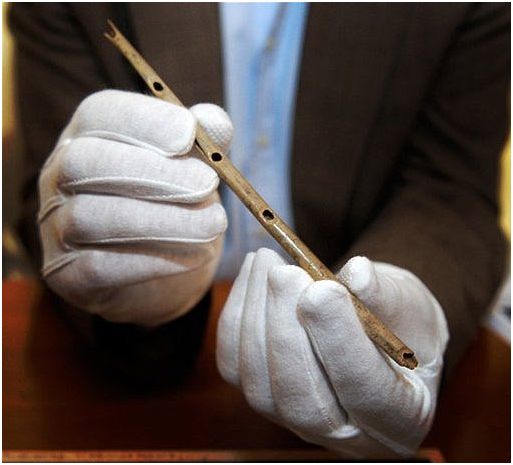
Berlin - This flute is the first musical instrument in the history of humankind—one of the first examples of technology—which has surprised everyone demonstrating that music already existed 35,000 years ago. Stone Age Rock Band, here we go.
It was made from the wing bone of a giant griffon vulture during the Upper Paleolithic and found in several pieces in the Hohle Fels Cave in Ach Valley, in the south of Germany, the 8.7-inch long, one-inch diameter instrument with complex and delicate craftmanship and has five holes, with two V-shaped notches carved on one side of it. This was the part in which the musician put the lips to blow, according to University of Tubingen's professor Nicholas Conard, the lead author of the discovery. The other end is broken just on the fifth hole.
Also according to the study, it was capable of producing a note range similar to those of modern flutes. Conard also points that while music probably didn't have much to do in the success of the first modern humans, it could have given them an advantage against the Neanderthals: Upper Palaeolithic music could have contributed to the maintenance of large social networks, and thereby have helped facilitate the demographic and territorial expansion of modern humans compared to the more culturally conservative and isolated Neanderthals.
Another flute excavated in Austria is believed to be 19,000 years old, and a group of 22 flutes found in the French Pyrenees mountains has been dated at up to 30,000 years ago.
Fossil find in Georgia challenges theories on early humans.
by Ian Sample, The Guardian, UK
September 8, 2009.
Early humans may have taken a detour into Eurasia before embarking on their epic journey out of Africa, according to new fossil evidence.
Palaeontologists in Georgia have unearthed remains of five primitive humans that date back to 1.8 million years ago, suggesting some of our oldest ancestors lived in the region at the time. The partial skeletons, which represent the earliest humans discovered outside of Africa, challenge the theory that our ancestors evolved entirely on the continent and left the cradle of humanity only 60,000 years ago.
David Lordkipanidze, director of the Georgian National Museum, said the primitive humans were short, with small brains and strongly developed legs. Other remains suggest they lived alongside predators including sabre-toothed cats. The fossils are thought to be early Homo erectus, a forerunner of modern humans, which lived in Africa 2 million years ago. Lordkipanidze said some Homo erectus may have left Africa for Eurasia before returning much later.
The fossils were uncovered at the Dmanisi archaeological site south-west of the Georgian capital of Tbilisi. Remains thought to belong to two males and three females were found next to stone tools and animal bones bearing cut marks, suggesting the species prepared meat for food.
"The Dmanisi fossils are extremely important in showing us a very primitive stage in the evolution of Homo erectus," said Chris Stringer, head of human origins at the Natural History Museum in London. "They raise important questions about where that species originated." By piecing the skeletal remains together, researchers estimate they stood about 1.5 metres tall and had brains a little more than half the size of those in modern humans.
Lordkipanidze said: "The Dmanisi people were almost modern in body proportions and were highly efficient walkers and runners. Their arms moved in a different way, and their brains were tiny compared to ours. They were sophisticated tool makers with high social and cognitive skills."
Studies detail new line on our evolution.
by Thomas H. Maugh II, Los Angeles Times
October 3, 2009.
A treasure trove of 4.4-million-year-old fossils from the Ethiopian desert is dramatically overturning widely held ideas about early evolution of humans and how they came to walk upright, even as it paints a remarkably detailed picture of early life in Africa.
The centerpiece of the diverse collection of primate, animal and plant fossils is the near-complete skeleton of a human ancestor that demonstrates our earliest forebears looked nothing like a chimpanzee or other large primate, as is now commonly believed. Instead, the findings suggest the last common ancestor of humans and primates, which existed nearly 2 million years earlier, was a primitive creature that shared few traits with modern-day members of either.
The findings published in the journal science, also indicate our ancestors began walking upright in woodlands, not on grassy savannas as previous generations of researchers speculated.
The discovery of the specimen called Ardipithecus ramidus which was shattered almost beyond repair, but was a complete skeleton. The fossils were found 15 years ago in the Afar Triangle of Ethiopia by a team led by paleoanthropologist Tim White, of the University of California, Berkeley, in a layer of sediment sandwiched between two layers of volcanic ash, each dating from 4.4 million years ago. The specimen was dubbed Ardi, and the team found more than 100 fossils from 36 other members of the same species. Lucy, the 3.2-million-year-old specimen was found in the Afar desert in the 1970's, but Ardi is a completely unknown creature, and are much stranger and more primitive than Australopithecus.
Scientists: New dinosaur species found in S. Africa.
by Celean Jacobson, AP
November 12, 2009.
Johannesburg - A newly discovered dinosaur species that roamed the Earth about 200 million years ago may help explain how the creatures evolved into the largest aninmals on land, scientists in South Africa said. The Aardonyx celestae was a 23-foot-long small headed herbivore with a huge barrel of a chest. It walked on its hind legs but also could drop to all fours, and could prove to be a missing evolutionary link.
This is a species "that no one has seen before and one that has a very significant position in the family tree of dinosaurs," said Australian paleontologist Adam Yates, at the University of the Witwatersrand's Bernard Price Institute for Paleontological Research.
The Aardonyx celestae species dates to the early Jurassic period stood nearly 6 feet high at the hip and weighed about 1,100 pounds. It was about 10 years old when it died and its death may have been caused by drought.
The newly discovered species shares many characteristics with the plant-eating herbivores that walked on two legs. But the new species also has similar attributes to dinosaurs known as sauropods, or brontosaurs, that grew to massive sizes and went to all fours with long necks and whip-like tails.
The discovery fills a marked gap in our knowledge of sauropod evolution.
New workers' tombs found near Egypt's Great Pyramids - They show how laborers lived.
by Paul Schemm, AP
January 11, 2010.
Cairo - Egyptian archaelogoists have discovered a new set of tombs belonging to the workers who built the Great Pyramids, shedding light on how the laborers lived and ate more than 4,000 years ago, the atiquities department said.
The thousands of men who built the last remaining wonder of the ancient world ate meat regularly, worked in three-month shifts and were given the honor of being buried in mud-brick tombs within the shadow of the sacred pyramids they worked on.
The newly discovered tombs date to Egypt's 4th Dynasty (2575 B.C. to 2467 B.C.) when the Great Pyramids were built, according to the head of Egypt's Supreme Council of Antiquities, Zahi Hawass.
Graves of the pyramid builders were first discovered in the area in 1990, and shows these 10,000 were paid laborers, and were not slaves.
On May 24, 2010 archeologist unearthed 57 ancient Egyptian tombs, most of which hold an ornately painted wooden sarcophagus with a mummy inside with the oldest ones dating to 2750 B.C., found at Lahoun, some 70 miles south of Cairo. Some tombs dating around 2030-1840 B.C. were decorated with scenes of ancient deities, such as the falcon-headed Horus.
Y chromosome study stirs up more evolutionary debate.
by Seth Borenstein, AP
January 14, 2010.
Washington - Women may think of men as primitive, but new research indicates that the Y chromosome - the thing that makes a man male is evolving far faster than the rest of the human genetic code.
A new study comparing the Y chromosomes from humans and chimpanzees, our nearest living relatives, show that they are about 30 percent different. That is far greater than the 2 percent difference between the rest of the human genetic code and that of the chimp's, according to a study in the journal Nature. The changes occurred in the last 6 million years or so, relatively recently in evolutionary terms.
"The Y chromosome appears to be the most rapidly evolving of the human chromosomes," said study co-author Dr. David Page, director of the prestigious Whitehead Institute in Cambridge and a professor of biology at the Massachusetts Institute of Technology. "It's an almost ongoing churning of gene reconstruction. It's like a house that's constantly being rebuilt."
This does not mean men are more evolved. Page claims that the Y stands alone and isn't part of a pair like 44 other chromosomes. So when there are mutations there's no matching chromosome to recombine and essentially cover up the change.
'Hobbit' alters view of human evolution - Creatures found in Indonesia.
by Michael Casey, AP
March 7, 2010.
Liang Bua, Indonesia - Indonesian researcher looking for the origins of tiny humans on the remote island of Flores, sheds light on the fossilized 18,000-year-old skeleton of a dwarf cavewomen whose discovery in 2003 was an international sensation.
Her scientific name is Homo floresiensis, her nickname is "the hobbit," and the hunt is on to prove that she and the dozen other hobbits since discovered are not a quirk of nature but members of a distinct hominid species.
The discovery shocked and divided scientists because there was a band of distant releatives that exhibited features not seen for millions of years but were living at the same time as much more modern humans.
Almost overnight, the find threatened to change our understanding of human evolution, pushing the issue that human evolution did not begin in Africa but was more complex than previously thought. Accusations that it was nothing more than a deformed human, but at the end the experts found that this is indeed a separate and prinitive species that lived in relatively modern times - 17,000 to 100,000 years ago.
Extinction Event.
by Thomas H. Maugh II, Los Angeles Times
March 8, 2010.
It's official: The extinction of the dinosaurs and host of other species 65.5 million years ago was caused by a massive asteroid that crashed into the Gulf of Mexico, creating worldwide havoc, and international team of researchers said. The 7.5-mile-wide asteroid is estimated to have been traveling at a speed about 10 times that of a rifle bullet when it hit, releasing about a billion times more energy than the Hiroshima atomic bomb. The impact set massive wildfires and tsunamis and earthquakes worldwide and continents to slip into the ocean.
The species lost included not only the dinosaurs, but also the birdlike pterosaurs, large marine reptiles and many smaller land and sea creatures, clearing the way for the emergence of mammals as the dominant life form on the planet.
This idea was proposed 30 years ago by Nobel laureate physicist Luis Alvarez and his son, Walter, after they found abnormally high concentrations of the element iridium in sediments from what was then known as the K-T boundary. This 65.5 million-year old layer of Earth separates fossils of the Cretaceous period from those of the Tertiary period. Iridium is rare on Earth, but common in space, and the Alvarezes proposed that a giant asteroid had hit the Earth, producing the sudden decline in species diversity previously observed at the K-T boundary (K is the abbr. for the Cretaceous). Then in 1991, researchers discovered a 120-mile wide, 1.5-mile deep crater called Chicxulub in Mexico with the same age as the K-T boundary.
Mammoth Opportunity.
by William Mullen, Chicago Tribune
March 15, 2010.
Chicago - Lyuba, the baby wooly mammoth that is on display at the Field Museum, was perserved almost perfectly intact right down to her baby fat for 42,000 years in frigid Siberian river muck and found in May 2007. She is perserved in a process called desiccation, removing all moisture from the body tissues.
Ancient bone stirs talk of new human ancestor.
by Malcolm Ritter, AP
March 25, 2010.
New York - In the latest use of DNA to investigate the story of humankind, scientists have decoded genetic material from a human ancestor that lived in Siberia and concluded it might be a new member of the human family tree. The DNA doesn't match modern humans or Neanderthals, two species that lived in that area around the same time - 30,000 to 50,000 years ago. Instead, it suggests the Siberian species lineage split off from the branch leading to moderns and Neanderthals a million years ago, the researchers calculated. So the Siberian species may be brand new, but anatomically modern humans have often lived alongside their evolutionary relatives.
Neanderthals live on in modern humans.
by AP
May 7, 2010.
Washington - We have met Neanderthal and he is us - at least a little. The most detailed look at the Neanderthal genome helps answer one of the most debated questions in anthropology: Did Neanderthals and modern humans mate?
The answer is yes; there is at least some cave man biology in most of us. Between 1 percent and 4 percent of genes in people from Europe and Asia trace back to Neanderthals. The Max Planck Institute for Evolutionary Anthropology in Leipzig, Germany researchers compared the genetic material collected from the bones of three Neanderthals with that from five modern humans. Thus suggesting that inter-breeding occurred in the Middle East, and the relationship was also found in people from Euorpe, China and Papua New Guinea, but not people from Africa.
Ancient pagan artifacts unearthed in Israel.
by AP
June 8, 2010.
Jerusalem - Archaeologists have unearthed a cache of rare, 35-century-old religious artifacts once used in pagan rituals. The items were found during an excavation ordered by the Israeli Antiquities Authority along the route of a new gase line in the country's north, and found more that 100 intact artifacts, including vessels for burning incense, and the sculpted face of a woman that was part of a cup used in a pagan religious ceremony.
Cave with prehistoric art to reopen to visits in 2011.
by AP
June 9, 2010.
Madrid - A cave complex boasting prized prehistoric paintings will reopen after eight years, despite scientists' warnings that heat and moisture from human visitors damage the site known as the Sistine Chapel of Paleolithic Art.
The Culture Ministry and the site's board of directors said that visits to the Caves of Altamira in the northern Cantabira region will resume next year on a restricted basis. The main chamber at Altamira features 21 bison painted in red and black estimated to be 14,000 to 20,000 years old.
11,000-year-old home is uncovered.
by AP
August 12, 2010.
London - Archaeologists have uncovered Britain's oldest house, the waterside home of nomad hunters dating back abount 11,000 years. The dwelling near Scarborough, in northeastern England, has lake views and a thatched roof. It predates Stonehenge by about 6,000 years and was built when Britain was still connected to continental Europe.
Mohler, professor debate evolution.
by Peter Smith, Courier-Journal
September 4, 2010.
Albert Mohler, president of Southern Baptist Theological Seminary in Louisville, has been in a sharp Internet debate with a Baptist physics professor over whether accepting Christian doctrine requires a rejection of evolution. Mohler contends that evolution cannot be reconciled with Christianity and that the age of the earth is likely in the thousands rather than billions of years. He is a strict believer that the interpretation of Genesis as a literal account of creation in six 24-hour days. He see no symbilism in the text at all. The earth and universe was fully developed and so was Adam according to him.
The professor, Karl Giberson of Eastern Nazarene College in Massachusetts, wrote that this view can't be squared with science, the author of "Saving Darwin: How to Be a Christian and Believe in Evolution" so that young people are not forced to choose between faith and science. Giberson supports evolution and hopes it brings us to a new understanding of the Bible and his website BioLogosForum stated purpose is to foster dialogue between science and religion. He wants us to grapple with it as did Galileo.
His point of view is that he is competing against those who believe that the biblical Adam literally existed and fathered the human race, Adam sinned in the Garden of Eden and caused the fall of humanity passing down his sinful nature to all his descendants.
Giberson said Mohler's responses amount to scientific nonsense. "Why would God create stars with half of their nuclear fuel already used up? he asked. "Why would God pepper the heavens with debris that looks exactly like it came from stars that exploded billions of years ago?" If the earth were a few thousand years old, he said, such stars could have never existed. "I do not think that I am showing how much doctrine Christianity has to surrender, but how problematic fundamentalist literalism is for engaging science," Giberson wrote. "...Does the saving power of Jesus vanish if sin becomes something that developed through natural history, rather than appeared all at once in the Garden of Eden?"
[Comment] I appeal to both of these gentleman to view my site at www.mazzaroth.com for a compromise viewpoint.
One more distant relative.
by Malcolm Ritter, AP
December 27, 2010.
Scientists have recovered the DNA code of a human relative recently discovered in Siberia, and it held a surprise. This relative roamed far from the cave that holds its only remains. By comparing the DNA to that of modern populations, scientists found evidence that these "Denisovans" from more than 30,000 years ago ranged all across Asia. They apparently interbred with the ancestors of people now living in Melanesia, a group of island northeast of Australia.
There's no sign that Denisovans mingled with the ancestors of people now living in Eurasia, which made the connection between Siberia and distant Melanesia quite a shock.
It's the second report in recent months of using a new tool, genomes of ancient human relatives, to illuminate the evolutionary history of humankind. See the article in May 2010 regarding Genome of Neanderthal.
As for Denisovans, the new work is probably just the start of what can be learned from their genpme, said one expert such as eye and skin color.
Scientists found evidence that in the genomes of people now living in Melanesia, about 5 percent of their DNA can be traced to Denisovans, a sign of ancient interbreeding.
Teeth may be oldest evidence of modern man.
by AP
December 28, 2010.
Jerusalem - Israeli archaeologists say they may have found the earlist evidence yet for the existence of modern man. A Tel Aviv University team excavating a cave in central Israel said it found teeth about 400,000 years old. The earliest Homo sapiens remains found until now are half that old. Archaeologist Avi Gopher said further research is needed to solidify the claim. If it does, he said, "this changes the whole picture of evolution," denying the out of Africa theory.
Tools hint at early human travel - They may have crossed Red Sea.
by Randolph E. Schmid, AP
January 28, 2011.
Modern humans may have left Africa thousands of years earlier than previously thought, turning right and heading across the Red Sea into Arabia rather than following the Nile to a northern exit, an international research team says. Stone tools discovered in the United Arab Emirates indicate the presence of humans between 100,000 and 125,000 years ago, the researchers report on Science. While science generally accepts an African origin for humans, anthropologists have long sought to understand the route taken as people spread into Asia, the Far East and Europe.
Previous evidence has suggested humans spread along the Nile valley and into the Middle East about 60,000 years ago. "There are not many exits from Africa. You can either exit" through Sinai north of the Red Sea or across the straits at the south end of the Red Sea, said Hans-Peter Uerpmann of Eberhard-Karls University in Tuebingen, Germany. "Our findings open a second way," which, in my opinion, is more plausible for a massive movement," he added.
Because of the different climate at the time, Arabia was moister and would have been a grassland with plenty of animals for prey, he added.
Taming fire - Civilizing step may have come late in Europe.
by AP
March 21, 2011.
A new study is raising questions about when ancient human ancestors in Europe learned to control fire, one of the most important steps on the long path to civilization.
A review of 141 archaeological sites across Europe shows habitual use of fire beginning between 300,000 and 400,000 years ago, according to a paper in the March 15 edition of Proceedings of the National Academy of Sciences.
Most archaeologists agree the use of fire is tied to colonization outside Africa, especially in Europe where temperatures fall below freezing, wrote Wil Roebroeks of Leiden University in the Netherlands and Paola Villa of the University of Colorado.
Yet, while there is evidence of early humans living in Europe as much as 1 million years ago, the researchers found no clear traces of regular use of fire before about 400,000 years ago.
After that, Neanderthals and modern humans living in Europe regularly used fire for warmth, cooking and light, they found.
"The pattern emerging is a clear as well as a surprising one," they said, considering these ancient people were living in the cold European climate. Their results raise the question of how early humans survived cold climates without fire. The researchers suggest a highly active lifestyle and a high-protein diet may have helped them adapt to the cold, adding that the consumption of raw meat and seafood by hunter-gatherers is well documanted.
Before that period, there is a single site in Israel with earlier evidence of regular fire use, the researchers noted, and there are sites in Africa indicating sporadic fire use.
Not so sure of the late date for controlling fire is Harvard archaeologist Richard W. Wrangham, author of the book "Catching Fire: How Cooking Made Us Human," who argues that learning to cook food - perhaps as much as 2 million years ago - improved nutrition enough for a burst of evolution promoting development of a bigger brain and, eventually, leading to modern humans.
He hinted that the lack of earlier evidence of fire could merely mean that, over time, the burned bones or ashes had been destroyed or dispersed. But Villa said there is evidence of burned bones in a South African cave from a million years ago, "so burned bones do preserve."
This is a case of 'science friction' resulting from the clash betweeen archaeolical and biological evidence, so it is a puzzle.
Pope: Humanity isn't random - Evolution focus of Easter homily.
by Nicole Winfield, AP
April 24, 2011.
Vatican City - Pope Benedict XVI marked the holiest night of the year for Christians by stressing that humanity isn't a random product of evolution. Benedict emphasized the biblical account of creation in his Easter Vigil homily, saying it was wrong to think at some point "in some tiny corner of the cosmos there evolved randomly some species of living being capable of reasoning and of trying to find rationality within creation, or to bring rationality into it." "If man were merely a random product of evolution in some place on the margins of the universe, then his life would make no sense or might even be a chance of nature, he said. "But no, reason is there at the beginning: creative, divine reason."
Church teaching holds that Roman Catholicism and evolutionary theory are not necessarily at odds: A Christian can, for example, accept the theory of evolution to help explain developments but is taught to believe that God, not random chance, is the origin of the world. The Vatican, however, warns against creationism, or the overly literal interpretation of the biblical account of creation.
OLD THEORY BITTEN - Ancient 'Nutcracker Man' really ate grass, study says.
by Randolph E. Schmid,
May 3, 2011.
Nutcracker man didn't eat nuts after all. After a half-century of referring to an ancient pre-human as "Nutcracker Man" because of his large teeth and powerful jaw, scientists now conclude he actually chewed grasses instead. The findings "reminds us that in paleontology, things are not always as they seem," said Peter S. Ingar, chairman of anthropology at the University of Arkansas.
Thure E. Cerling of the Universtiy of Utah and his team annalyzed the carbon in the enamel fo 24 teeth from 22 individuals who lived in East Africa between 1.4 million and 1.9 million years ago. One type of carbon is produced from tree leaves, nuts and fruit, another from grasses and grass-like plants called sedges.
It turns out that the early human known as Apranthropus boisei didn't eat nuts but dined more heavily on grasses than any other human ancestor or human relative studied to date. Only an extinct species of grass-eating baboon ate more, they said. They did not expect to find the primate equivalent of a cow dangling from a remote twig of our family tree. .
As of May 6, 2011, I have stopped typing from news articles and began using the Electronic Edition of the Courier-Journal newspaper so from this point on the articles are from those pages and may be shortened in some cases for highlights and space considerations.
Tracks lead to Ireland - Scientists find modern polar bears’ DNA stems from Irish matriarch by Amina Khan, Los Angeles Times
All polar bears alive today are descended from a single female brown bear who most likely hailed not from Alaska — as widely presumed — but from Ireland, scientists said.
The discovery, reported online July 7 in the journal Current Biology, suggests that polar bears and various species of brown bears probably encountered each other many times in the past 100,000 years or so as climate change forced them into each other’s territory.
On some occasions, those meetings produced hybrid offspring whose genetic signature lives on in polar bears today.
The findings were made by analyzing mitochondrial DNA extracted from 242 bear lineages. Some of them were polar bears, and some were brown bears. Some lived recently, and others have been dead since the late Pleistocene Epoch, which ended nearly 12,000 years ago.
Polar bears and brown bears are uniquely suited to their habitats. Polar bears have white coats to help them blend in and sneak up on prey, a carnivore’s fearsome set of teeth, and superb swimming abilities. The smaller brown bear lives on land in warmer climes and eats plants and small animals.
Based on fossil evidence and genetic analysis, scientists had thought that polar bears’ closest relatives were the brown bears living on islands off the coast of Alaska.
Although members of the two species can, and have, met and mated — as evidenced by the occasional “grolar bear” hybrid popping up in the Canadian Arctic — those couplings are extremely rare and thought to be brought on by global warming as melting glaciers force polar bears into the brown bears’ habitat and brown bears to encroach northward into polar bears’ Arctic refuge.
So imagine study leader Ceiridwen Edwards’ surprise when she analyzed mitochondrial DNA in the bones of extinct brown bears collected from Irish caves and discovered that it most closely resembled the DNA of modern polar bears.
Unlike nuclear DNA, mitochondrial DNA is passed down essentially unchanged from mother to child and provides a clear record of maternal lineage. Using mitochondrial DNA, scientists had already determined that all living polar bears could trace their roots to a single “Eve.”
But to think that she was an Irish brown bear? “I thought maybe I’d made a mistake,” said Edwards, an archaeological geneticist at University of Oxford.
To rule out the possibility that the bones recovered from the Irish caves belonged to polar bears, not brown bears, she and her colleagues analyzed isotopes of carbon and nitrogen in the bones and found that the remains belonged to an animal with a land-based diet, not one feeding on marine life.
Then the researchers teamed with Beth Shapiro, an associate professor of biology at Pennsylvania State University, who compared the Irish mitochondrial DNA to genetic samples of bears that lived in Asia, Europe, North Africa and North America in the past 120,000 years.
Shapiro’s bear family tree showed a number of strange patterns. For instance, Irish brown bears that lived right around the peak of the glacial period, between 38,000 and 10,000 years ago, shared their mitochondrial DNA with polar bears — more so than the brown bears living on islands off the coast of Alaska.
The researchers think that during colder times, the glacial ice sheet would have extended all the way south into Ireland, allowing polar bears to roam into brown bear territory and making cross-species hybridization possible. One of the resulting female cubs probably went on to become a polar bear matriarch, and the descendants of all other matriarch lines died off.
The study showed that, rather than being an aberration, these hybridizing events may have happened multiple times in the course of polar bears’ history and might be a more common part of the evolutionary process than previously thought. The researchers even point out that it may be time to provide protections to such hybrids, the same as those given to “purebred” species.
“I think it’s really cool,” said Graham Slater, an evolutionary biologist at the University of California, Los Angeles, who was not involved in the study. “These ancient DNA studies are really exciting because they give you a window into the dynamics of how these animals moved around, and who they were interbreeding with, that you just don’t get with only the living individuals.”
Homo erectus traveled by sea - Researchers find tools on Crete similar to early Stone Age tools from Africa by Helen Chappell, McClatchy Newspapers Early manlike creatures may have been smarter than we think. Recent archae-ological finds from the Mediterranean show that human ancestors traveled the high seas.
A team of researchers that included a North Carolina State University geologist found evidence that our ancestors were crossing open water at least 130,000 years ago. That’s more than 100,000 years earlier than scientists had previously thought.
Their evidence is based on stone tools from the island of Crete. Because Crete has been an island for eons, any prehistoric people who left tools behind would have had to cross open water to get there. The tools the team found are so old that they predate the human species, said Thomas Strasser, an archaeologist from Providence College who led the team. Instead of being made by our species, Homo sapiens, the tools were made by our ancestors, Homo erectus.
The tools are very different from any others found on Crete, Strasser said. They’re most similar to early Stone Age tools from Africa that are about 700,000 years old, he said.
Initially the team didn’t have any way to date the tools. That’s where NCSU geologist Karl Wegmann came in. At the time, Wegmann didn’t know much about archaeology, but he did know quite a bit about Crete’s geology. He had been figuring out the ages of Crete’s rock formations to study earthquakes.
A few of the stone tools the team had discovered were embedded in those same rock formations. Those rocks were formed from ancient beach sands, Wegmann said.
Today, the rocks and the tools embedded in them are hundreds of feet above the shore. . The same process that drives the region’s strong earthquakes — colliding continents — is pushing Crete upward out of the sea at a rate of less than an inch every year. The island’s slow rise has preserved beaches from many eras as terraces along the coast.
The lower terraces are the easiest to date. Scientists can measure the age of seashells embedded in the rock using radioactive carbon dating. This method estimates the age of those terraces at about 45,000 and 50,000 years old.
“We know that (the tools) are tens of meters above the terrace we dated at 50,000 years old, so we know right off the bat that they have to be at least that old,” Wegmann said. But 50,000 years ago is carbon dating’s limit. Anything older has to be dated using another method.
Crete’s rise from the sea gives a fairly simple way of doing that. Once they know the age of lower terraces, geologists can calculate the age of higher terraces just by measuring the difference in the beaches’ elevation. If geologists know how much farther the older terrace traveled upward from the newer, and they know how fast it was going, they can figure out how long it took to get there. Or, in other words, its age — in this case, a record-smashing 130,000 years old. “The thing to me that really makes this unique and exciting is … these other sister species maybe weren’t entirely stupid like we portray them,” Weg-mann said. “They were capable of really complex things.”
Science - HEAD START - Study: Ancient humans may have had hand axes far earlier than thought by Alicia Chang, Associated Press
Ancient humans fashioned hand axes, cleavers and picks much earlier than believed, but didn’t take the stone tools along when they left Africa, new research suggests.
A team from the United States and France made the findings after traveling to an archaeological site along the northwest shoreline of Kenya’s Lake Turkana. Twofaced blades and other large cutting tools had been previously excavated there along with primitive stone flakes.
Using a sophisticated technique to date the dirt, researchers calculated the age of the more advanced tools to be 1.76 million years old. That’s older than similar stone-age artifacts in Ethiopia and Tanzania estimated to be between 1.4 and 1.6 million years old.
This suggests that prehistoric humans were involved in refined tool-making that required a higher level of thinking much earlier than thought. Unlike the simplest stone tools made from bashing rocks together, the early humans who shaped these more distinct objects planned the design and then created them.
This “required a good deal of forethought as well as dexterity to manufacture,” said paleoanthropologist Eric Delson at Lehman College in New York, who was not involved in the research. Results of the study, led by Christopher Lepre of Rutgers University and Columbia University’s Lamont-Doherty Earth Observatory, appear in the latest issue of the journal Nature.
The stone tools, known collectively as Acheulian tools, are believed to be the handiwork of the human ancestor Homo erectus. The teardrop-shaped axes were “like a stone-age Leatherman or Swiss Army knife,” said New York University anthropologist Christian Tryon.
The axes were suited for butchering animals or chopping wood while the thicker picks were used for digging holes. Homo erectus walked upright like modern humans, but possessed a flat skull, sloping forehead and a smaller brain. It emerged about 2 million years ago in Africa.
Most researchers think Homo erectus was the first to fan out widely from Africa. There’s archaeological evidence that the first to leave carried only a simple toolkit. The earliest sites recovered in Asia and Europe contain pebble tools and flakes, but no sign of Acheulian technology like hand axes.
Why that is “remains an open question,” said anthropologist Sally McBrearty of the University of Connecticut, who had no role in the research. Theories abound. Some surmise that the early humans could not find the raw materials in their new settlement and lost the technology along the way. Others suggest they later returned to Africa where they developed hand axes.
NYU’s Tryon, who was not part of the study, has a different thought. Perhaps the early populations who expanded out of Africa didn’t need advanced technology because there was less competition.
Early humans were “behaviorally flexible” and making hand axes “was something that they did as needed and abandoned when not needed,” Tryon said.
The latest work does little to settle the issue, but scientists now have identified the earliest known site in the world containing Acheulian tools.
Geologists collected about 150 samples of sediment from the site in 2007. To come up with an age, they used a technique known as paleomagnetic dating, which takes advantage of the flip-flop of Earth’s magnetic field every several hundred thousand years.
The tools were not too far from where the bones of Turkana Boy — the most complete skeleton of a prehistoric human — were unearthed in 1984.
African bones may shake family tree - Called evolution ‘game-changer’ by Randolph E. Schmid, Associated Press
WASHINGTON — Two million-year-old bones belonging to a creature with both apelike and human traits provide the clearest evidence of evolution’s first major step toward modern humans — findings some are calling a po-tential game-changer.
An analysis of the bones found in South Africa suggests Australopithecus sediba is the most likely candidate to be the ancestor of humans, said lead researcher Lee Berger of the University of Witwatersrand in South Africa.
The fossils, belonging to a young male and an adult female, show a novel combination of features, al-most as though nature were experimenting. Some resemble pre-human creatures, while others suggest the genus Homo, which includes Homo sapiens, modern people.
“It’s as if evolution is caught in one vital moment, a stop-action snapshot of evolution in action,” said Richard Potts, director of the human origins program at the Smithsonian Institution. He was not among the team, led by South African scientists, whose research was published online Thursday in the journal Science. Scientists have long considered the Australopithecus family, which includes the famous fossil Lucy, to be a primitive candidate for a human ancestor. The new research establishes a creature that combines features of both groups. The newly studied bones were found in 2008 in the fossil-rich cave region of Malapa near Johannesburg. Berger’s then 9-yearold son, Matthew, found a bone that was determined to belong to the male creature. Two weeks later, Berger found the fossils of the female. The journal published five papers detailing the findings, including separate reports on the foot, hand, pelvis and brain of A. sediba. Berger said the brain, hand and foot have characteristics of both modern and early pre-human forms that show a transition under way. It represents a bona fide model that could lead to the human genus Homo, Berger said.
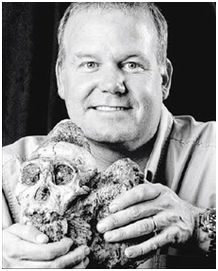
A candidate to be the ancestor of humans with lead researcher Lee Berger of the University of Witwatersrand in South Africa.
Ancient paint - Art supply, tools found in S. African cave by Associated Press
Researchers in South Africa have discovered what may have been the world’s earliest artist’s studio. A 100,000-year-old workshop used to mix and store the reddish pigment ochre has been discovered in Blombos Cave on the rugged southern coast near Cape Town. At the same site, scientists have found some of the earliest sharp stone tools, as well as evidence of fishing.
The latest find was reported in Friday’s edi¬tion of the journal Science. It includes pieces of ochre, grinding bowls, shells for storage and bone and charcoal to mix with the pigment.
Lead researcher Chris¬topher Henshilwood of the University of Bergen, Norway, said the find represents an important benchmark in the evolu¬tion of complex human mental processes.
The ochre could have been used for painting, decoration and skin pro¬tection, according to the researchers.
The discovery shows that even at that time “humans had the concep¬tual ability to source, combine and store sub¬stances that were then possibly used to enhance their social practices.”
Two separate tool kits for working ochre were found at the site, the re¬searchers said.
Henshilwood, who is also affiliated with South Africa’s University of Witwatersrand, said in a statement that research¬ers believe that pieces of ochre were rubbed on rock to make a fine red powder, and that was mixed with crushed bone, charcoal, stone chips and a liquid. The mixture was put into abalone shells and stirred with a bone.
Researchers found a 100,000-year-old art workshop in Blombos Cave along the Indian Ocean coast near Capetown, South Africa. The workshop was used to mix and store the reddish pigment ochre. The find was reported in Friday’s edition of the journal Science. MAGNUS HAALAND/AP
Return each year for updates for 2011 and on.
|| 2012 || 2013 || 2014 || 2015 || 2016 || 2017 || 2018 || 2019 || 2020 || 2021 || 2022 ||