
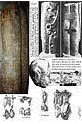
From The Alpha and the Omega - Volume III
by Jim A. Cornwell, Copyright © July 20, 2002, all rights reserved
"Volume III - Dynasty Zero"


Go to the bottom of this page


    The following page is excerpts from the website, which is part of two articles submitted for a paper and for a University concourse, by the author Francesco Raffaele, who is preparing a degree thesis on the Second Dynasty at the I.U.O. Napoli, Italy.    He has also created the website EARLY DYNASTIC EGYPT on the Internet at http://members.xoom.it/francescoraf/ ©

FRANCESCO RAFFAELE 2000-2001
    From http://xoomer.virgilio.it/francescoraf/hesyra/KingScorpion2.htm which I enjoyed so much I transferred the text and images to this page, just incase the site is not available in the future.    It is a very thorough analogy of the research and excavations being done on Dynasty 0 and Dynasty 00, in regard to King Scorpion, which I am following with interest on new discoveries.

    Entitled KING SCORPION (II) by Francesco Raffaele, and associated with his DYNASTY 0 page.
    King SCORPION (II) is known by a single inscribed object, and the date of this ruler is surely not post-Narmer and very likely neither pre-Ka.    He might be thought to represent a 'Gegenkönig' (as Dreyer defines Horus Crocodile); more likely they were the last expressions of ancient local independent ruling lineages which ceased to reign only when the powerful kings of the Thinite region moved northward to occupy the territories with which, until then, they had only entertained peaceful commercial relations.    The position of Scorpion II at Hierakonpolis is harder to explain and Dreyer thinks this was a Thinite king too.    The different writing of his name and the Nekhen finds can't be a certain indication of the Hierakonpolite origin of Scorpion II.    Iry Hor had a different royal name mark too, and Narmer was also known at Nekhen.
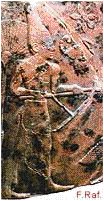
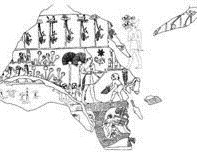
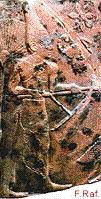
    The giant from Hierakonpolis is another important masterpiece of the period and virtually the only object surely attributable to this king.    As to the macehead the name of this king is not written in the serekh and is not surmounted by Horus; the expression for 'sovereign' is rendered by the 'Rosette.'    E. Baumgartel proposed that there was no need to distinguish this king from Narmer; in the same way Horus Ka had been already interpreted to be possibly an indication that B9/7 was the tomb of Narmer's ka (but this is impossible for the finding of a seal impression in B7 and other reasons).
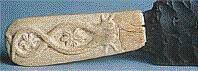
    Cfr. H.S. Smith in Adams - Friedman eds. 'The Followers of Horus', 1992, 244ff for the semantic value of the Rosette; but also T. Schneider in S.AK. 24, 1997 p. 241ff. For other Rosettes cfr. below (Qustul incense burner and MMA knife handle) but note that some more appear on Gebel Tarif, Carnarvon, Univ. College (Petrie UC16294) and Brooklyn Museum knife handles, Metropolitan Mus. comb).
    Cialowicz thinks that at the right end of the rows of Rekhyt-bows standards and dancers in the upper registers, there would be the standing king Scorpion represented with the red crown of Lower Egypt (cfr. Adams - Cialowicz, Protodynastic Egypt, 1997 fig.1).

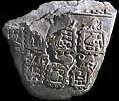
The Scorpion Macehead (Ashmolean Museum, Oxford E3632)
A line drawing of the Scorpion Macehead    King Scorpion    Macehead

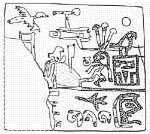
    Another macehead from the same cachette at Hierakonpolis, far more fragmentary than the already fragmentary previous one, shows a king sitting under a canopy; he wears the red crown and the Heb Sed robe.    Arkell interpreted a slightly visible sign before the head as a Scorpion.    A reference to this is found in Antiquity 37, 1963; see also B. Adams, Ancient Hierakonpolis, 1974, p.3, pl. 1, 2; K.Cialowicz, Le Tetes de Massues..., 1987 p. 41-3 fig. 5.    The Macehead is in University College, London inv. 14898.    For another macehead in UC (inv. 14898 A) the 'Bearers Macehead' cfr. Quibell 'Hierakonpolis' I (1900) pl. XXVIA and Cialowicz op. cit.    Adams has found no trace of the rosette in a break in front of the red crown curl, therefore the object could belong to another king of the period immediately before Narmer (or Narmer's own).    I would suggest that the fragmentary glyph might be interpreted as a standard with a crocodile whose tail hangs down (Horus Crocodile?).

    Cialowicz has given a convincing interpretation of the scene as the Sed celebration after a military victory of Scorpion (or Narmer), to the right of the sitting king, in the centre of the scene, there is a big falcon (turned towards the king) holding in the claws a rope which directs to the right-end of the preserved fragment.    Behind and in a lower position than the falcon, there must be a number of prisoners (one ear is clearly visible) which the rope kept during their presentation to the king by Horus.
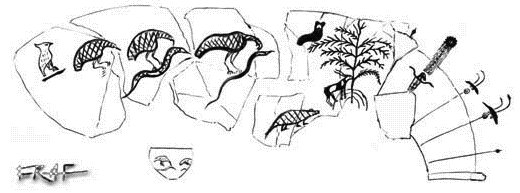
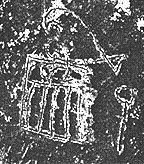
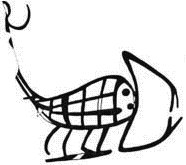
    The last reluctantly accepted piece of evidence for king Scorpion II is a graffito in Upper Nubia, Gebel Sheikh Suleiman, and referenced to a published work by W. Needler in J.A.R.C.E. 6, 1967, p. 87-91 pl. 1 and 2.
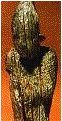
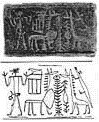
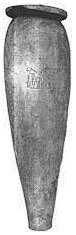
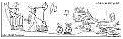
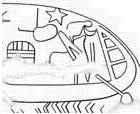
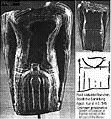
    This scorpion, with long linear claws may be compared with the sign in a serekh on a statuette in München (Munchenstt) (Staatliche Sammlung Äg. Kunst, ÄS 7149, unknown provenance, sedimentary rock, 11,2 cm high; head and legs lost) which has only two very short appendices.    The time span between the two monuments seems however wide.    It is not far from the notorious graffito now in Khartoum Museum: it represents a scorpion with a prisoner into its claws; two more human figures with a bow and false tails, are directed towards the captive and the scorpion.    This scene could, in my opinion, be far earlier than the presumed time of Scorpion II and it's surely related to a chief, but I would prefer a date in Naqada IIIa (Scorpion I?) or even late Naqada II.

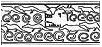
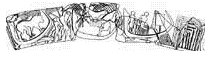
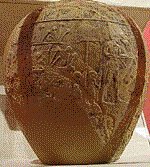
    The date is far more certain for an alabaster vessel from Quibell and Green's Hierakonpolis excavations, but the scorpions and bows which surround its body can't be attached with full confidence to king Scorpion.    A larger group of objects which would be assigned to this king's reign has been proposed by Kaplony, noted as an example is the incision on the Abu Umuri palette and others, Kaplony, in: Orientalia 34, 1965, 132ff., Pl. 19-23; id., IAF.    Also note that the cited alabaster vessel (Quibell, Hierakonpolis, Pt. 1, Pl. 19f.) with Scorpions (in boats?, like the god Nemty or Andjety).    Falcons in relief has been proposed by Dreyer as a possible indication of filiation or gift between the supposed successive (Naqada IIIa2) rulers Scorpion I and Falcon I (Umm el-Qaab, vol. 1, 173, n. 249).    See also Quibell, op. cit. Pl. 34 (vessels with incised ka and scorpion signs), but it can't be assumed that almost any known late predynastic representation of scorpions ought to refer to the king in object.

    The tomb of Scorpion II has never been found.    Dreyer and Hoffman have speculatively proposed respectively the 4-chambers Abydos B50 and the Hierakonpolis loc. 6 tomb 1, referenced to Dreyer in M.D.A.I.K. 43, 1987; id., M.D.A.I.K. 46, 1990 p. 71; and Hoffman, The Sciences, Jan/Feb 1988, 40-7.    Therefore the slight traces of Scorpion II hinder any safe reconstruction about the place of origin of this obscure sovereign and his role in the late predynastic history.

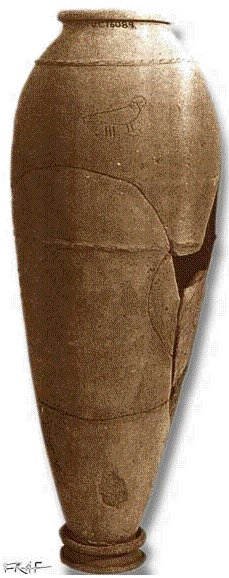
Minshat Abu Omar tomb 160, jar incised serek,
 after vanden Brink op. cst 1996 pl 28b (Type III)

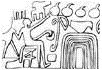
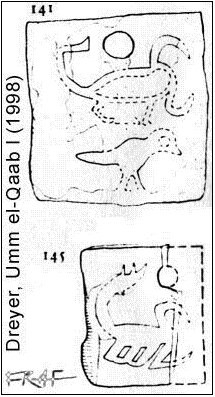
    A royal name within a falcon topped serekh incised on a jar from tomb 160.1 at Minshat Abu Omar has been alternatively read as Aha and Scorpion.    The sign does look like a scorpion, curved with both the tail, drawn above the body, and the head looking rightward, whereas the falcon looks towards the left.    Van den Brink has proposed that this sign might be an upset variant of the coil identified by Dreyer on two vessels and a seal impression from
Tarkhan (cfr. below) and referenced to Wildung, Aegypten vor den Pyramiden, 1981 fig. 32; van den Brink op. cit. pl. 28 a,b: Horus (Crocodile -Sbk or Hmz-) the Subduer (cfr. id. op. cit. 1996 and 2001 in preparation); only B.    Adams has attempted the equation of this serekh with Horus Crocodile; for Dreyer cfr. n. 35.
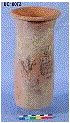
Ink serekh on a jar from Tarkban tomb 315

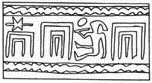
    The two ink-inscribed cylinder (Crocodile) vessels were found by Petrie, as referenced T. 1549: Petrie, Tarkhan II, 1914, 11 and pl. 9.3; t. 315: Petrie et al. 1913, 9, 29, pl. 31.66 (wrongly reproduced as Ka) and pl. 60 (no mention of the vessel here); cfr. Kaplony I.A.F. III pl. 1, 2; id. I.A.F. II, 1090., in tombs 1549 and 315.    Kaiser and Kaplony read their serekhs name as Scorpion (with the tail now curved below the animal); but this is impossible because the scorpion would have on both the examples an opposite orientation than the falcon above the serekh; Dreyer and referenced to G. Dreyer in Adams - Friedman eds. op. cit. 1992, p. 259ff.; also cfr. n. 39., has introduced, to account for these two serekhs (but not the M.A.O. one), a king CROCODILE, ruler of the Fayum region.
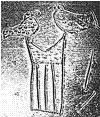
    Finally there is an inscription in a serekh on the Munchen Staat.    Samml. statuette which has been read Nar(mer) and this could be perhaps a scorpion, but none of the two readings really convinces.

(Continues on Dyn 0 page)

Munchen statuette
 (Staatliche Sammlung Ag Kunst, AS 7149,
unknown provenance, sedimentary rock, hr II, 2 cm


    For the possible datation (proposed by G. Dreyer, in Umm el-Qaab I, 1998, 173ff.) of the Tehenu palette (tehenu or Towns palette) to the reign of King Scorpion II cf. Dynasty 00 page.

Towns Palette


    The following is found on http://xoomer.virgilio.it/francescoraf/hesyra/dynasty00.htm

"Dynasty 00" Naqada IIc (IIC) - IIIa2 (IIIA2) by Francesco Raffaele

    PART 0 - PRELIMINARY NOTE (On the Terms "Dynasty 0" and "Dynasty 00" - Cf. also text below)
    "Dynasty 00" is a term which has not gained general acceptance in Egyptology.    Some authors use it to indicate the rulers of the period before Dynasty 0, but there isn't any family relation among many of the rulers within "Dynasty 00", because they are local chiefs of different centers and they did not consider themselves as being part of the same ruling family except at the single local levels.
    Although improper, the term provides a useful subdivision of or distinction between the sovereigns or chiefs of the period when Egypt was in the process of cultural unification (late Naqada II- early III) and the kings of Naqada IIIB ('Dynasty 0'), when the political unification of the whole Egypt was accomplished.
    In the former period Upper Egyptian independent regional chiefdoms, then proto-states (Hierakonpolis, Naqada, Abydos) shared similar cultural traits, and probably had some kind of relations (trade, marriages, warfare) among each others.
    The period covered starts with the ruler (?) buried with the Gebelein cloth kept at present in Turin Museum (early Naqada II), the owner of HK tomb 100 (loc. 33, Naqada IIC period), those of some (possibly royal) tombs in Naqada cem. T (Kemp, JEA 59, 1973, 36-43 ; Wilkinson, 1999 p. 52) and finally those buried in Abydos cem. U (tombs of local chieftains in late Naqada IID- to late IIIA, especially some of the mudbrick ones of Naqada IIIa2) and the contemporary ones from Hierakonpolis loc.6 (tomb 11); of the end of this period should be also the tomb L24 at Qustul and 137,1 at Seyala in Nubia (end Naqada IIIa2 for B. Williams; but these have been recently considered slightly later, in Naqada IIIB).

    A far more correct terminology would be one involving the period and geographical designation of the ruling lines: e.g. ...Scorpion I, a late Naqada IIIA1 (middle stufe IIIa2 in Kaiser's chronology) ruler of Abydos (... buried in tomb U-j, Umm el-Qaab, Abydos).

    A new series of possible royal names has been recently evidenced and reconstructed by Günter Dreyer from inscriptions on some bone tags and ceramic vessels deriving from the U cemetery of Abydos, on certain Naqada IId1-IIIa2, on the Tehenu Palette, and on the graffiti (Coptocolossi) incised on the Coptos Colossi.
    The complete list and discussion of Dreyer (Umm el Qaab I, 1998 p. 173-180) includes the following probable royal names or rulers' indicators (loc. cit. p. 178; also see the TABLE below): Oryx, Shell, Fish, Elephant, Bull, Stork, Canid (?), Cattle-head standard, Scorpion I, Falcon I, Min standard + plant, ?, Falcon II (?), Lion, Double Falcon, Irj-Hor, Ka, Scorpion II, Narmer.    More local rulers (mostly of dynasty 0, Naqada III period) are Nb (or R ?), Hedjw(-Hor), Pe + Elephant, Nj-Hor, Hat-Hor, Crocodile (the Subduer), Falcon + Mer (Tarkhan, also read as P.N. 'Mer Djehwty'), and Qustul L2 Pe-Hor.

    Within the time interval covered by "Dynasty 00" there are enormous differences (the socio-political situation in which did live the mentioned chiefs of Gebelein and Hierakonpolis t. 100 on one hand, and that of the Naqada IIIA2 Abydene kings of cemetery U on the other one.    We are considering a period of c. 300 years.    Certainly further findings and studies will bring into this phase more order and new criteria of chrono-geo-political subdivision are going to be provided.
    The first serious use of the term "Dynasty 00", by van den Brink (in id. ed 'The Nile Delta in Transition' 1992 p. vi, n. 1) was related to the 'members of the ruling class buried in cemetery U at Abydos Umm el Qaab' who were 'possibly the predecessors of the Dynasty 0 Kings'.
    G. Dreyer had already jokingly used the term to indicate the rulers earlier than Naqada IIIB Dynasty 0.
    Also "Dynasty 0" is either used to designate only the Abydos dynasty buried in cemetery B, or the whole Egypt Naqada III B kings.    Moreover others apply this term to all the rulers of the Late Predynastic period (= "Dynasty 00 + 0").    There is no need to further remark that these terms are both nearly ridiculous (although Dynasty 0 is rather more accepted by scholars than "Dynasty 00", yet equally misleading) and applied here only in a distinction, temporary.

    Summarizing, 'Dynasty 00' (less misleading would be "DYNASTIES 00") is henceforth used here as a descriptive term which indicates a period in the protodynastic, not a single line of rulers from a specific place; the period covered is Naqada IIC-IIIA2 (Kaiser's stufen IIc, d1-2 and IIIa1-2).
    See also the Synthesis page in this site, the discussion below and the Table at the bottom of this page.

"Dynasties 00":
The proto-states of Naqada IIC-IIIA2 period (c. 3500-3220 BC)

PART I - INTRODUCTION
    I have already introduced the main chronological subdivisions and problems of the Naqada culture (Petrie's Sequence Dates -SD-, Kaiser's and Hendrickx's improvements), which I won't rehearse here.    (cf. F. Raffaele, Dynasty 0, in: AegHelvet 2002; the Dynasty 0 page ; also see this synthesis of earlier predynastic cultures as Fayyum, Merimde, Badarian).
    In a very summary way, Naqada I (formerly 'Amratian') was characterized by some diagnostic pottery types and by a large production of crafts-objects like human figurines, amulets, decorated ivory combs, animal shaped cosmetic palettes; to this 'figurative' repertory we must add stone vessels, flint blades, weapons and other tools which suggest a transparent progress in technology (division of labour, advanced food production, artifacts masterpieces) and, above all, in the broader ambit of thought.    It's important that Naqada I-II are main phases of the same cultural Unit (further divided into more subphases): therefore the elements of continuity between respectively phase I-II, II-III and III-Early Dynastic (= Naqada IIIC1/D) are to be considered much more relevant than the detected breaks between contiguous phases; and the 'cold' terms Naqada I-III are actually more apt to render the idea of one civilization in evolution than Petrie's terminology.
    The Naqada civilization developed in a core-area stretching, during Naqada I, from the Abydos to the Hierakonopolis regions, having its heart in the eponymous site of Naqada (Nubt, Ombos).
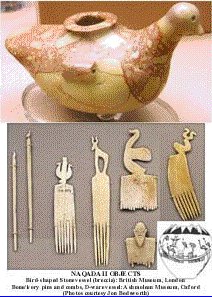
Nagada II objects

    In the following phase II (Petrie's Gerzean) the impact of the Naqadian influence had already reached the Upper Nubia, the East Fayum region (Gerzeh) and the Delta (Buto); the period IID-IIIA marks the culmination of the cultural superimposition of this southern civilization into the Delta, where it definitively replaced the local (Maadi-Buto) tradition; the following phases (IIIA2-IIIB) are an age of political contrasts, a long series (about two centuries) of struggles and alliances which led to the supremacy of the Thinite regional (proto-) state that finally realized the Unification of Egypt.    But we have only sketchy fragments of the complicate puzzle; and we must not disregard the fact that the unequal knowledge of the main sites of that period is a heavy bias onto our reconstructions.    Furthermore the evidence for violent competition amongst the early U.E. chiefdoms or proto-states is, for now, almost entirely based on the artifacts iconography.
    There is not yet a terminology for the Late Predynastic phases; "Protodynastic" is employed as a synonym for Dynasty 00 and 0, which are in turn not true dynastic lines as those of Manetho, but rather designations of periods or of the contemporary local ruling lineages thereof; for distinction purposes I will provisionally follow the (playful) indication of Dreyer, labelling the Naqada IIC-IIIA2 sovereigns as "Dynasty 00" and the Naqada IIIB ones as "Dynasty 0" (but note that most of the Egyptologist means 'Dynasty 0' as either all the late predynastic kings or only the Abydos line buried in cemetery B and -eventually- U).    The denomination of "Dynasty 00" is however still very rarely adopted in Egyptology.    The emergence of the earliest rulers is only one aspect of the State formation in Egypt; kingship has its roots in the archaic African folklore substratum, although some accessory elements of the Dynasty 00-0 sovereignty and culture were borrowed from ancient Uruk and Susa civilizations.    Scholars have individuated two main periods of Near Eastern influence on the emerging Egyptian proto-state(s): one during Dynasty 0 (c. 3200-3050 B.C.) culminating with Narmer and Aha's reigns, and an older one around 3500/3400 B.C., thus in the middle-late Naqada II.
    However the reception of Near Eastern influences was only in terms of some forms (figurative motifs, palace façade device) and practices (use of cylinder seals, writing ?), but these elements were always re-elaborated according to the Egyptian own culture, beliefs and ideological needs.    These external influences were never a decisive input onto the Egyptian state formation and evolution.    I've already shown (F. Raffaele, TM 2, 2002, 27) that the origin of the state is a multi-faced complex process which involves several causal components and thus entails a polimorphic explanation based on the analysis of different factors (population, territory /environment resources, war, trade, technology, beliefs/thoughts) and the multiplicatory effect of their interaction.
    In this period we can draw the development of the basic components of the future State mechanism, namely an homogeneous set of beliefs concerning the afterlife and the origin of the chiefs' power: a series of mythical and material corollaries to these subsystems furnished the justification and legitimisation of the inner inequalities of a society with an already deep fault between the ruler and the ruled: the construction of monumental buildings in the towns and of richer tombs on holy grounds (conspicuous consumption), the availability of luxury and exotic materials (display) through the monopoly of long distance trade, the production of artifacts symbolizing and reinforcing their status, the possibility to dominate large masses of populations with violent coercive methods and with subtle mythological/ religious strategies, were some of the devices adopted by the élite to proof, motivate, confirm and strengthen their superiority and supremacy.
    The divine kingship and its ideological background was one of the pillars of the Egyptian state, and the union of secular and supernatural power within a single individual was a decisive factor for its success.
    The other key innovation was specialization: to build up the imponent state-machine and make it work, it was necessary to subtract parts of the population from the food production and destine them to other full-time activities: administration, army, religion and cult, building of tombs and temples (and their decoration), crafts, trade, mining.    These unproductive classes and the royal court were sustained by the large mass of the population which practised agriculture; the yield was in fact coercively gathered by the State as taxes, then stored and unequally redistributed.    In a State-system, specialization spans all the sectors of the society and its structural components: labour, food and crafts production, war, technologies, religion, perhaps even ideas (see I. Takamiya 2002).
    Artefacts were status symbols which conveyed a coded message the élite could comprehend; but they have also an external aspect, a visual impact which the masses are subjugated with (think about monumentality of structures or splendour of art masterpieces) and which contributes to the creation, definition and persistence of the roles of the masters and servants.
    Someone has tried to compare on a general level, early Naqada III polities with Archaic Greece or classic Maya city-states; both the Greek as well as the Maya situations are better known than the Late Predynastic Egyptian one.    Certainly there must have been a hierarchy in the cities around each Egyptian proto-nome capital, and some interrelation among the different regional states.    At one point some of them (especially those with bordering territories) must have been engaged into military competition, for territorial exploitment, trade monopoly or further reasons, while others possibly united through alliances stipulated by gifts exchanges, cross-marriages, construction of monuments, celebration of public ceremonies and feasts.
    In Egypt there's evidence of an organization in form of city-states or archaic regional proto-states as early as late Naqada II: one sealing possibly dates Naqada I and further ones from Naqada IIB,C are known.    Most of the oldest Egyptian seals (Naqada, Naga ed-Der) have been considered as possible imports from (rather than copies of) ancient Uruk (VI-V) examples.
    Writing did emerge in early Naqada III mainly within two spheres: Royal display (particularly kingship-symbolism, kings' names and properties) and Administrative practices (seals, labels and other systems to count, control and recognize incomes, stored and forwarded goods).
    Cross-comparison among different cultures of the World at a similar phase of development are certainly helpful and welcome; however these are often limited to the general features of the paralleled subjects, because, actually, it is very difficult for one and the same person to have an in-depth knowledge of two proto- or advanced- State cultures.
    Yet, also on a general level, it has been shown that there are interesting comparisons to be further researched [Trigger, 1993].

PART II - EVIDENCE OF EARLY RULERS
    One of the earliest representations of an Egyptian ruler is to be found in the scene painted on the wall of a Naqada IIC tomb (in Locality 33) at Hierakonpolis, the famous tomb 100.
Hieroconpolis 100 (Nagada IIc-d)
Cairo Museum (Quibell-Green, Hieroconpolis I)
    The scene is constituted by two processions with large boats and various subsidiary motifs (animals taming and entrapment, chief smiting captives and other isolated hunting and clashing scenes).
    The interpretations attempted have been manifold, ranging from actual reports of warfare victories with related ceremonies, to ritual and symbolical generic evocations of triumph.    Williams and Logan proposed to integrate most of the scenes, like the present one and those carved on ivory knife handles, into a broader cycle of representation of the (proto-) Heb Sed royal ritual [But cf. Hendrickx, CdE 74, 1998, 203ff. esp. p. 220-224, for an alternative interpretation of a part of the painting].
    A similar depiction with boats processions, struggles, hippo hunting and fishing scenes is found on the painted fragments of a textile from Gebelein (Turin Mus., suppl. 17138) dated to Naqada Ic-IIb (fig. >).
Gebelein Textile, or linen
 Museo Egizo di Tonno S. 17138 (Nagada II b-c)
    Naqada I and II witness the origin of many beliefs connected with the later Dynastic era.    In particular the first signs diagnostic of a coherent (?) tradition of the Kingship seem to remount to these two phases: a recently found C-ware vessel from Abydos tomb U-239 (Naqada Ic-IIa) shows a ruler smiting groups of enemies (the same pictorial symbol present -more than a century later- in tomb 100 and -nearly half a millennium later- on Narmer palette); a B-ware sherd with a red crown in relief was found by Petrie in tomb 1610 at Naqada; whole series of traits, emblems, attributes and ritual actions of the ruler as the false tail, penis sheath, crowns, maces, reed, sceptres, ritual race, gazelle- and hippopotamus-hunt and further ones have been since long time identified [Fattovich, in: RSO 45, 1970, 133-149]; these are the African-log backbone of the divine kingship institution.
    Therefore we know a good number of constitutive elements of the Pharaonic state which were inherited from late prehistory; one could try to excerpt similar patterns of developments of kingship, administration and iconography into other sectors of the archaic Egyptian civilization as mortuary beliefs and practices, cult/religion/myths, 'art', technology, economy and trade, subsistence.

    Among the most important recent achievements in our knowledge of the 'history' of the early Naqada III period ("Dynasty 00") there are Dreyer's excavation and publication of king Scorpion I's tomb U-j at Abydos and the Darnells' discovery of some graffiti of the Gebel Tjauty, in the Desert west of Thebes (recently discussed by Friedman and Hendrickx).
Scorpion I: ink inscriptions on jars
 and jar fragments from Abydos tomb U-j

    The impressive amount of funerary goods gathered in the Abydos tomb U-j (mid Naqada IIIa2 = late Naqada IIIA1), among which nearly seven hundred Palestine-imported jars, plus few thousand wine and beer jars (many Wavy-handled jars are inscribed with painted signs), an Heka scepter (in the N corner of the burial chamber), scores of bone/ivory labels http://xoomer.virgilio.it:80/francescoraf/hesyra/new/U-tags.jpg (173) with short inscriptions (the earliest written evidence presently known from Egypt), some fine artefacts (obsidian hands-bowl, pieces of furniture, very fragmentary ivories with animal reliefs) and the same size of the tomb, have caused some scholars to suggest the possibility that Egypt would have been politically unified since Naqada IIIa2/A1.    One needs to be very cautious in these statements for it often happens (as with Dreyer's discovery or also with Williams' publication of the excavations at Qustul cemetery L in Nubia) that the astonishing character of new finds can lead to underestimate other eventualities.
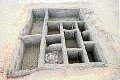
Abydos Tomb U-j (from the east)

    In case of Egypt, there is no further evidence of a Royal cemetery of Early Naqada III period except at Hierakonpolis (loc. 6) (Naqada cem. T declines in that period) [cf. Wilkinson, MDAIK 56, 2000]; therefore the possibility that the owner of tomb U-j, Scorpion I, might have already reigned over a united Egypt has only the strength of the lack of similar attestations from other sites.
Scorpion I: ivory tags from tomb U-j II

    Indeed, despite the cultural uniformity which enveloped the whole country already in late Naqada II, and the shared belief in an early beginning and long lasting process of political unification, the present data suggest that the final transformation of the Egyptian Nile Valley, from a land with different regional polities into one ruled by the same sovereign, was only accomplished in late Naqada IIIB; probably by Narmer and/or by one of his nearest predecessors (Ka, Iry Hor) of the same Abydene ruling line buried in Abydos cemetery B.    This necropolis is the continuation of the few northerly cemetery U, and thus we can affirm that Narmer was a late successor of Scorpion I and that the Thinite élite had a major role in the development and completion of the Unification.
    This is in part also based on a negative evidence, namely the lack of attestations of Naqada IIIA ("Dynasty 00") rulers outside the Thinis/Abydos territory.    Only since Naqada IIIB ("Dynasties 0") there are the first royal serekhs [1] from various zones of Egypt as Double Falcon (whether this was a single king's name; cf. below) and, later, Ka and Narmer (see F. Raffaele, op. cit.; also cf. Dynasty 0 http://xoomer.virgilio.it:80/francescoraf/hesyra/dynasty0.htm page).

    An important point about the tomb U-j is the fact that the substructure plainly reproduces a model palace (cf. Dreyer, Umm el-Qaab I, p. 6f., fig. 5-6); some slits provide the access to the various chambers of the tomb, surely imitating the true doors in the royal palace (and on the other hand possibly anticipating the false doors in later tombs); near the top of each slit two holes supported a wooden stick on which a rolled mat was wrapped; at least six more mudbrick tombs in the cemetery U had their chambers connected by lists.
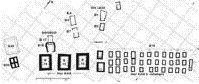
    Recently S. Hendrickx has proposed a possible explanation for the marked difference in the size of the tomb U-j compared to almost all the others in the cemetery.    It might be thought that soon after the reign of Scorpion I the separation between the tomb and its funerary enclosure did happen; an offering court (Opferplatz) is located just south of tomb U-j and U-k (vessels found in it dated from Naqada III to early 1st Dynasty); on the other hand the earliest funerary enclosures (c. 1 and 1/2 Km North of Umm el Qaab) are known only from the time of Djer (or Aha); but these were built in mudbrick, whereas it can be supposed that the older ones were simple palisades made with perishable materials as wooden poles, which would be disappeared with the passing of time.    At Hierakonpolis the roughly contemporary (élite or royal) tomb 11 in Locality 6 was also provided with a fence (as did the late-Dynasty 0 tomb 1, which Hoffmann tentatively attributed to Scorpion II).

    Certainly it can be supposed that Scorpion I had a prosperous reign; tomb U-j (dated just later than U-k and earlier than U-i) had its substructure built in two phases: to the first one the W burial chamber (U-j 1) and the nine E magazines (U-j 2-10) do belong (c. 10 x 20 cubits in size); in a later period the two S chambers (U-j 11-12) were added and the tomb came to measure 10 x 16 cubits; however no large span of time must have separated the two building phases (same size of bricks).
    The sheer size and the amount and kind of gravegoods indicates that the owner of this burial, Scorpion I, must have been a relevant personality of that time, and certainly responsible of major achievements.

    But it must be rehearsed that (in my opinoion) the political Unification was really brought to completion only with Narmer, when the sparse and relatively few regional powers were probably subjugated or annihilated by the Thinite family.    However the incipit of this process is undoubtedly to be found in the so called 'Dynasty 00'.

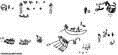
Djebel Tjawty grafitto of King Scorpion
 (J.C. Darnell - D. Darnell, 1995-96
 Annual report in the Abzu
 Chicago Oriental Institute page)

A preliminary report of the Exploration of Luxor-Farshut road in the ABZU
http://www-oi.uchicago.edu/OI/PROJ/DES/Desert_Road.html site (O.I. , http://www-oi.uchicago.edu/)

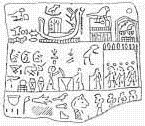
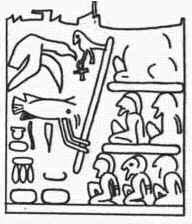
    In this respect it assumes a great value the evidence of the Gebel Tjauty graffiti, with their possible narration of a military victory by Scorpion I over the ruler of a nearby regional state (Naqada ?) whom he captured (the defeated personal name or region/city name was possibly written with a Bull head over a standard, an emblem also recurring on tomb U-j ink inscribed jars).
    Before the captured person (who's followed by the victorious ruler with a mace) there is the figure of a wading- (or secretary ?) bird pecking a serpent (a symbolographic label for "victory" or an emblem of a nome/region ?) which is also found on Davis comb, Brooklyn and Pitt-Rivers knife-handles http://xoomer.virgilio.it:80/francescoraf/hesyra/Egyptgallery071.html and on a painted vessel from Qustul tomb L23 http://xoomer.virgilio.it:80/francescoraf/hesyra/egypt/Qustul-L23bowl.jpg.    Beyond the bird there's a figure carrying a staff preceded by a standard (?) and further on the right a falcon over a scorpion (royal name?; cf. fig. above).    The defeated chief on the left side has his hands bound behind his back and held with a rope by the winner; the latter is pictured at higher level (and scale) on the extreme left of the scene.
    The interesting character of the graffito is, in my opinion, in its evenemential narrative; on the same level as the Gebel Sheikh Suleiman http://xoomer.virgilio.it:80/francescoraf/hesyra/suleim.gif graffito, near Wadi Halfa in Nubia, the scene appear to represent the celebration of a real victory.    The scenes on Late Predynastic objects (originally destined to temples and tombs) are mostly considered to be ritual or symbolic in character (tomb 100, decorated ceremonial palettes) whereas the scenes carved on the rocks of the Gebel Tjauty and Gebel Sheikh Suleiman may instead have been true "reports" of historical events.
    In particular the Tjauty one has been speculatively related by Wilkinson [op. cit., 386] as possibly signifying the victory of the Thinite ruling line over the one of the decadent polity of Naqada.
    Gebel Tjauty was perhaps a short-cut for the Thinite traders and armies to double the Naqada territory on the way towards the Hierakonpolis or the Lower Nubia regions (Sayala and Qustul are A-Group capital centres which had their apogee in that period and slightly later; when late Dynasty 0/ early Dyn. 1 kings aimed at the direct exploitation of the Nubian territory, the A-group culture disappeared; see the Dynasty Zero http://xoomer.virgilio.it:80/francescoraf/hesyra/dynasty0.htm page; a similar pattern might be hypothesized in relation with the demise of the Maadi-Buto cultural complex in the Delta).

    All this tells us relatively few on the organization of the proto-states previously to the 'Unification'; perhaps a pattern of rough correspondence between the Nile Valley macro-regions in Naqada III and the later subdivision into Nomes could reasonably be followed (the emblems of many of the later nomes already appear in the late IIIrd Dyn early IVth oldest "Biographies" as those in the tombs of Metjen and Pehernefer; some of the D-ware vessels standards on the boats and some of those on the Hunters-, Battlefield-, Bull-, Narmer- palettes and Scorpion- and Narmer-Maceheads have been tentatively interpreted as proto-nomes or ruling lineages' emblems).    This would depend on the strategic location of the early settlements which can be explained by the presence of easily accessible resources (minerals in the Desert widian as at Nubt and Nekhen, wide flood-plain as at Abydos), factors that we can assume to have continued to be relevant in the following periods; the religious/cultual importance of settlements and cemeteries of ancient local chiefs would be another reason for the later (Nome-) capitals to arise nearby or upon the old ones.
    The scarcity of data from protodynastic urban centers in the Nile Valley is indeed an important and often stressed lack in our knowledge of this period (as also in the dynastic age); but during these last decades the situation is getting better (Delta sites).

    The reconstruction provided by Dreyer [in: Umm el-Qaab I, 1998, 173-180; id., in: SDAIK 28, 1995] of a possible line of about 15 rulers from early Naqada IIIA1 to late IIIA2 (nine kings before and five after Scorpion I; cf. below, table 1) is still tentative and to be checked with/against further evidence; this argument is a central one for the history of this period and is the object of the following discussion.    For a different view and in particular a possible total of only 2 or 3 reigns between Scorpion I and Iry-Hor cf. A. Jimenez-Serrano, Los reyes del predinàstico Tardìo, in: BAEDE 10, 2000, 33-52.
    Dreyer's theory is based on the interpretation of two main sources: the reliefs on the three fragmentary statues known as 'Koptos Colossi' and the hieroglyphs on the Tehenu palette; further confirmation of the royal names would be some of the inscriptions on vessels and labels from tomb U-j.

Min Collosi from Coptos
 in Ashmolen Mus. (2) and Cairo Mus. (1)

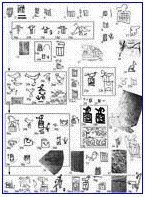
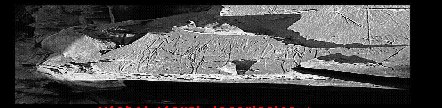
    The colossal limestone statues of Min were found by Petrie in the temple of Koptos in 1894.    They had been fashioned with hammering technique (no chiselling) and represented the god standing with erected phallus; only the torso and part of the legs was preserved and the head of one of the statues in Oxford, although almost entirely effaced; some signs http://xoomer.virgilio.it:80/francescoraf/hesyra/new/Coptoscolossi.jpg in relief were noted on the statues showing animals, plants, shells and standards.
    In an article published in 1988 [JARCE 25, 35-60], B. Williams suggested the presence of a fragmentary trace of the name of Narmer on the Cairo statue; this gave an important clue about the long disputed question of the date of the statues (which in the past had ranged from Predynastic to 1st Intermediate Period according to the opinions of different Egyptologists).    [For reconstructions of the colossi and temple see this page http://www.petrie.ucl.ac.uk/digital_egypt/koptos/reliefs/index.html in the Petrie Museum website: Digital Egypt http://www.petrie.ucl.ac.uk/digital_egypt/Welcome.html].

    In 1995 Dreyer (loc. cit. above) proposed that the graffiti on the statues were the names of older rulers, and Narmer had been the last one to make his name be carved on those statues; therefore the colossi probably dated well before his reign, down to Naqada IIIa, and the signs carved onto them would be perhaps something similar to a king list.    I must notice that the Nar-fish and the Mer-chisel are very fragmentary -only the left end preserved- and, as suggested by Kemp, the upper sign is rather the tail of a bird than that of the Nar cat-fish, thus suggesting a falcon on a perch or on a standard [cf. B.J. Kemp, CAJ 10.2, 2000, 211-242, fig. 10; H. Goedicke, MDAIK 58, 2002, 253].
    Basing on the reciprocal placement and superimposition of the signs on the colossi, Dreyer seems to have found a possible sequence of the stages in which the graffiti were incised (cf. table): Animal-head standard, Shell, Elephant, Bull, Stork, Canid, Min-standard, Plant, Lion and Narmer (for the Tehenu palette, see below).


    TABLE 1 - Abydos succession "Dynasty 00-0"
(G. Dreyer)Min statues Coptos Tomb U-j Abydos Tehenw palette Others Sequence of Rulers
Oryx standard . . . Oryx standard
Shell Shell . . Shell
. Fish . . Fish
Elephant Elephant . . Elephant
Bull . . Bull (W-ware) Bull
. (Bucranium standard?) . . (= Bucranium standard ?)
Stork Stork (?). . . Stork
Canid Canid . . Canid
. Bucranium standard (^) . . Bucranium standard (^)
. Scorpion I . . Scorpion I
. Falcon Falcon (= MMA palette ?) Falcon (I)
Min standard + plant . . ink on net-painted cylinder jar Min standard + plant
. . N.2 (lost) . ?
. . N.3 (Falcon II?) . ? (Falcon II)
Lion . Lion Lion in the Hunters palette [?] Lion
. . Double Falcon incised on jars Double Falcon
. . . . .
. . ......... . ..........
. . . . .
. . . Iry-Hor (B1/2) Iry-Hor
. . . Ka (B7/9) Ka
. . Scorpion II Scorpion macehead Scorpion II
Narmer . . Narmer (B17/18) Narmer

List of Naqada IIIA1-early IIIC1 rulers of Thinis/Abydos* reconstructed by G. Dreyer (cf. above) in Umm el-Qaab I, 1998, p. 178

    * This table only considers the Naqada III Thinite/Abydene ruling line; the kings whose serekhs have been found only elsewhere (as Hedj-Hor, Hat-Hor, Ny-Hor, Pe-Hor, Ny-Neith, Djehwty-Mer/Falcon-chisel, Crocodile and few others) are thus excluded.    In this respect it's Dreyer's opinion (one on which not all the scholars do agree) that Scorpion II was also originary of the Thinite nome.    Cf. DYNASTY 0 page for detailed informations on these Naqada IIIB (IIIb1-2) rulers.
    For a lexico-grammatical-iconographical approach to these inscriptions see: A. Anselin, "Notes pour une lecture des inscriptions des Colosses de Min de Coptos", in CCdE 2, 2001, 115-136.    For a linguistic and morphological analysis of the structure of hieroglyphic writing in this period, cf. J. Kahl, Hieroglyphic Writing During the Fourth Millennium BC: an Analysis of Systems, in: Archéo-Nil 11, 2001, 102-134; for a critic to the reading of the animals-signs as predynastic sovereigns' names, cf: F.A.K. Breyer, Die Schriftzeugnisse des Prädynastischen Königsgrabes U-j in Umm el-Qaab: Versuch einer Neuinterpretation, in: JEA 88, 2002, 53-65.

    For the main contra-opinion to Dreyer's reconstruction (presented in: "Die Datierung der Min-Statuen aus Koptos", in: Kunst des Alten Reiches = SDAIK 28, 1995, 49-56, Pl. 9-13; and in "Umm el-Qaab I", Mainz 1998, p. 173-180), see: B.J. Kemp's (et al.): "The Colossi from the Early Shrine at Coptos in Egypt" in: CAJ 10/2, 2000, 211-242; J. Kahl, in: Archéo-Nil 11, 2001, 102-134; id., in: GM 192, 2003, 47-54.
    Note that in Kahl's (rather convincing) hypothesis, also the hieroglyph of the Scorpion, drawn on wavy-handled jars' painted marks and incised bone and ivory tags from Abydos tomb U-j and recently found at Djebel Tjauti, could represent a god (or a place where it was worshipped, likely Hierakonpolis) instead of the name of the owner of the tomb and the victorious sovereign of the Tjauti tableau 1.
    Also other symbols such as those on Coptos Colossi and Towns palette should not be related to royal names but probably indicate centres or regions of religious/political importance, or religious emblems, most probably gods' names.    In my opinion, it seems that before Naqada IIIB, territorial designations (on decorated artifacts, jars, rock inscriptions and other documents of either political or economical relevance) where far more important than the specifical names of the leaders commanding these polities.
    There are various sources that more or less clearly attest this aspect.    It is open to mistakes the fact that early place-names could have been indicated with the main divinity which was worshipped there, but also kings' names have always been theophorous or someway related to gods.

    The number of rulers who would have reigned, in Dreyer's reconstruction, between Scorpion I and Iry-Hor could be object of criticism: cf. A. Jimenez-Serrano, in: BAEDE 10, 2000, 33-52 (in which only 3 reigns are postulated for this lapse of time).
    I would consider a time span of c. 150-200 years between the owner of Abydos tomb U-j and Narmer: this should allow for about 9-12 kings in the only ruling line of Thinis/Abydos.    Whether and where more proto-kingdoms have to be located, and until which period would have their kings competed with those of Hierakonpolis and Abydos, it is still difficult to tell.    For now the latter two centres appear to have been where the two most powerful Upper Egyptians élites of Late Predynastic resided, the main powers of early Naqada III that started the long process of political unification which was (probably) definitively accomplished only by Narmer.
    We are not yet provided with sufficient informations and details to describe with scientific certainty the last steps which made of the whole Egyptian Nile valley a state.    Despite the evidence for some struggles, it seems clear that a good part of the violence and of the expressions of hostility 'frozen' on Late Predynastic sources could concern "foreign" peoples and/or have a different sense than that of purely "historical accounts".

    On the other hand there are good proofs for similar proto-states to have existed in Lower Nubia (Seyala, Afieh, Qustul) during a period (classical and terminal A-group) corresponding with Naqada IIIA1-C1 in Egypt (c. 3350-2950 B.C.).    Possibly other local proto-states had developed in Late Predynastic, contemporarily with the Abydos Dynasty 00-0 kings, elsewhere in the North, as in the Fayyum, Memphite and Delta regions (Abusir el-Meleq, Tarkhan, Fayyum sites, Tura, Helwan, Sais, Buto, East-Delta) but it is still impossible to establish the cultural and especially the political relations of these unities with both the contemporary Upper Egyptian ones and with the precedent ones which predominated in those areas.

    In the earlier part of the period in object, other iconographic devices were adopted to convey the idea of sovereignty, but we are still unable to detect them with full confidence.
    Surely one of these symbols was the scepter: Heka-scepters have been found at Abydos in cem. U (tomb U-547, U-j) and a Naqada IID palette from el-Amrah (palettes/min) tomb B62 (in London, BM 35501) was decorated with a "Min-emblem" over a Heka-scepter in relief: perhaps the name of a local chief?

Gallery of decorated knife handles, mace-heads, combs

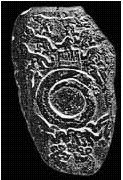
    Another element which preceded the serekh (and in part coexisted with it, as in Lower Nubia) was the rosette; this symbol appears since late Naqada II on seal impressions [cem. U: Dreyer, op. cit., 1998, fig. 72c], gold and ivory knife-handles, an ivory comb, the Scorpion II mace-head and the Qustul tomb 24 incense burner (qustul)) [cf. the author's website page on Dynasty 0].    The rosette/flower/star has been linked by H.S. Smith to the concept of (divine) kingship and to the Sumeric and especially Elamite glyptic [id., in: Friedman-Adams eds., The Followers of Horus, 1992, 235-246].
    B. Kemp [op. cit., 233f.] has also individuated other "control signs" (at the end of animals rows on some knife-handles) with possible relations to kingship or to other social institutions and groups.
    The "reading" of several proto-hieroglyphs like those carved or painted on tomb U-j labels and jars, on seal impressions, on the Koptos Colossi, on the decorated knife handles and palettes is still a riddle; but as the number of finds is increasing with new discoveries, more clues to their real purpose and meaning are hoped to be achieved.
    I must once again stress the central role of the royal cemetery U of Abydos (especially for the importance of the in-situ finds which can provide useful means of datation of already known unprovenanced and thus undated objects) [cf. G. Dreyer, in: C. Ziegler (ed.) "L' Art de l'Ancien Empire ègyptien..." 1999, 195-226; H. Whitehouse, in: MDAIK 58, 2002]; cemetery U was started in Naqada I but it became the local élite burial ground only by late Naqada IId; the first (anonymous or plain) serekhs known in Egypt come from the early Naqada IIIa tombs U-s and U-t, which are located 40-50m N.E. of Iry-Hor's chambers B1-2; also the modern excavations in the Delta sites and those at Hierakonpolis have a key role, as well as the revisions, systematizations and publications of old unpublished excavations and material.

    The Tehenu palette (or Towns palette) in Cairo (C.G. 14238) is named after a sign on its verso: this shows three registers with domestic animals files and a fourth lower one with plants (trees) and the hieroglyph of the throwing stick on an oval (which means 'region', 'place', 'island'), thus a toponym of Libya or Western Delta (THnw, Tjehenw).    The recto of the palette is of great importance, showing the feet of some persons and, below the register line, two rows of four and three groups respectively; each group is constituted by an animal grasping the Mer-hoe on the crenellated wall of a town; the name of each town is is written within the wall [see my Corpus of Late Predynastic Decorated Palettes].
Tehenu Palette

    Since the publication of the palette (unprovenanced but said to be from Abydos) the action of the animals (interpreted as numinose aspects of the kingship or as true kings) was said to be a destructive one; but, comparing the use of the hoe by king Scorpion II on his macehead, Nibbi (1977) and Wildung (1981) moved the first criticism to this generally followed interpretation, proposing that a constructive action was implied, namely the foundation of the named towns (indeed the same interpretation of Scorpion's Macehead ritual as the foundation of a temple or the inauguration of a channel's excavation is still debated).
    Barta, and more recently Dreyer, have rejected this view; Dreyer interprets the names over the walled towns as Dynasty 00/0 kings' names: Lion, Scorpion (II) and Double Falcon (right to left, lower row) and Falcon, [Seth ?], Falcon (?), [lost] (upper row).
    The German archaeologist correctly emphasized that, being the palette very similar in character (relief style, register lines, hieroglyphs) to the Narmer Palette, it was possibly from the reign of King Scorpion II, a near predecessor of Narmer (whose name in fact doesn't appear on the palette); the Scorpion king appears in a prominent position at the center of the lower row; the other rulers were ancient predecessors of Scorpion II in the Dynasty 00-0 (Abydos ?) royal line.

    Falcon (see table above) was possibly the follower of the owner of tomb U-j, Scorpion I; Dreyer hypothesized that Falcon's name also appears on the Metropolitan Museum palette serekh (MMA 28.9.8; cf. TM 3, fig. pag. 28).    The relief on an alabaster vessel from Hierakonpolis showing a frieze of falcons and scorpions was perhaps a tribute of King Falcon to his own father Scorpion I [Quibell-Green, Hierakonpolis I, pl. 19.1].

King Elephant property ?
 Abydos: Tag from tomb U_i sud (K 840; n 59)
 Nagada IIIa 2
    King Lion is, in Dreyer's opinion, named on a seal impression from Mahasna; Dreyer thinks that many of the royal names of that period (since king Elephant), do appear in the names of royal properties/domains: thus a tree beside a lion would be 'King Lion's plantation' (or property; in the Dynastic period there are plenty of examples of places named after kings' names or after royal domains names).    The same author advanced that the lion on the Battlefield (or Vultures) palette was just this Lion king, by the same way as the Bull palette must show a (later) king Bull (Bull II, distinct from the Bull I identified on the Koptos colossus).
    The two falcons on standards would relate to Double Falcon: this is one of the first attestations of serekhs known, early in Naqada IIIB (Dynasty 0); he's known from Southern Palestine, Sinai, East Delta, Memphite region (Tura) and Upper Egypt (Abydos, Adaima); not all the scholars do agree in the interpretation of his serekhs (with different graphical variants: cf. F. Raffaele, op. cit.; id., Dynasty 0; id., TM 2, fig. pag. 29, n. 8-12) as a single ruler's royal title.

    Dreyer has postulated that, given the mentioned late-Dynasty 0 manufacture of the Tehenu palette (which in my opinion is in fact later than the Battlefield and Bull palettes but earlier than the Plover and Narmer palettes), it could never neither celebrate nor narrate the foundation of the towns by those kings: the town of the Heron (Djebawty), probably Buto, which is currently being excavated by T. Von der Way, was founded much earlier than Naqada IIIA.    Therefore the action performed by the royal entities on the palette could eventually be the foundation of fortresses in the respective centers (cf. the example from Elephantine), or more probably it was the (symbolic ?) destruction of the centers after their defeat by the Southern Kings; this progressive military expansionism and submission of the Delta by the Thinite sovereigns, which is echoed in the scenes of battle and of their aftermath represented on Naqada III palettes and ivories, was probably a relatively common scenario until the country unification (cf. M. Campagno 2002).    As quoted above, and always with the due cautions, it can be supposed that a parallel warfare-pattern should have been followed by the Dynasty 00-0 kings in respect of the Nubian antagonists.    Perhaps also in the Delta the Maadi-Buto decline hadn't happened (Naqada IIC-D) without some conflict; the EB I Canaan colonization is instead a different matter (although some scholars hypothesized, in the past, massive military interventions of the Egyptians there): the difference between Egypt and Canaan at that time was too large to favour the assumption of any possible competition between them.    Egyptians must have found no resistance in their infiltration into those territories, contributing to their evolution towards the EB II Urbanization [cf. the interesting and still valid synthesis 'The relations between Early Bronze I age Canaanites and Upper Egyptians' by Branislav Andelkovic, 1995].

PART III - CONCLUSIONS
    The amount of data on predynastic regional-states is rapidly increasing in the last decades.
    I am sure that our knowledge on many aspects of this phase of Egyptian proto-history is going to further augment in the next years.    Once it was the Thinite period (Dynasty I-II) to be considered the egg from which the Dynastic Egypt Civilization sprang out; but indeed, as we have seen, also and already during the late Gerzean (Naqada IID) and Naqada III (Petrie's Semainean) we can find clear signs of the outset of the future Dynastic state peculiarities.

Abydos-Cemetery U statuettes
    We have rapidly passed by some of the "faces" of the Egyptian Predynastic and through the ages of the most ancient kings of Egypt and of the whole humanity.    I have tried to outline in this paper the way in which the Neolithic villages acquired more and more aspects diagnostic of a progress towards complex associative units to finally become regional states governed by the paramount leaders of Dynasty 00, on which I've focussed the discussion.    Many factors contributed to the constitution of the Dynastic Egypt tradition.    The kingship and 'arts' canons (the rules of J. Baines' concept of decorum), religious, philosophical and funerary beliefs, first appeared before, during and few after the Dynasty 00; early Naqada III provides the link between the more egalitarian and less developed societies of the previous periods and the rise of the warrior kings that opened up the path leading to the State of Dynasties 0-2.
    The civilization which developed since this period, through the reign of "Menes" and up to the time of the great pyramids, saw heavy transformations and achievements, obscure ages of crisis, brilliant reprises; but along these phases the underlying continuity and the "archetypal" elements of the "Dynastic culture" can be followed as I have tried to do in this article; Dynasty "00" and "0" are metaphorically the foundation stones of that magnificient monument which Ancient Egypt was; maybe they are for most part hidden beneath the sands, not as apparent as the Old and New Kingdom 'constructions' above them, but at least as much fascinating and mysterious.
    They are the precious keys to understand where, why and how it all began!
--- --- ---
    Most of this page was (originally) part of my article (in print - French translation) in: TM 7, 2002 However this page has been (and will be) updated, enlarged, modified.    Francesco Raffaele, 2002
NOTA BENE: the copyright of the images is of the respective publishers and authors.
--- --- ---
NOTES
    1 - It has been hypothesized that the serekh device might have originated from some of the representations on the tags from cem. U, or that they had the same referent (cf. Dreyer, Umm el-Qaab I, tags 127, 128,129, X188).    The earliest ones known are from tombs U-s, U-t, but some motifs which resemble serekhs are much older (as the one painted on a C-ware sherd from Hierakonpolis loc. 6: cf. B. Adams, in CCdE 3/4, 2002, p. 8, fig. 5; this one has been considered as a 'proto-serekh' by the late Adams and some dotted patterns beside it as fences; but it is hard IMO to credit hers more than one of the possible interpretations).
    For serekhs in general: Wignall, in: GM 162; O'Brien, in: JARCE 33, 1996, 123-138; also cf. Dreyer, in: MDAIK 55, 1999, 4f.; for important considerations on the Delta origin of Serekh and mudbrick architecture (palace-façade features possibly reflecting the existence of relevant Maadi-Buto élites): Jimenez-Serrano in GM 183, 2001, 71ff., interestingly commented on by van den Brink, in: GM 183, 2001, and disputed by Hendrickx, who proposes arguments for an independent Upper Egyptian origin of both the iconographical and architectural devices, in: GM 184, 85-110, 2001.    For a study of pottery incised serekhs in relation to the jar types cf. van den Brink in Spencer ed. 1996; id., Archéo-Nil 11.
    -Essential Bibliography (recent studies)-
J. Baines, Origins of Egyptian Kingship, in: D. 'Connor - D. Silverman (eds.), Ancient Egyptian Kingship 1995, 95-156
K. Bard, The Egyptian Predynastic: A review of the Evidence, JFA 21/3, 1994, 265-288
K. Cialowicz, La naissance d'un royaume, Krakow 2001
G. Dreyer, Umm el-Qaab I, Mainz 1998
F. Hassan, The Predynastic of Egypt, JWP 2, 1988, 135-185
S. Hendrickx, Arguments for an Upper Egyptian Origin of the Palace-Facade and the Serekh during Late ..., GM 184, 2001, 85-110
M. Hoffman, Egypt before the Pharaohs, New York 1979 (1990²)
A. Jiménez Serrano, Chronology and local traditions: the Representations of Power and the Royal name in the Late Predynastic Period, in: Archéo-Nil 12, 2003, in press
W. Kaiser, Einige Bemerkungen zur ägyptischen Frühzeit, ZÄS 91, 1964, 86-125
id., Zur Entstehung des gesamtägyptischen Staates, MDAIK 46, 1990, 287-299
F. Raffaele, Early Dynastic Egypt (Internet site) http://members.xoom.it/francescoraf/ id., La fin de la période pré-dynastique et la Dynastie 0, TM 1, 2001, 20-23; TM 2, 2002, 26-29; TM 3, 26-29
A.J. Spencer (ed.), Aspects of Early Egypt, London 1996
J. Vercoutter, L'Egypte et la vallée du Nil, vol. I, Paris 1992
S. Vinci, La Nascita dello stato nell' Antico Egitto: La Dinastia "Zero", Bologna 2002
T.A.H. Wilkinson, Early Dynastic Egypt, London/New York 1999 id., Political Unification: towards a reconstruction, MDAIK 56, 2000, 377-395.

Text © Francesco Raffaele, 2002
Images © of the respective authors

TABLE 2 - Naqada I-early IIIc1 Chronology


Period - years Dynasty Phase (Kaiser) Tombs - objects types- Rulers Palettes
Amratian(c. 3900) . Naqada Iabc, IIa Abydos tomb U-239
Hierakonpolis Loc. 6,
tombs 3, 6
B-, P-, C- class pottery
Gebelein painted textile
(Turin Museum)
Early rhomboidal
palettes, undecorated or
with incised drawings
Gerzean (c. 3600) . Naqada IIb Decorated Pottery (D-class)
Naqada tombs 1411, T4
From rhomboidal shapes to fusiform,
with appendices and animal heads on the edge
Gerzean (c. 3600) DYNASTY 00 Naqada IIc/d1,2 Wavy handled pottery (W-class)
Hierakonpolis tomb 100
Brooklyn, Carnarvon knife handles (Naqada IIc-IIIa)
(NOTE: Abu Zeidan t.32, which contained the
Brooklyn knife-handle, dates early Naqada III)
.Abydos t. U-q, U-547; knife handle in t. U-503 and fragments from U-127
Zoomorphous palettes(fishes, turtles, mammals)Ostrich palette
Gerzeh palette. Min palette
Late Predynastic
(c. 3300)
DYNASTY 00 Naqada IIIa1,2 Hierakonpolis Loc. 6, tomb 11
Abydos U-cemetery kings (cf. TABLE 1)
Abydos tomb U-j: Scorpion I
Louvre palette
Oxford palette
Hunters palette
. DYNASTY 0 Naqada IIIb1 Seyala tomb 137.1; Qustul tomb L24 Horizon A
Anonymous Serekhs, Double Falcon,
Ny-Hor, Pe-Hor, Hat-Hor, Hedj-Hor;
(Iry-Hor) Gebel Sheikh Suleiman graffito
Hierakonpolis Loc. 6, tomb 10
Metropolitan Mus. paletteBattlefield (Vultures) paletteBull palette
Tehenu palette
Plover palette
Narmer Palette
(end of Narmer's reign c.3000)
Protodynastic
(c. 3150-3000)
DYNASTY 0 Naqada IIIb2/c1 Horizon B
Tarkhan Crocodile, Hk (?)
Scorpion II, Abydos: Iry Hor, Ka, Narmer
Hierakonpolis Loc. 6, tomb 1
.


    http://xoomer.virgilio.it/francescoraf/hesyra/dynasty0.htm
THE DYNASTY 0
Francesco Raffaele - I.U.O. Napoli


Part I - Introduction
    The general picture we have of the Egyptian Late Predynastic period and early state is profoundly changing in the last decades.
    Modern archaeological campaigns, re-examination of scarcely published old excavations, fresh new theoretical and methodological approaches to old and new problems, are quickly transforming the way in which we interpret this important stage of the ancient Egyptian history and its material remains.
    An outstanding step of renewal in the Egyptological studies has been accomplished under the influence, since the '70s, of anthropological- formation scholars like B. Trigger and M. Hoffman; Egyptologists have begun to accept and adopt a real multidisciplinary approach in their researches as well.

    Especially in the first half of the 20th century the 'lack of history' characterizing the period in object, was a main factor leading very learned scholars to try to extract historical events from myths, iconography and royal symbolism.
    K. Sethe arrived to reconstruct two predynastic stages of the process of expansion of the Lower Egyptians southwards and then of the Upper Egyptians northwards, through sparse allusions in later myths and the order of importance of some hieroglyphs of the royal titulary.

    In these years one of the mostly debated aspects of Egyptian Late Predynastic studies concerns the State formation: infact we are still very uncertain about the causes and the modalities of its origin and development.
    As we will see below there must have been a combination of different factors to start the process of state formation; indeed the attempt to gain the control of Palestinian and Nubian trade routes seems a determining element.

    Modern Egyptologist are inclined to give more weight to the archaeological data than to representations imbued of ideology; and many of the 'dogmas' of the past are falling down: for example, the Narmer palette, once considered one of the key sources attesting the 'Unification' of Upper and Lower Egypt by this king, is now almost completely dismissed as a proof for such an event, and tendencially removed from discussions about Unification.
    Scholars now tend to look at this important object as a memorial of a military victory [Victory over the Libyans (A. Schulman, B.E.S. 11, 1992) but also other peoples have been proposed as Asiatics (Yadin, I.E.J. 5, 1ff; W.S. Smith, B.M.F.A. 65, 1967 p. 74ff, asiatic bedouins of the N.E. frontier of Egypt) and Nubians (?) (W.A. Fairservis jr., J.A.R.C.E. 28, 1991 p.1-20; ib. p. 20: "... a memorial to Djbwty Ankh, an officer of Narmer's military forces who participated in the conquest of both banks of the Nile Valley south of Edfu -or Nekhen- and into Northern Nubia").] or as a ritual object reinforcing the role of the king through the depiction of a scene (not necessarily happened in Narmer's reign) which was part of an already well formed iconography and ideology of kingship [J. Baines in O' Connor - Silverman eds.    Ancient Egyptian Kingship 1995; but note that a recently found ivory label of Narmer (M.D.A.I.K. 54, 1998 p. 139) depicts the same 'eponymous event'. Also cfr. part II n. 16.].

    The Unification is still a recurrent argument in the discussions on the origin and evolution of the Egyptian state.
    There is a whole series of so called "monuments of the unification" [J. Monnet Saleh in B.I.F.A.O. 86, 1986 and 90, 1990; H. Kantor, J.N.E.S. 3,1944 p. 110-136+ fig.; E. Baumgartel, The Cultures of Prehistoric Egypt II, 1960; H. Asselberghs, Chaos en Beheersing: Documenten uit Aeneolitisch Egypte, 1961.]; palettes, maceheads, other types of decorated objects, but also later-dated documents like Royal Annals, Kings-lists and traditions or quasi-legends preserved by Greek - Roman historians.
    We have no explicit source of late predynastic date which mentions the 'Uniting the two Lands' ('Sma Tawy') in the same terms as it appears in Khasekhemwy's reign [This king had succeeded, at the end of the Second Dynasty, in reuniting Egypt after a serious crisis which had probably resulted in two contemporary ruling powers, one in the Memphite area, the other one in the Abydos or Hierakonpolis region. The formula/ceremony "Sma Shema / Ta-Mhw" recurs during the First Dynasty on Adjib's (and perhaps also on Hor-Aha's) inscribed stone vessels (Pyr Deg IV, nr. 33) and on an important ivory label of Semerkhet (from Qaa's tomb) cf. MDAIK 52, 1995, pl. 14d (lower-right part); this latter has been uncorrectly interpreted by Dreyer as a tax indication (see ibid., p. 73-74).],; the Vth Dynasty Annals report a 'Sma Tawy' ceremony at the beginning of each king's reign, since those of the Ist Dynasty (Djer).
    The Palermo stone has preserved, in the first line, some Lower Egyptian kings' names [Below their names the hieroglyph of the sitting king with the Red Crown, later symbol of Lower Egypt.    Of seven names fully preserved and readable, not one has been found in other contexts (...pu, Ska, Hayw, Tyw, Tjesh, NHb, Wadj?, Mekh, ..a).] while on the Cairo 1 fragment both Lower Egyptian and Upper Egyptian Kings were listed (although their names are lost); it's possible that the left hand end of the first line of the original monument did report 'Double Crown Kings', thus sovereigns already at the head of a united state [The Cairo 1 fragment, for internal reasons, must be surely placed on the left of the Palermo, i.e. after it (this piece is read from right to left), at 10 year-compartments of distance (in line 2). This object probably does not belong to the same original slab as the Palermo (slight differences in the stone thickness and in the size of the year- compartments) but this doesn't affect the discussion.    The major reconstructions of the original slab and the reciprocal placement of the fragments were attempted by L. Borchardt, W. Kaiser (Z.A.S. 86, 1961, 39ff), W. Barta (Z.A.S. 108, 1981, 11ff), W. Helck (M.D.A.I.K. 30, 1974, 31ff; id., Untersuchungen zur Thinitenzeit, 1987).    All agree in that the line 2 must have begun with Aha's reign (= "Menes" in their view): henceforth each king's reign is divided in rectangular compartments citing the most important events and the Nile level of every single regnal year; therefore Narmer should have been at the end of line 1 which, as we have said, only enumerates a number of earlier and nearly forgotten (mythical ?) kings.].
    The Turin Canon gives an important list of the kings of Egypt [The Greek historian Manetho (IIIrd century B.C.) who introduced the subdivision of the Ancient Egyptian history into dynasties, likely used a source like the Turin Canon to compile his list; but this latter, except for some intervals giving subtotals of years, is a continuous list of kings names, each with his reign duration and with no grouping into 'dynasties'.], the tombs in Naqada cemetery T, the Hierakonpolis painted tomb (100) and the Gebelein painted cloth", therefore all evidence of high status, likely local chiefs, which do belong to the previous period, Naqada II and, above all, to different regions-stocks.    See Wilkinson op. cit. 53, 61 for the term 'Dynasty 0'.    As noticed above J.E. Quibell, in Hierakonpolis I, 1900, already applied the definition "Dyn. 0" to his book plates with late predynastic materials, thus in a clear chronological not 'genealogical' sense.].    This papyrus was written during the reign of Ramses II.    Contrarily to the funerary Kings lists like those found at Abydos and Saqqara (same period) the papyrus of Turin also includes 'pre-menite' sovereigns like the 'Followers of Horus' and, before them, a number of gods each one reigning in turn for lengthy periods of time since the creation (cfr. Hinduism Yuga, Near Eastern myths, some Maya long counts).
    Herodotus was the first one to record the Unification of the two lands of Egypt; in the past some Egyptologists have pushed as far as to propose that this concept did not reflect Egyptian history but it could have been instead an effect of the well known and recurrent dualism of ancient Egyptian ideology tending to conceive the One as union of two opposites.

    Some iconographic motives recurring in the predynastic Egyptian 'art' since the Naqada IIc period are assumed to have been introduced through various kinds of contacts with Near Eastern contemporary cultures.
    The Master of the Beasts, an hero depicted frontally while grasping with his hands two rampant lions beside him, surely had a precise symbolical meaning.    Certainly the Egyptians were initially inspired by the iconography of late Uruk and Elamite glyptic - cylinder seals, which they knew through long distance commercial contacts; but they re-elaborated and manipulated these visual metaphors according to their own ideology: later in Naqada III another similar motif, that of the two 'serpopards' with their long necks held with ropes, recurs in the central register of the Narmer palette obverse.    It has been advanced that this would have the same value as the later fusion of the Upper and Lower Egyptian heraldic plants which symbolized the Union of the two Lands.
    Indeed, as we have seen, Narmer was probably ritually, magically and symbolically enhancing his role through the depiction of a military victory and subsequent ceremonial of sacrifice of the defeated [Later pharaohs used to copy the representations of their predecessors' military exploits; Schulman (op.cit.) has shown that the names of the sons of the defeated Libyan chief , Wni and Wsa, are the same in the Abusir reliefs of Sahura and Neferirkara, in the Saqqara reliefs of Pepi I and II and in those of Taharka at Kawa; these belonged respectively to the Vth, VIth and XXVth dynasty!    And curiously the two dead prisoners in the bottom register of the Narmer palette reverse, are labelled with hieroglyphs which have phonetical value 'Wnt' and 'Sa', recalling the cited Wni and Wsa. (Cfr. Smith, B.M.F.A. 65, 1967, 76).].
    The described motives abruptly ceased to be represented with the end of the Dynasty 0; on the other hand a further old motif, the king smashing his enemies' heads by a mace, first attested in middle-late Naqada II (c. 300 years before Narmer) did remain as one of the major symbols of the violent aspect of the Egyptian kingship in its role of annihilator of the forces of chaos which constantly menace the order the king must grant [S. Hall, The Pharaoh Smites his Enemies, 1986 (esp. p. 4-7).]; but we generally don't use to attribute to each depiction of a pharaoh smiting enemies a value of chronicle of a real victory he would have obtained.

    It's impossible here to even only list the whole series of attributes, emblems and rituals of the early sovereigns which they had manifestly inherited from the middle Naqada or older chiefs [R. Fattovich, 'Elementi per una ricerca sulle origini della monarchia sacra Egiziana', Rivista Studi Orientali 45, 133-49 describes false tail, penis sheath, crowns, maces, reed, sceptres, ritual race, gazelle and hippopotamus hunt, and some further characters common to both predynastic and dynastic sovereigns. See also n. 17.].    These 'paraphernalia', which continued to accompain the pharaohs for the following 3000 years, are thus part of an ideology of power which had already begun to form in the predynastic period.    Although, as we have shown, some aspects of the predynastic material and ideological culture were abandoned, many others were maintained forming the base of the Ancient Egyptian civilization and the symbols of a successful ruling elite.
    This powerful state, which appeared in the past (for the scanty evidence available) as if come out of the nothingness, has had a long period of formation.    Cheops and the Great Pyramid are not a starting point in Egyptian history, but the result and the apex of nearly one millenium of evolution, half of which was accomplished before the dynastic period.

    Therefore, as a result of the actual knowledge, we are inclined to stress the points of continuity between the predynastic and dynastic periods rather then the sudden change between them, which was only a distorted view depending on the scarcity of data available in the past for the oldest phases of this culture.
    The German archaeologist Werner Kaiser is an outstanding figure of modern Egyptology; still young in 1957 he re-elaborated Petrie's Sequence Dating chronology devising the subdivision into stufen: Naqada I, II and III with 11 and later 14 sub-phases; the system has carried on for forty years and has only recently undergone some corrections [W. Kaiser, Archaeologia Geographica 6, 1957, 69-77; id., M.D.A.I.K. 47, 1991; S. Hendrickx, in A.J. Spencer ed. 'Aspects of Early Egypt', 1996; id., Archéo-Nil 9, 1999 p. 13ff.].
    In 1964 Kaiser proposed, in an important article, that the political unification of Egypt had to be happened some generations before Narmer [W. Kaiser, Z.A.S. 91, 1964 p. 86-125.]; moreover the study of the objects commonly found in cemeteries, particularly pottery, had already shown that well before this political unification, a 'cultural unification' had affected and amalgamated customs and traditions of the peoples living along the Nile valley.    These processes must have been both prolonged ones, not lasting the time span of only one or two generations.

    As early as the Badarian and Naqada I the cemeteries denote the beginning of social stratification [K. Bard, From Early farmers to pharaohs.    Mortuary evidence ... 1994.].
    The increasingly larger funerary offerings in certain tombs, the same presence of larger tombs and wealthy burials for children, are all the expressions of two important factors: 1) diffused specifical mortuary beliefs; 2) the formation of a ruling class which did not share anymore the same destiny in life and death as the common people.    The small egalitarian communities are becoming large low-density farming villages [For some models of State formation cfr. B.J. Kemp, Ancient Egypt. Anathomy of a Civilization, 1989; M. Hoffman et al., A Model of Urban Development..., J.A.R.C.E. 23, 1986, p.75ff.; C. Kohler, G.M. 147, 1995, 79ff.].

    Initially these elites lived in small villages sparsely scattered along the Nile valley; this was not very densely populated at that time; but the climatic conditions were no more favourable for a life far from the river, hence the small population had begun to concentrate near the Nile; the agricolture and breeding, which mean better life conditions and increase in the population, were the main sources of food, but also hunt and fishing were practiced (Badarian, Naqada I).
    Once a group of individuals took the leadership of a larger population (for the charisma, success in battle, superstition, inclination to the power or other attributes proper of their leader), this class became the ruling one, the others they ruled.
    The rulers exploited the lower classes who were forced to produce for them; the increasing population means larger needs of lands for cultivation and breeding; specialization of crafts requires that agricolture sustains a broader part of population; not only the rulers and their families, but also those who work for them, producing objects, building their houses, procuring them particular materials, defending them from inner and outer dangers.    The storage of large quantities of products, made these centers an easy and fat prey for ravagers; but, above all, other similar centers were contemporarily growing by the same 'multiplicatory effect' of various causes interplaying with each other.
    The most powerful centers of the late Naqada I period were those controlling the Thinis-Abydos region, Naqada (Nwbt - Ombos and Ballas) and Hierakonpolis (Nekhen); before Naqada II there likely still existed at least two more independent key- areas at Abadiya (on Qena bend, between the Abydos and Naqada region, thus Hu, Abadiya, Dendera; cfr. part II note 36) and in the south at Gebelein, between the Naqada and Hierakonpolis regions.

Nagada II-III model town,
 after Williams, 1994 op. cit. in n. 15

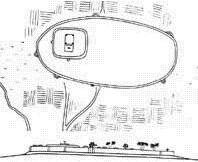
    These sites, possibly founded on old islands of the Nile (flowing within a narrower course than before), began to be fortified with massive surrounding walls; the wood palisades which must have protected the older villages from the beasts, were no longer sufficient for these centers of the Naqada II period; a clay model of fortification walls has been found at Abadiya [B. Williams,' Security and the problem of the city in the Naqada period' in P. Silverman ed. 'For his Ka' 1994 p. 271-83].
    Kemp efficaciously described this stage of conflicts and competition in terms of many 'Monopoly' games simultaneously played along the Nile: a combination of chances (local factors, enviroment, gold and other resources, luxury-goods trade, 'military' victories) and personal decisions resulted in the growth of fewer and fewer centers which became more and more important and wide by conquering the territory of the neighbouring city-states.

    The scenario at the end of Naqada II - beginning of Naqada III is infact that of few regional states, each one controlling a long sector of Nile valley for many kilometers [C. Kohler, G.M. 147, 1995 p. 79 ff; T.A.H. Wilkinson, M.D.A.I.K. 56. 2000 p. 376-94, fig. 1 p. 379.].    These emerging polities were ruled by authoritative chiefs who were continuously strenghtening their position through warfare, monopoly of long distance trade, control of important resources of their territory, and also elaborating a true ideology which is evident in the objects their craftsmen produced ('powerfacts'), the first signs of display and 'conspicuous consumption' [K. Bard, 'Toward an Interpretation of the Role of Ideology in the Evolution of complex Society in Egypt' J.A.A. 11 (1) 1992 p. 1-24; B. Trigger, 'Monumental Architecture, a thermodynamic explanation ...' W.A. 22.2, 1990 p. 119 ff.].    By this time, in Upper Egypt, only the 3 principal polities centered in Abydos, Naqada and Hierakonpolis continued to flourish; Abadiya and Gebelein had already lost their importance.    (MAP http://xoomer.virgilio.it:80/francescoraf/hesyra/egypt/Dyn0-map.jpg)

    The cemeteries of Naqada, probably the largest center in the Naqada II (Petrie's Gerzean) period, show a rather rapid decline in wealth, size and number of tombs during the following period Naqada III; it could be assumed that this site was being eclipsed by the emerging rulers of the Thinite region, buried in Abydos cemetery U [T.A.H. Wilkinson, M.D.A.I.K. 56. 2000 p. 377-95; id. State Formation in Egypt, 1996.
    But note that (as my friend John Degreef justly comments) the general mortuary evidence used as a basis to reconstruct 'events' could be deceiving: the abandonment of a burial ground might have completely different reasons than the political or economical decline of the center which the cemetery served.]; the Thinis/Abydos regional state, alike the southern one with capital in Hierakonpolis (Nekhen), lasted since the dawn of the dynastic period and probably struggled up to that time for the 'scepter of Egypt'; an alternative theory, stressing the importance of trade, would account for the decline of important centers of the past owing to the loss of their commercial importance; the Hierakonpolis leaders might have based their power on the intermediation in long distance trades between northern centers and the Lower and Upper Nubia; if the Thinite had begun to directly entertain commercial relations with the A-Group cultures of Seyala and Qustul [The cemeteries 137 at Seyala and L at Qustul have yielded some objects of Upper Egyptian culture inspiration; a row of animals on a gold mace-handle from 137.1 and the important incense burner from L24 (with barks processions leading a ruler with White Crown, Rosette and falcon topped anonymous serekh to a palace facade structure) are dated early Naqada III; the excavator B. Williams hypothesized a Nubian influence or origin of some of the early Egyptian state iconographic traits; but this assumption, as that of the earliest Unification of Nubia than Egypt, was made some years before the most important findings of the German archaeologists in the Abydos cemetery U. (cfr. larger descriptions in part II).] by-passing HK with the use of the Western Desert roads [For which there is recent evidence in Gebel Tjawty (and Wadi Qash) newly found serekhs and graffiti: cfr. Wilkinson, 'Early Dynastic Egypt' 1999; id. op.cit., 2000 p. 386.], the decline of centers like Nekhen (as perhaps Nwbt - Naqada before), would find a good explanation without recurring to military conflicts.    In turn the same A-Group rapidly rapidly disappeared with the beginning of the First Dynasty, when the Egyptian kings military expeditions made them capable to directly exploit the Nubian territories.

    Indeed it's ascertained that the Thinite kings were the founders of the Ist Dynasty; the commercial contacts that had spread the Upper Egyptian culture in the north since mid- Naqada II probably (but by no means certainly) drove the main U.E. city states to found new centers in the northern lands; C. Kohler [Kohler, op. cit. in n. 16.] has recently pointed out two important factors of this process: Von der Way's 'cultural unification' of Egypt did happen through peaceful interactions (trade contacts) between the Upper Egyptian Naqada Culture and the Lower Egyptian 'Maadi-Buto'; the predynastic Middle Egypt, from Badari to the Gerzah and Tarkhan areas, is now the least known region of Egypt: Kohler thinks there could have been another regional polity, the Badarian facies, in this area, which favoured the northwards expansion of the Naqada culture; certainly this latter had reached the Gerzeh - Tarkhan region (i.e. cemeteries of Gerzeh and, later, Abusir el Meleq and Tarkhan) in early Naqada II, and its superimposition in Buto Layer III, marking the beginning of its influence in the Delta, coincides with Naqada IId2-IIIa1.    In this period the local (Maadi-Buto) ceramic types are substituted by a production in the distinctive forms of the Naqadan jars, and a Naqada and Near Eastern influenced mudbrick architecture makes its first appearance here in the same period.

    Later the earliest attestations of royal serekhs at Tarkhan (Petrie's S.D. 77-80 = Naqada IIIB-C1) and Helwan (Abydos Horus Ka) seem to show that the Upper Egyptians were now moving themselves, not only their products and culture, to the North.
    The Memphite region was a fundamental strategic place: like the U.E. sites it was both very close to important resources and dominating the access to trade routes.    Maadi-Buto sites all through the Delta had enjoyed commercial relations with the Palestine and other Canaanite city-states at least since early Naqada; through those relations foreign pottery reached Abydos where it has been aboundantly found in the cemetery U.
    In the same way as with Nubia and A-Group cultures in the south, the Thinite rulers shifted their interests towards the northern rich commercial network with Palestine and Syria.
    We have said that Naqada culture spread into the Delta at the end of the phase II (d2); the following period signs a progressive uniformation of the whole Egypt into one and the same civilization; but the political uniformity and the events of the phase III, remain obscure: there is not a marked funerary evidence of diffuse warfare and similar tensions; neither the Delta sites show any kind of distructional layers.
    Maadi-Buto peoples were peaceful ones, living of their lands products and of trades; instead the southern 'Naqadians' are supposed to have been conquerors which had become few local entities after reciprocal annihilation and consequent enlargement of the strongest proto-states [But we have already pointed also for them the importance of factors like trade and control of resources. (F.R.)]; but if so, where are the proofs of their violent subjugation of the Lower Egyptian region?    We'll examine these and other arguments in the next part, dedicated to Naqada III and the so called Dynasty 0.


Part II - DYNASTY 0: THE KINGS
(NAQADA IIIb1,2 - early IIIc1)


    When W.M.F. Petrie readily published his excavations in the cemetery B of Abydos, [1] it soon became clear to him that that some of the piece of evidence he, and E. Amelineau few years before, had found on that site, did belong to a very ancient period, one immediately preceeding the First Dynasty Horus Aha and the legendary Menes (who was then thought to have been buried in the Naqada "Tomb of Menes" discovered in 1897 by J. de Morgan) [2].

[[1] Petrie, Royal tombs pt. I, 1900, id., Royal Tombs pt. II, 1901, id., Abydos pt. I, 1902; For general discussions of the period see J. Vandier, Manuel d' Archaeologie Egyptienne I, 1952; J. Hayes, The Sceptre of Egypt, 1953; B. Trigger in Trigger, Kemp, O' Connor, Lloyd eds., The Rise of Egyptian ..., 1-70, 1983; W. Helck, Untersuchungen zur Thinitenzeit,1987 (esp. p. 90-99); T.A.H. Wilkinson, State Formation in Egypt, 1996; id., Early Dynastic Egypt, 1999, esp. 47-59; id. M.D.A.I.K. 56, 2000; Jimenez Serrano, Los Reyes del Predinàstico Tardìo (Naqada III), in: BAEDE 10, 2000, 33-52; K. Cialowicz, La Dynastie 0, conquerants ou administrateurs ?, in Studies in Ancient Art and Civilization, n. 7, 1995 p. 7-23; id., La Naissance ... , 2001; S. Hendrickx, Arguments for an Upper Egyptian Origin of the Palace-Facade and the Serekh during Late Predynastic - Early Dynastic times, G.M. forthcoming 2001 (I must thank Stan Hendrickx for sending me this article).
    Petrie was undoubtly the first Egyptologist to think and work in a modern scientific way; he excavated sites from all the periods of Egyptian history, but his greatest contribute was that in the Perdynastic and Early Dynastic.    He always used to quickly publish his excavations (although he was often forced to make selections of his findings for limits of budget and costs); his researches had not as a main aim the 'hunt for Museum pieces' (he openly criticized Amelineau's "methods") but in his view a sherd could have the same value as a statue.    He was not only a forerunner in the fieldwork, but also in theoretical approach: despite the lack, at that time, of methods of absolute datation, Petrie had invented an ingenious system of relative chronology (Sequence Dating) based on seriations of archaeological contexts (tombs) through their founds (mostly gravegoods which he previously arranged in a relative order basing on the development of their shapes, decorations and other attributes).    This method allowed him to have a sufficiently precise idea of the datation (into 50 seq.dat. stages) of any tomb(-type) he excavated which produced a good number of pottery types or other classes of seriated objects. Petire's published excavations and corpora of predynastic pottery (nine classes and more than 700 types), protodynastic pottery and slate palettes continue to be of fundamental importance for the modern pre- and proto-dynastic studies.
    His subdivision of the predynastic into three 'cultures', Amratian [S.D. 30-37 (mod. shift. 30/31 - 37/39)], Gerzean [S.D. 38-60 (38/40 - 52/62)] and Semainean [S.D. 60-75/76 (54/62 - 76/79)], was later refined and correlated with the Early Dynastic period, forming the basis of the successive chronologies (Kaiser's 'stufen'; cfr. W. Needler, Predynastic and Archaic Objects..., 1984, 44: NAQADA I = S.D. 30-38; NAQADA IIa,b = S.D. 38- 40/45; NAQADA IIc,d = S.D. 40/45 - 63; NAQADA III = S.D. 63-80; for further adjustments see Kaiser, M.D.A.I.K. 46, 1990 and especially S. Hendrickx, in A.J. Spencer ed., Aspects of Early Egypt, 1996 p. 36-69).

[[2] Petrie equated Aha with 'Menes' which, in later traditions, is the name given to the foundator of Memphis and of the 'First Dynasty'.    Petrie was one of the first scholars, with J. Garstang, to challenge the ownership of the Naqada mastaba to Menes.    For a recent re-analysis of this tomb and its founds cfr. Kahl et al., M.D.A.I.K. 57, 2001 (in print) and id., Vergraben, verbrannt, verkannt und vergessen.    Funde aus dem "Menesgrab", Munster 2001 (my most sincere thanks to J. Kahl for presenting me this publication).]
    The term 'Dynasty 0', used by James E. Quibell to describe late predynastic materials he found at Hierakonpolis, was adopted by W.M. Flinders Petrie for rulers such as Ka-Ip, Ro, Zeser, Nar-Mer and Sma [Zeser and Sma revealed not to be royal names at all; 'Ip' is not part of Ka's name but an indication of U.Eg. product.
    I have been unable to ascertain the absolute first use of the name "Dynasty 0"; Petrie uses it in Diospolis Parva, 1901, 24, (and in his divulgative 'History of Egypt' 7th ed., 1912, but I think already in its 5th edition, 1902 and I don't know if in the older editions too).    In Hierakonpolis part I, 1900, J. E. Quibell describes some predynastic objects as 'Dynasty 0', thus it must be Quibell or Petrie to first adopt this term around 1899.    (I am indebted to J. Kahl and E.C.M.van den Brink for their suggestions on this and other matters; but obviously eventual mistakes are only mine).]; only more recently it has gained a general acceptance with its use by W. Kaiser [M.D.A.I.K. 41, 1985, p. 71.].

Abydos B Cemetary, linked to .../new/AbydosBcem.htm

    The Dynasty 0 rulers of Thinis/Abydos were buried in the cemetery B; its latest royal tomb was that of Aha (if we exclude Dreyer's attempt to attribute B40 to Athotis I); Djer started the cemetery commonly known as Umm el Qa'ab which became the burial place of all the other kings of the First Dynasty, queen Merneith, and the hundreds of retainers slain at their burial; after a period of disuse, kings Peribsen and Khasekhemwy of the late Second Dynasty also built their tombs on this sacred ground.
    Cemetery B, the 'predecessor' of the Umm el Qaab, was in turn the continuation of an older necropolis, some steps to the north, i.e. the currently excavated cemetery U.
    What had emerged after the work of the archaeologists was not the only clue suggesting the existence of a "Dynasty 0": Royal Annals, Turin Canon and later Greek-Latin sources [As Herodotus, Manetho, Diodorus Siculus, Plinius the Elder; for the Shemsu Hor, the names on Annals line 1, and Annals reconstructions cfr. pt. I passim and notes 5-7; also cfr. Kaiser, Z.A.S. 84, 1959 p. 119-32; id., Z.A.S. 91, 1964 p. 86ff; W. Helck, Untersuchungen zu Manetho..., 1956; id., Untersuchungen zur Thinitenzeit, 1987.], proved as well that many kings had reigned in Upper and Lower Egypt before the so called 'First Dynasty'.

    It must be soon made a precisation: the terms 'Dynasty 0' and 'Dynasty 00' ['Dynasty 00' has been introduced by E. van den Brink, The Nile Delta in Transition, 1992, but it hasn't been as widely used as 'Dynasty 0'.    He states that Dynasty 00, 0 and 1 respectively coincide with the periods Naqada IIIa, b and c.], were both cloned to account for newly found royal names and objects of older and older periods: those just mentioned found by Petrie and the more recent ones discovered by the German archaeologists directed by Gunter Dreyer (cfr. below); but the word 'dynasty' is here somewhat improperly used, because it is often no longer applied to indicate a same line of rulers of a certain site and of equal origin (like for the Manetho's dynasties).    Dynasty 0 infact, not only includes the Abydos kings of the B cemetery who preceeded Aha, but also chiefs from entirely different ruling elites of other sites like Tarkhan or Hierakonpolis; they have in common only the same chronological collocation in Kaiser's stufe Naqada IIIb1-2.    Similarily the tomb U-j king Scorpion I and his contemporaries of Naqada IIIa1-2 period, are to be considered Dynasty 00 kings within the same 'chronological acceptation' of the term [cfr. prev. n.; also note that T. Wilkinson, Early Dynastic Egypt, 1999 p. 52 tends to include in the Dynasty 00 meaning, also the anonymous "owners of the Abydos vessel [U-502, U-239], the tombs in Naqada cemetery T, the Hierakonpolis painted tomb (100) and the Gebelein painted cloth", therefore all evidence of high status, likely local chiefs, which do belong to the previous period, Naqada II and, above all, to different regions-stocks.    See Wilkinson op. cit. 53, 61 for the term 'Dynasty 0'.
    As noticed above (n. 3) J.E. Quibell, in Hierakonpolis I, 1900, already applied the definition "Dyn. 0" to his book plates with late predynastic materials, thus in a clear chronological not 'genealogical' sense.].

    In this survey on Dynasty 0 I'll proceed in an inverse chronological order (but note that no fixed succession has been followed except for Iry Hor-Ka-Narmer; many of the following kings must have had contemporary reigns).
    The predecessor of Hor Aha was ceratinly the famous NARMER http://xoomer.virgilio.it:80/francescoraf/hesyra/narmer.html.    Since his discovery, a century ago, almost simultaneously at Hiraconpolis by Quibell and Green and at Abydos by Petrie, many more attestations of his name (especially by pottery incised serekhs) have been found in Upper and Lower Egypt, Western and Eastern Deserts and outside Egypt in Palestine.
    Narmer is one of the few single individuals of the Egyptian history before the Fourth Dynasty on whom whole books might be written; the role of this sovereign, who can be both considered the last one of Predynastic and the first one of the Dynastic age, must have been a crucial one in the development of the early state.
    Some uncertainties in his collocation in late Naqada IIIb2 or Naqada IIIc1, possibly also reflect either a long reign with important cultural transformations in act, or the fact that this figure fits equally well at the end of a period as at the beginning of a new one.
    The long debated question of the identity of Menes is an argument which can hardly escape any discussion on such a subject: but it has been until recently treated by many scholars [W.S. Smith, Two Archaic Egyptian Sculptures, B.M.F.A. 65, 1967, 70-84; D. Wildung, Die Rolle Agyptischer Konige ..., 1969, 4ff; S. Morentz, Z.A.S. 99, 1972 pref.; Helck, op. cit. 1987 passim; id., Lexicon Ag.; J.P. Allen, G.M. 126, 1992 p. 19ff; M. Baud, Archéo-Nil 9, 1999, 109ff; ; P. O' Mara, D.E. 46, 2000 p. 49ff; id., G.M. 182, 2001 p. 97ff.    For a good general summary of the discussion cfr. J. Kinnaer, Narmer or Aha.    Who was Menes?    KMT forthcoming issue, 2001 (I disagree with this author on few minor points only).], thus I won't rehearse discussions already known and available elsewhere, because my aim here is to focus on the fresh new data and objectives, rather than to face over-speculated problems.

Aha Label from Nagada Mastaba
 (Abydos B15 fragment)
 linked to ../labels/xxaha1.htm

    Suffice here to underline three points:
1) none of the 'proofs' for the identity of Menes with Narmer or Aha has revealed to be decisive out of any doubt: the so called 'tomb of Menes' a giant niched mastaba at Naqada probably built for the king's mother Neithhotep, produced an ivory label http://xoomer.virgilio.it:80/francescoraf/hesyra/labels/xxaha1.htm on which the 'Men' sign was below the shrine of the double goddesses, represented beside the serekh of Aha.    The scholars advanced scores of theories on the meaning of this shrine [W. Spiegelberg, O.L.Z. 4, 1900; V. Vikentiev, A.S.A.E. 33, 1933 (double throne); B. Grdseloff, A.S.A.E. 44, 1944 p. 279ff; S. Schott, Hieroglyphen 1950.], on the reading of the sign [The new fragment of this label found in Aha's tomb central chamber (B15) at Abydos (M.D.A.I.K. 38, 1982 pl. 57c) leaves out any doubt that the sign is really the men checkboard hieroglyph (Gardiner sign Y5).], and on the interpretation of the name Men (Menes) as that of Aha or Aha's dead father (Narmer) [Cfr. arguments for Menes in W.B. Emery, Archaic Egypt, 1961, 33-7; J.P. Lauer, Histoire Monumentale ... 1962, 19ff; I.E.S. Edwards, The Early Dynastic Period in Egypt, C.A.H. IIIed. I.1, 1-70, 1971.].
    By the same way Helck's interpretation of the "Prinzenseal" of Narmer with rows of his serekh beside the men checkboard [Helck, ZDMG 103 (=28 n.s.), 1953 and id. et al, in L.A.], has had, with the diffusion of this opinion in some articles of the Lexicon der Aegyptologie, a certain weight in the equation Aha - Menes.    Another important factor is that Menes was later said to have been the foundator of Memphis; Narmer is indeed scarcely attested at Saqqara and Helwan [Saqqara: serekh on stone vessel found in the Step Pyramid gallery 7 (B) (Cairo Mus. J.d.E. 88406), Lacau -Lauer Pyr. Deg. IV.1, p. 9 pl. 1.1; ibid. IV.2 p. 1-2; Abydos: Petrie, R.T. I pl. 4.2; id. R.T. II pl. 2.3,6; Helwan: serekh on a fayence tag in the debris near tombs 1H3 and 40H3.], while Aha appears as the first ruler to have had a giant mastaba (S 3357) in North Saqqara (probably built for his highest official of the Memphite administration) with impressive funerary offerings [W.B. Emery, Hor aha, 1939; circa 800 cylinder vessels with ink inscriptions of Aha were found, but also stone vessels, labels, long pottery horns of rhinoceros.
    Isolated serekhs of Aha from other memphite cemeteries have been found on cylinder jars at Helwan, Zawiyet el Aryan (Z1), Abu Rawash (402).].
2) I have mentioned [cfr. part I] the modern interpretations of the Narmer palette http://xoomer.virgilio.it:80/francescoraf/hesyra/palettes/narmerp.htm and the fact that the Unification it was once thought to depict, seems to have happened well before Narmer's reign and lasted for more than a reign or a generation [I want to shortly express here my view on the matter of the period of political Unification; it has been argued since Kaiser's foundamental researches that this must have happened some generations before Narmer; indeed, although we have seen that a cultural uniformity was achieved as early as Naqada IId2-IIIa on the whole Egypt, it is equally true that up to the very end of the predynastic period few local and indipendent royal lines did exist at Tarkhan, Tura, Hierakonpolis and probably elsewhere; the relationship of these ones with the Thinite rulers whose successors form the Ist Dynasty is obscure.    But the mere attestation of mysterious and yet undefined figures like Scorpion II and Crocodile (also cfr. text below) may indicate that only with Narmer's reign the last local polities had been finally and definitively abolished (in a peaceful or violent way).
    Important clues in this question are the already discussed Narmer's label year-event, mentioning the same defeat as the palette' s, the abrupt disappearance of the 'dualistic motives' (like the two monsters on the palette's recto) just with the end of his reign, and, finally, the apparent contemporaneity of his reign with that of his rival (?) of Hierakonpolis, Scorpion II (indipendently of how did Narmer ruled him out). Therefore, even if I agree that the process of political superimposition or subjugation of the southerners over the north did last for generations and did begin before Narmer, it seems to me very likely that this latter king might have had still an outstanding part in this play.].
3) Despite frequent examples of misinterpretations of early dynastic writings (espec. kings' names) by later scribes, it is not easy to think that Menes (Meni in New Kingdom lists) ought to be considered an entirely mythical figure [A mythical Sesostris, mixing the characters of more than one XIIth dynasty kings, is known from the Greek sources; the name Menes could be interpreted as well as conflation of two or more archaic kings.]; leaving aside the latest (and more corrupted) sources we must admit that the Ramses II period occurrance of Meni in the funerary king lists (Abydos) and Royal Canon of Turin [D.B. Redford, King-lists, Annals and Day-Books ..., 1986; for the Shemsw-Hor cfr Kaiser, Z.A.S. 84, 119 ff; id., Z.A.S. 85, 118 ff; Helck, ArOr, 18, 120ff; von Beckerath M.D.A.I.K. 14, 1ff.] can't be overlooked, also given the general correspondence of the other names with Nebty names attested on Ist Dynasty objects.    But this name strangely appears only with the 18th and 19th dynasty!    Furthermore on the Turin papyrus it directly follows the Shemsw Hor (which in turn come after the dynasties of gods) and is written twice: on the first of the two lines with a human determinative, and on the second one with the god determinative.    I continue to prospect the alternative hypothesis that, whatever the meaning of the 'men' on the Princes-seals of Narmer and on the Naqada and Abydos Aha label, New Kingdom scribes or priests might have mistaken archaic documents which they surely knew or they could have created a mythical figure of the initiator of the Egyptian human kingship for religious and propaganda purposes, for the need to estabilish a precise point of departure of their successful kingship, state, tradition, culture [H. Fischer pointed out two more possible men-like occurrances (Artibus Asiae 21, 1958): the palace facade device on the serekhs on a stela fragment (UC14278) found by Petrie at Abydos (nearby Narmer and Aha tombs) and that on the Metropolitan Museum palette (anonymous serekh) are very apt to be confused with the sign men (also some graphies of the sign djer can and have been mistaken with the serekhs palace facade).
    Schott, po.cit., 1950, proposed to read "Ma-nu" the Lion + nw-vessel name in a fortress of the Bull palette, Louvre E 11255.].

    In 1986 the German expedition re-excavating Umm el Qa'ab and the cemeteries B and U at Abydos, found an important seal impression http://xoomer.virgilio.it:80/francescoraf/hesyra/merneithlist.jpg with the Horus names of Narmer, Aha, Djer, Djet, Den and the king's mother Merneith; some years later a new example, again with the kings' names and the necropolis god Khentyamentiw was found containing all the names up to Qa'a http://xoomer.virgilio.it:80/francescoraf/hesyra/qaalist.jpg, the last Thinite king of the Ist Dynasty (but now Merneith's was excluded).
    On both the clay impressions the oldest king in the list was Narmer: a clear statement of the light in which he was in the middle and late First Dynasty!    If a Menes did exist, in his quality of initiator of an epoch, he would have never been preceeded by another individual's name: thus Aha can't be considered Menes and, even if Aha's reign monuments at Saqqara, Abydos, Naqada are much more impressive than Narmer's ones, we can plainly believe that this depends on the fact that Aha enjoyed the wealthy state which his father (?) handed him down.    As I've stated above, Narmer is much more attested in the whole country and abroad and his reign is marked by an evident evolution in various aspects of the culture of this growing civilization which appears to owe more to him than to Aha [See T. Wilkinson op. cit, 1999 p. 68 for the Menes-Narmer debate and p. 71 for the change in the commercial relation with Near East during Aha's reign.].

Hierokonopolis cylinder
 (Quibell, Hierokonopolis I, 1900 pl. 15.7)
 Ashmolean Mus., E3915

    Many more objects bearing the name of Narmer are known: in the Hierakonpolis temple 'Main Deposit', together with the Great Palette http://xoomer.virgilio.it:80/francescoraf/hesyra/palettes/narmerp.htm and further older objects, it was also found a small decorated ivory cylinder with the Nar-fish of his name handing a reed towards three rows of Libyan prisoners; another well known and widely discussed and described object is Narmer's Macehead http://xoomer.virgilio.it:80/francescoraf/hesyra/narmrmhd.jpg; very important is also the 1998 finding at Abydos, a label http://xoomer.virgilio.it:80/francescoraf/hesyra/labels/xxnarmer1.htm with the year-event depicting the same military victory as on the palette and the cited ivory); the recent book of T.A.H. Wilkinson has a good summary of the sources for this king [op.cit.1999, p. 68,69,70 (Zawiyet el Aryan, Tura, Helwan, Naqada); for a complete list of all the inscriptions of Narmer known up to 1993 cfr. J. Kahl, Das System der Agyptischen Hieroglyphenschrift der Dynastie 0. - 3., quellen 79-131; my website http://members.xoom.it/francescoraf/ has an updated list in the Dynasty 0 page.]; however it doesn't include some pieces which have often been related (indeed without any sure ground to do it) to Narmer, as the unprovenanced king's head in University College http://xoomer.virgilio.it:80/francescoraf/hesyra/new/narmerhead.gif (he proposes a Second Dynasty date for it), or the ivory statuette http://xoomer.virgilio.it:80/francescoraf/hesyra/abydsttt.jpg from Abydos in the British Museum, or, possibly, the limestone stela fragment http://xoomer.virgilio.it:80/francescoraf/hesyra/new/uc14278.jpg from Abydos (U.C. 14278; it might have belonged to Horus Aha); furthermore Narmer's serekh is on the base of a statue of Baboon, the god Hedj-Wr, in Berlin [Berlin Mus. 22607, h. cm. 52; cfr. also E. Schott, R.d.E. 21, 1969 p. 77ff.; and M.D.A.I.K. 50, 1994, 224ff.
    The limestone stela fragment with serekh device (niches and a 'men-like' top) is in Petrie, Abydos I, 1902 pl. 13; Fischer, Artibus Asiae 21, 1958 fig. 24; id., J.A.R.C.E. 2, 1963 pl. VIb.
    Other mostly unprovenanced inscriptions on jars and stone vessels are found in Kaplony I.A.F.S. fig. 1061-2; id. K.B.I.A.F. 1138; id. Steingefasse 5; id. Klein Beitrage... pl. 6,7,18,19 (= id. M.D.A.I.K. 20, n. 1-3).
    An alabaster plate fragment M.D.A.I.K. 46, 1993 p. 38 fig.5; an ink inscription on cylinder vessel M.D.A.I.K. 54, 140, fig.30; a (type 74b!) jar incised serekh Dreyer interprets as a eastern Delta estate of Narmer in M.D.A.I.K. 55, 1999, 1ff.], and (almost completely erased) on the thigh of one of the three Coptos Colossi http://xoomer.virgilio.it:80/francescoraf/hesyra/new/Coptos-colossi.jpg, the one in Cairo Museum (incisions http://xoomer.virgilio.it:80/francescoraf/hesyra/new/Coptoscolossi.jpg) [B. Williams, J.A.R.C.E. 25, 1988 p. 35-59; in fig. 1, p.26 there are also three further incisions: a Nar fish, a serekh and an harpoon.    (Also cfr. G. Dreyer, S.D.A.I.K. 28, 1995 and id. Umm el Qaab I, 1998; B. Kemp, C.A.J. 10, 2000, 211-242).].    A stone vessel http://xoomer.virgilio.it:80/francescoraf/hesyra/narmersvi.jpg from Djoser's complex at Saqqara has his serekh incised, some vessels from Abydos http://xoomer.virgilio.it:80/francescoraf/hesyra/narmersvi.jpg bear his serekh in relief and a couple of cylinder jars from Tarkhan http://xoomer.virgilio.it:80/francescoraf/hesyra/narmersvi.jpg (?) are inscribed in ink with Narmer's Horus name.    It is not sure if Nar(mer) rather than Scorpion or [Ra]Neb is the inscription in the lower half of a serekh incised on the left part of the thorax of a statuette (h 11,2cm) in München St. Samm http://xoomer.virgilio.it:80/francescoraf/hesyra/new/Munchenstt.jpg.    ÄK(7149) (cf. the earlier Oxford -"MacGregor" man [1922.70] and the Third Dynasty Brooklyn Museum [58192] Onuris statuette).

Narmer year-label,
linked to ../labels/xxnarmer1.htm

Ivory statuette of a King from Abydos

    As I have said above, Narmer is attested in the Desert (graffiti around Hierakonpolis, Wadi Qash, Gebel Tjawty, Coptos). [NOTA: removed passage on Western Desert graffiti].
    Yet most of the occurrances of Narmer's name is on jars and jar fragments; an astonishing number of serekhs has emerged in the last 25 years from excavations in Israel and Palestine (Tel Erani, Arad, 'En Besor, Halif Terrace/Nahal Tillah http://xoomer.virgilio.it:80/francescoraf/hesyra/narmer%20srkh.jpg and more) signifying an apex of commercial contacts between Egypt and Canaan (in comparison, such proofs are less frequent for the preceeding and following periods).

Berlin Staat. Mus. 22607
 (unprovenanced, bought in 1927; h 52 cm)

    Some more serekhs have been excavated at Minshat Abu Omar (44.3), Tell Ibrahim Awad and Tell Fara'in-Buto in the Delta and at Kafr Hassan Dawood (913) in a c. 1000 tombs cemetery on the southern limit of the Wadi Tumilat.
    Dreyer interprets a mark on a jar in a private collection (cfr. n. 22) as an estate of Narmer in the Eastern Delta.
    There is a slight possibility that a Naqada IIIb1 ruler with the name Nar did exist: a couple of serekhs of this one appear on too early jars types (cfr. n. 22 and n. 50); but all the other forms 'Nar' do belong to Narmer.

    In fact his name often recurs in this abbreviated form with only the Nar sign; it is unlikely that, as it was hypothesized, the use of the writing 'Nar' was (always) from the latter part of his reign [In the important tomb Tarkhan 414 a third form, Narmer-Tjay, appeared on one of the seal impressions of Narmer found in it: cfr. Petrie et al. Tarkhan I, 1913 pl. 2,2 (also cfr below and n. 36); V. Vikentiev (J.E.A. 17, 1931, 67-79) proposed to read his name 'Nar Ba Tjay', whereas Godron advanced the reading 'MeryNar' (A.S.A.E. 49, 1949, 217-20, pl. 1 with 24 examples, + note compl.).    The Nar sign in the abbreviated form varies from a simple horizontal stroke to a wider sign (where the fish head and tail are easily distinguishable) as the R.O.M. example G.M. 180, 2001, 67ff.    Another very doubtful attestation of Narmer is a ink inscription on a jar from Tarkhan tomb 415 (Petrie et al. op.cit. 1913, pl. 31.69) cfr. below.].
    Narmer was buried in the sacred necropolis (B) of Abydos, tomb B17/18 http://xoomer.virgilio.it:80/francescoraf/hesyra/new/B17-18.jpg (two united rectangular mudbrick-lined chambers; tot. length c. 10m x 3,00-3,10 large and 2,50-2,80 deep); it is few meters north of the westernmost chamber (B10) of his follower Aha (Kaiser-Dreyer, M.D.A.I.K. 38, 1982, 220-221).

    Some meters to the north of Narmer's, a true double chamber tomb B9/7 http://xoomer.virgilio.it:80/francescoraf/hesyra/new/B7-9.jpg (these two are circa 1,80 meters distant; B9 is c. 5,9 x 3,1m; B7 is c. 6 x 3,2 m; both are c. 1,9m deep), produced inscriptional material of his predecessor: his name, KA, also appears in at least two different writing forms: with the standard 'ka' sign and with the same sign but upset; because this latter can also have a different reading, i.e. the verb 'to embrace', P. Kaplony proposed (1958) to read the name Sekhen.    More than 40 inscriptions have been found in Ka's burial chamber (B7, the southern of the two) of the Abydos tomb: one is a seal impression, all the remaining ones are inscribed on tall jars or cylinder vessels (incised or written in black ink).

Abydos B7/9 (Ka)

Ka, U.C. 16072 from Tarkhan tomb 261   The two jars from Helwan

    Apart from this site, the only further attestation of Ka in Upper Egypt is a carbon inscription on a jar fragment recently found at Adaima (N. Grimal in B.I.F.A.O. 99, 1999 p. 451 fig.1; more inscriptions in van den Brink, Archéo-Nil 11, 2001 in print).

Helwan tomb 160 H3 seal

    Other traces of Ka have been found in northern sites: in the cemetery A of Tarkhan an ink inscribed cylinder vessel from tomb 261, and in Helwan tombs 1627 H2 and 1651 H2 two tall jars with incised inscriptions; a couple of inscribed vessels fragments are unprovenanced.
    A new serekh has been found on pottery by F. Hassan in tomb 1008 at Kafr Hassan Dawood, at the southern boundary of the Wadi Tumilat (Hassan in E.A. 16, 2000, 37-9), and another one is known from a pottery fragment from Tell Ibrahim Awad (van den Brink, The Nile Delta... p. 52 fig. 8.2).
    Finally there is a cylinder seal from Helwan 160.H3 with an anonymous serekh and a human figure beside it; this has his arms raised and the right hand appears to be partly placed in the serekh, just nearby to where the name would be written; A.J. Serrano has thus proposed that this figure could designate the king and his royal name -Horus Ka- contemporarily [The seal was found by Z. Saad; recently reconsidered by C. Kohler (G.M. 168, 1999 p. 49ff) and by A. Jimenez Serrano (G.M. 180, 2001 p. 81ff).    For the tomb of Ka and more findings from within and nearby it cfr. M.D.A.I.K. 38, 1982 p. 221ff, 229-30; fig. 14 and 15; Petrie, Abydos I pl. 1, 2, 3; id., R.T. I pl. 13.89 (seal impr.) and 13.90; Gilroy, G.M. 180, 2001 fig. 2, pl. Ib (Royal Ontario Museum unpublished fragmentary serekh).    About the Helwan jars: note that Z. Saad (S.A.S.A.E. 3, 1947 p.111) states that the provenance of these jars is inverted than that shown in the number written on his plate 60 (where 1627H2 is written below the right hand jar with inverted ka; I think I can also read 1651H2 at the right end of the label placed below the left hand jar); I have followed the plate 60 indication as did Kaiser 1964 and contrarily to Kaiser 1982 and van den Brink 1996.].
    The serekh is probably anonymous and of slightly earlier date than Ka's reign, as Dr. C. Koehler believes.

    The stratigraphic analysis at cemetery B seems to confirm that Ka immediately preceeded Narmer; indeed there are some inconsistenies: an important tall jar type which has been used before and after Ka's reign, has never been found during his own.
    A recent useful innovation in the study of this period has been achieved by E.C.M. van den Brink [In A.J. Spencer ed. 'Aspects of Early Egypt', 1996 p. 140-158; E. van den Brink has kindly informed me that the second part of his study (Incised Serekhs on pottery fragments) is going to be published in Archéo-Nil 11, 2001.]: he has produced a catalog of 24 complete jars with incised serekhs of Naqada IIIb-c1.    The interest of this work is in that, contrarily to two older corpora provided by W. Kaiser in 1964 and 1982, van den Brink's has been prepared giving much more than a superficial consideration to the pottery types on which the serekhs are incised.    The analysis of the pottery types has resulted in a distribution of the serekhs within four main phases corresponding to the development of the jars types; this comparative study has succeeded in fixing a more certain chronological frame for some royal names of Naqada IIIb; although few minor problems do arise [For example the serekh with the Nar fish from Tarkhan 1100 has too early a position to be Narmer's as the epigraphy would suggest; the serekh 22, of king Iry Hor (B1), is later than those of Ka and than some of Narmer too; of course these strange behaviours can't depend on van den Brink's method of tracing and subdividing the pottery types development: instead it's possible that there are external factors to be reconsidered, as the duration of some pottery types which might have to be stretched out.] this system has offered a valuable means of relative datation of these names and it has even avoided the weak points inherent to Kaiser's subdivision into three 'Horizonten'.

King Scorpion

    Before continuing to ascend the Abydene line of Dynasty 0 we must consider two rulers who have left no trace of themselves at Abydos; King SCORPION (II) http://xoomer.virgilio.it:80/francescoraf/hesyra/KingScorpion2.htm and Horus Crocodile.    Both are known by very few inscribed objects.
    The particularity of these rulers is that the epigraphy, provenance and typology of their sources speaks for a datation surely not post-Narmer and very likely neither pre- Ka.    They might be thought to represent 'Gegenkonigen' (as Dreyer defines Crocodile) thus rebels or usurpers; more likely they were the last expressions of ancient local independent ruling lineages which ceased to reign only when the powerful kings of the Thinite region moved northward to occupy the territiries with which, until then, they had only entertained peaceful commercial relations; but in this respect the position of Scorpion II at Hierakonpolis is harder to explain and Dreyer thinks this was a Thinite king too.    The different writing of his name and the Nekhen finds can't be a certain indication of the Hierakonpolite origin of Scorpion II: Iry Hor had a different royal name mark too, and Narmer was also known at Nekhen.
    The giant macehead of Scorpion http://xoomer.virgilio.it:80/francescoraf/hesyra/new/Scorpion.gif from Hierakonpolis (it's bigger than Narmer's) is another important masterpiece of the period; for this reason (as well as for its being virtually the only object surely attributable to this king, for the debates on the ritual it depicts and for some further motives) this macehead is of public domain in the field of divulgative Egyptology; there is no need to add a detailed description; I only remark that the name of this king is not written in the serekh and is not surmounted by Horus; the expression for 'sovereign' is rendered by the 'Rosette' [E. Baumgartel proposed that there was no need to distinct this king from Narmer; in the same way Horus Ka had been already interpreted to be possibly an indication that B9/7 was the tomb of Narmer's ka (but this is impossible for the finding of a seal impression in B7 and other reasons).    Cfr. H.S. Smith in Adams - Friedman eds.    'The Followers of Horus', 1992, 244ff for the semantic value of the Rosette; but also T. Schneider in S.AK. 24, 1997 p. 241ff.    For other Rosettes cfr. below (Qustul incense burner and MMA knife handle) but note that some more appear on Gebel Tarif http://xoomer.virgilio.it:80/francescoraf/hesyra/new/GebelTarif.jpg, Carnarvon http://xoomer.virgilio.it:80/francescoraf/hesyra/new/carnarvon.gif, Univ. College http://xoomer.virgilio.it:80/francescoraf/hesyra/new/PetrieUC16294.jpg and Brooklyn Museum knife handles, Metropolitan Mus. comb).]; Cialowicz thinks that at the right end of the rows of Rekhyt-bows standards and dancers in the upper registers, there would be the standing king Scorpion represented (in higher scale) with the red crown of Lower Egypt (cfr. Adams - Cialowicz, Protodynastic Egypt, 1997 fig.1 http://xoomer.virgilio.it:80/francescoraf/hesyra/new/Scorpion.gif).
    Another macehead http://xoomer.virgilio.it:80/francescoraf/hesyra/new/HKmacehead2.jpg from the same cachette at Hierakonpolis, far more fragmentary than the already fragmentary previous one, shows a king sitting under a canopy; he wears the red crown and the Heb Sed robe; Arkell interpreted a slightly visible sign before the head as a Scorpion [In Antiquity 37, 1963; see also B. Adams, Ancient Hierakonpolis, 1974, p.3, pl. 1, 2; K.Cialowicz, Le Tetes de Massues..., 1987 p. 41-3 fig. 5.    The Macehead is in     Universoty College, London inv. 14898.    For another macehead in UC (inv. 14898 A) the 'Bearers Macehead' cfr. Quibell 'Hierakonpolis' I (1900) pl. XXVIA and Cialowicz op. cit.]; Adams has found no trace of the rosette in a break in front of the red crown curl; therefore the object could belong to another king of the period immediately before Narmer (or Narmer's own): I would suggest that the fragmentary glyph might be interpreted as a standard with a crocodile whose tail hangs down (Horus Crocodile ?).
    Cialowicz has given a convincing interpretation of the scene as the Sed celebration after a military victory of Scorpion (or Narmer); to the right of the sitting king, in the centre of the scene, there is a big falcon (turned towards the king) holding in the claws a rope which directs to the right-end of the preserved fragment; here, behind and in a lower position than the falcon, there must be a number of prisoners (one ear is clearly visible) which the rope kept during their presentation to the king by Horus.
    The last reluctantly accepted piece of evidence for king Scorpion II is a graffito in Upper Nubia, Gebel Sheikh Suleiman [Published by W. Needler in J.A.R.C.E. 6, 1967, p. 87-91 pl. 1 and 2.].
    It is not far from the notorious graffito now in Khartoum Museum: it represents a scorpion with a prisoner into its claws; two more human figures with a bow and false tails, are directed towards the captive and the scorpion.    This scene could, in my opinion, be far earlier than the presumed time of Scorpion II: it's surely related to a chief, but I would prefer a date in Naqada IIIa (Scorpion I?) or even late Naqada II.
    The date is far more certain for an alabaster vessel from Quibell and Green's Hierakonpolis excavations: but the scorpions and bows which surround its body can't be attached with full confidence to king Scorpion; a larger group of objects which would be assigned to this king's reign has been proposed by Kaplony [i.e. the incision on the Abu Umuri palette and others: Orientalia 34, 1965, p. 132ff, pl. 19-23; id., I.A.F. I, II passim]: but it can't be assumed that almost any known late predynastic representation of scorpions ought to refer to the king in object.
    The tomb of Scorpion II has never been found; Dreyer and Hoffman have speculatively proposed respectively the 4- chambers Abydos B50 and the Hierakonpolis loc. 6 tomb 1 [Dreyer in M.D.A.I.K. 43, 1987; id., M.D.A.I.K. 46, 1990 p. 71; Hoffman, The Sciences, Jan/Feb 1988, 40-7.].    Therefore the slight traces of Scorpion II hinder any safe reconstruction about the place of origin of this obscure sovereign and his role in the late predynastic history.

jar incised serekh from tomb 160

    A royal name within a falcon topped serekh incised on a jar from tomb 160.1 at Minshat Abu Omar has been alternatively read as Aha and Scorpion.    The sign does look like a scorpion, curved with both the tail (which is drawn above the body) and the head looking rightward, whereas the falcon looks towards the left.

ink serekh on jar Tarkhan t. 315

    Van den Brink has proposed that this sign might be an upset variant of the coil identified by Dreyer on two vessels and a seal impression from Tarkhan (cfr. below) [Wildung, Aegypten vor den Pyramiden, 1981 fig. 32; van den Brink op. cit. pl. 28 a,b: Horus (Crocodile -Sbk or Hmz-) the Subduer (cfr. id. op. cit. 1996 and 2001 in preparation); only B. Adams has attempted the equation of this serekh with Horus Crocodile; for Dreyer cfr. n. 35. A. Jimenez-Serrano (BAEDE 10, 2000) points to Scorpion II.    In my opinion this serekh must be compared with those of Horus Ka, especially the falcon of the serekh incised on the jar from Helwan tomb 1627 H2 (also associated with the mace sign) and the inverted ka sign of that from Helwan t. 1651 H2; alternatively the MAO serekh could name Hor Aha or even quite a different unattested sovereign.    See this table http://xoomer.virgilio.it:80/francescoraf/hesyra/Dyn0serekhs-fig.htm n. 29, 30a, 30b.].
    The two ink-inscribed cylinder vessels http://xoomer.virgilio.it:80/francescoraf/hesyra/new/Crocodile.jpg were found by Petrie [T. 1549: Petrie, Tarkhan II, 1914, 11 and pl. 9.3; t. 315: Petrie et al. 1913, 9, 29, pl. 31.66 (wrongly reproduced as Ka) and pl. 60 (no mention of the vessel here); cfr. Kaplony I.A.F. III pl. 1, 2; id. I.A.F. II, 1090.] in tombs 1549 and 315.

Crocodile Seal impression from Tarkhan t. 414

    Kaiser and Kaplony read their serekhs name as Scorpion (with the tail now curved below the animal); but this is impossible because the scorpion would have on both the examples an opposite orientation than the falcon above the serekh; Dreyer [G. Dreyer in Adams - Friedman eds. op. cit. 1992, p. 259ff.; also cfr. n. 39.] has introduced, to account for these two serekhs (but not the M.A.O. one), a king CROCODILE, ruler of the Tarkhan region; he also advanced that to this king might belong the apparently anonymous serekh (? cf. n. 36) (surmounted by a bull's head and surrounded by crocodiles) on a seal impression http://xoomer.virgilio.it:80/francescoraf/hesyra/new/crocodileseal.jpg also found by Petrie at Tarkhan (tomb 414, Narmer's reign)[cfr. n. 24; Tarkhan 414 (S.D. 78) contained some seal impressions of Narmer and a wine jar (type 76b) of his too; for Dreyer cfr. notes 35, 39.    My friend Andreasson Leif notes that the crocodile on standard, with a feather on the head, is the later emblem of U.E. nome VI (Dendera); as I state above there was, before Naqada II, a strong polity between the Thinite and Ombite regions (Hu, Abadiya, Dendera).    I would also add that the bull-head on the serekh of the seal recalls the Hathor cow heads on Narmer palette.    John D. Degreef kindly points out to me that the central element of the seal is not a serekh at all, but it must be the representation of the temple of Sobek at Crocodilopolis, an opinion which I fully agree with.].
    Contrarily to Kaiser and Kaplony, Dreyer (thanks to new infrared photos) doesn't see only one sign in the ink serekhs, but a crocodile (in profile) above a coil of rope (cfr. note 39).
    I must now make a remark: the M.A.O. 160.1 has much more distinction between a squarish body and a slender linear tail, but I suggest that a crocodile would not be depicted, even in a cursive and stilized writing, as an animal with two very distinct parts of the body (cfr hieroglyphs of other animals as bees, scarabs, birds), because it has a uniform shape from his head to almost all the tail length; so this is surely not a crocodile.    The sign looks more like a scorpion (this must not necessarily mean that it belongs to king Scorpion II of Hierakonpolis, it might also be another omonymous sovereign).    The alternative proposed by van den Brink is also interesting becuse he thinks that the only coil is here represented, thus (Crocodile) The Subduer (snj.w).
    The crocodile is generally depicted in profile (with straight or curved tail) not to be confused with the lizard [Gardiner signs i3-i5; Moller, Hieratische Palaographie I, 1927 sign n. 239, 241; 'snd' is n. 226.    See IInd Dynasty ink drawing and glyph of a crocodile in Lacau-Lauer, La Pyramide à Degrées V, 1961 n. 247 and 18*.]; the scorpion sign here is identical with the Gardiner's sign G 54 http://xoomer.virgilio.it:80/francescoraf/hesyra/new/snd-palaogr.jpg ('fear') which is used in Saqqara king list and Turin Canon as a later variant of the mid Second Dynasty king's name Sened.
    This makes what we have assumed to be the scorpion tail become the head of a goose; and this is the only way to account for the animal to look towards the opposite direction than Horus (unless considering it as an unlikely kind of political statement against the other Horus kings of the country), because the sign 'snd' is always written with the body in accordance to the writing direction and the curved snout and face in the opposite direction (cfr the Saqqara King list and Turin Canon).
    Therefore the two vessels in Tarkhan t. 315 and 1549 could not name Scorpion (II) but a Naqada IIIb2 king whose name can be read Horus Sened, The Dreadful [The presently known oldest attestations of the goose hieroglyph date to the Old Kingdom (Unas P.T.).    But in the Second Dynasty offering lists on Helwan stelae (with 'pictographical use' but drawn alike the later hieroglyph G54) at least two examples are shown in Z. Saad, Ceiling Stelae (C.A.S.A.E. 21), 1957 pl. 13 and espec. 24 (1641 H9).    W. Helck, Untersuchungen zur Thinitenzeit, 1987 p. 92, states about the goose-like sign that "an die snd-Gans ist wohl kaum zu denken!".] or (if two signs are involved as Dreyer has hypothesized) Crocodile the Subduer [Dreyer, loc.cit., proposes the reading of the (Gardiner V1, V7) curls on one of the seal impr. from Tarkhan 414 and on the two mentioned Tarkhan vessels (below the crocodile) as Sheny or Shendet, recalling the Fayyum old name Shedet; but also the reading Ive proposed of the ink inscriptions Sened recalls She(n)ed(t),and this could have been an efficacious word- pun for a king of the Fayyum region (see also n. 36).    Note that Dreyer's op.cit, 1992 fig. 1b presents a clear spot on the crocodile's head, like a kind of eye: but owing to the brush size and to similar spots which must be traces of the ink deterioration (see fig. 1a and 2a) this can't by no means indicate the animals' eye; finally I rehearse that the attributive 'The Subduer' for the reading of the rope coil has been proposed by van den Brink (op. cit. 1996, 2001 cfr. n. 33) whom I thank for some informations and corrections.].

Iry Hor: wine jar from Abydos B)
in Univ. College (16089) after van den Brink
 op. cit. 1996 pl. 31 (Type IVa) digitally colored

    The oldest king known from Abydos necropolis B is IRY HOR.    His name was read 'Ro' by Petrie but the identification as a royal name was considered doubtful because the falcon is directly placed on the mouth sign and it never appears in a serekh; only since an article of Barta (G.M. 53, 1982 p. 11-13) and the publication of the second DAIK (re)excavations campaign at Umm el Qaab his status and reading as king 'Iry Hor' has been almost universally accepted; Wilkinson has advanced this could be a treasury mark; Kaplony read it, since 1963, as a private name Wr-Ra (thus interpreting the bird as a wr swallow) [Barta's (loc. cit. in the text) reading followed by Kaiser-Dreyer (M.D.A.I.K. 38, 1982, 232ff) has been questioned by Wilkinson in J.E.A. 79, 1993 p. 91-3; see also Petrie, Abydos I, p. 4. For Wr-Ra cfr. Kaplony, I.A.F. I, 1963, 468 (Personal names index).].
    Many jar fragments from the chamber B1 (c. 6 x 3,5) of his double tomb (B1/2 http://xoomer.virgilio.it:80/francescoraf/hesyra/new/B1-2.jpg) were incised with this name; the German equipe excavation of B2 (m. 4,3 x 2,45) produced another incised jar fragment plus eight ink inscriptions and a private seal impression, vessels fragments with the name of Narmer and Ka and parts of a bed, in particular a fine ivory fragment of bull-leg bed-foot.    An offering pit B0 is immediately south of B2.
    Two seal impressions with rows of Hor+mouth (no register line) are known: one from Abydos B1 and another from debris of tombs Z86-89 at Zawiyet el Aryan [Kaplony, I.A.F. I, 62, 66, 467-8; I.A.F. III fig. 13; Zawiyet el Aryan: Dunham, Zawiyet ..., 1978 pl. 16B.]; this latter is the only signal of the presence of Iry Hor outside of Abydos necropolis, if we exclude a further uncertain incision on a spindle whorl from Hierakonpolis [Quibell- Green, Hierakonpolis I, 1900 pl. 63.1; this is attributed by Kaplony to Wr-Ra, and inserted in J. Kahl 's S.A.H, 1994 quelle n. 5 (Iry Hor).    Note that van den Brink has proposed to read Iry Hor the post-firing scratch on a storage jar from Qustul L2 and two desert graffiti actually considered a distinct royal name, Pe-Hor.    For the evidence on Iry Hor and the whole 'Dynasty 0' also see Jimenez Serrano, op. cit. in (pt. II).].
    Few meters north of Iry Hor's B 0/1/2 there are 3 tombs (X, Y, Z) which link the B cemetery with the more ancient cemetery U; some of its latest tombs (U-j, U-k, U-s, U-f, U-g, U-h, U-i, U-t and the cited U-x, U-y, U-z datable to Naqada IIIa2-b1) prosecute towards the past the history of the Abydos chiefs; they will be analyzed in a further study ("Dynasty 00").

    We leave now definitively Abydos to consider royal names from other cemeteries.    Note that (contra Kaiser, Dreyer, van den Brink and partly T. Wilkinson) Stan Hendrickx doubts that all the serekhs I am going to consider from early Naqada B actually do represent royal names (G.M. 2001 in print).

    Three pear-headed mace signs form the name of another king whose serekhs were found at Turah [By Junker (1912) in tombs 15g2 and 17L7a.]; these have both three circles below the serekh and no falcon atop it.    These signs substitute the palace facade device in the serekh, and only a narrow empty space (where the name is usually written) is left in the upper part.    But a variant of the same name was found somewhere in the Eastern Delta, with the palace facade lines, the three maces in the name compartment and a further mace out of the serekh (which this time has the falcon on it) [H.G. Fischer, J.A.R.C.E. 2, 1963 (part 8), p. 44; fig. 1, pl. 6a, 6c.    Other drawings in T. Wilkinson, op.cit. 1999 fig. 2.3.3; Helck, op.cit. 1987, 93 i; photos in van den Brink, op.cit. 1996 pl. 30a; although considering the difficulty to draw precise small circles, it's relatively easy to do this when the clay is still wet, before firing the jar; a careful look at the drawings and photos procures me at least a light doubt that the name on this jar in the Metropolitan Museum might not be formed by three identical signs and none of these might be an hedj mace.    The serekh on Fischer published jar might indeed represent a different ruler than the one attested on the two Tura jars.].    All the three inscriptions were incised on (completely preserved typ.74j) jars which belong to van den Brink's IIIrd phase/type [Op. cit. 1996, 140ff and tab. 5], roughly spanning Naqada IIIb2 (Kaiser's Horizon B), therefore the same period as the reigns of Iry Hor, Ka, early Narmer, Crocodile and Scorpion.

Hedjw Hor (?) tall jar from Eastern Delta
(MMA (1.122) after van den Brink op. cit.,
1996 pl. 30 (Type III)

The serekh from Turah tomb 17L7a jar

    Interestingly van den Brink has associated this rulers' name with the sign Gardiner M8 (sha) and with Helck's reading 'Wash' of the name of the prisoner Narmer smites on the verso of his palette [Van den Brink, op.cit. 1996 p. 147; for the reading Wash and other textual considerations on Dynasty 0 kings: Helck op. cit. 1987 p. 90-99.].    If the writing showed instead tree maces the reading would be Hedjw / HEDJW-HOR.

Serekh on jar from Turah tomb 16g9

    Two more serekhs from Turah are dated in v. den Brink phase/typology IIb (Kaiser, 1982 Horizont A) or Naqada IIIb1 [Junker, 1912, tombs 19g1 and 16g9, both incised on completely preserved jars of Petrie's (Protodynastic Corpus, 1953) type 75s.]; the serekhs have only an horizontal line in the name-space, so, despite the lack of the falcon, they' re usually read NY-HOR.
    Sometimes they have been read as a variant of Narmer's name [As T. Wilkinson, op. cit. 1996 p. 13 indicates.]: a serekh of this latter (?) from Ezbet el-Tell [[Van den Brink, op.cit., 1996 number 21; it has a falcon on serekh, the name variant Nar, and a circle with central point (as the later sign Ra or day).    The two Nj-Hor jars are in van den Brink, op.cit. 1996 nos. 8 and 7 respectiv., fig. 25 b-d.] Van den Brink, op.cit., 1996 number 21; it has a falcon on serekh, the name variant Nar, and a circle with central point (as the later sign Ra or day).    The two Nj-Hor jars of are in van den Brink, op.cit. 1996 nos. 8 and 7 respectiv., fig. 25 b-d.] has the Nar sign represented just as an horizontal stroke.    Another serekh has been always considered to be of Narmer: it was found by Petrie in Tarkhan tomb 1100; the (complete) jar inscription has the Nar fish inside the serekh (no falcon upon) and a kind of mer-hoe below it; Helck supposed this sign was an alternative to the mer chisel for the second part of the king's name; but probably the hieroglyph is Gardiner sign U13-14 (shen'a, deposit).    The problem with this vessel arises by its form typology (74b), which is v.d.Brink type IIb: too early for Narmer's reign; indeed the horizontal hieroglyph is here not a simple stroke but it closely resembles the body of the Nar-fish [Petrie, Tarkhan II, 1914 pl. 6 and 30; Kaiser-Dreyer, M.D.A.I.K. 38, 1982 fig. 14.39; van den Brink, op.cit., 1996 n.10; the same problematic affects Narmer' s (?) jar in M.D.A.I.K. 55, 1999, 1ff (n.22).].

Serekh from Tarkhan tomb 1702

    HAT-HOR is the reading of a serekh http://xoomer.virgilio.it:80/francescoraf/hesyra/new/uc16084detail.gif on a jar http://xoomer.virgilio.it:80/francescoraf/hesyra/new/uc16084Tarkhan1702.jpg from Tarkhan tomb 1702 (as for Nj-Hor this serekh is falconless too, so the reading could be simply Hat or Haty [Petrie, Tarkhan II, 1914 pl. 6 and 30; Kaiser-Dreyer, M.D.A.I.K. 38, 1982, 264ff ('Hat Hor' reading) fig. 14.6 ; van den Brink, op. cit., 1996 n. 9.]); the name sign would be probably associated with Nar(mer) too if the jar on which it is incised (type 74b) wasn't of too early a type for Narmer's reign which is Naqada IIIb2-c1.

    The earliest serekhs of Naqada IIIb1 (van den Brink type IIa) are, alike the oldest of those emerged from the necropolis http://xoomer.virgilio.it:80/francescoraf/hesyra/new/Ucem-serekhs.jpg at Abydos (IIIa2) [Pumpenmeier, in Dreyer et al. M.D.A.I.K. 49, 1993, 39-49; Dreyer in Umm el Qaab I, 1998.], anonymous and without falcon atop of them.
    The only exception is provided by five known attestations of an anonymous serekh surmounted by two falcons facing each other.

Double Falcon complete from El Beda

    Generally indicated as Double Falcon this king name was encountered by M.J. Cledat; in the spring of 1910 he was excavating at El Mehemdiah, in north-eastern Delta, when a bedawin arrived to his camp with a jar and some fragments incised with inscriptions which Cledat soon recognized as archaic; their provenance was a site few miles distant, known as El-Beda, where they had been found during the planting of a palm-grove.    Led to that place Cledat found more fragments in the debris, but, when he returned once again in the following year he only gathered few flints [M.J. Clédat, A.S.A.E. 13, 1914, 115-121, fig. 3-6, pl. 13.].    In his publication he reported three serekhs with the double falcon and another one with only a strange mark on its right (see below and n.56).
    In 1912 it had already been published the excavation in Turah by Junker; in a tomb at Ezbet Luthy (SS) [South of the southern cemetery; Junker, Tura, 1912, 1, 31, 46ff, fig. 57.5; van den Brink, op. cit., 1996 n. 6.] some years before, a complete jar with the Double-falcon serekh had been found.
    The fifth inscription of Double Falcon is on a jar from Sinai [Oren, Sinai, 184 fig. 37; Kaiser-Dreyer, M.D.A.I.K. 38, 1982 marke 5.]; all the 5 incised serekhs have a mark on the right (but the Turah on the left).    Dreyer (M.D.A.I.K. 55, 1999, 1ff) thinks the upper part of two of the serekhs from el-Beda represents a 'dw' related to the royal name Double-Falcon (he considers dw as a variant of the three-mounts sign khaset) which might have influenced later concave-top serekhs.
    The last known Double-Falcon serekh fragment has been found at Tell Ibrahim Awad (van den Brink, Nile Delta p.52 fig. 8.1).
    More inscriptions of Double Falcon will be published by van den Brink in Archéo-Nil 11, 2001 in print.
    A relief on a slate palette in Geneva http://xoomer.virgilio.it:80/francescoraf/hesyra/palettes/nebwy.htm shows a standard (?) with two falcons facing each other; beside it there is the curly-tail dog which is also found on the Brooklyn Museum Knife handle from Abu Zeidan tomb 32 (early Naqada III, cfr. Needler, 1984), on the Pitt-Rivers comb, and on the Gebel Arak and Gebel Tarif knife-handles (see their pictures below, in the Conclusions).

Paticular of the Geneva palette relief
a link to ../palettes/nebwy.htm

Serekh fragment from El Beda

    Anonymous serekhs are being somewhat frequently found in Delta, Upper and Lower Egypt, but also in Southern Palestine.
    One of the fragments Cledat found at El-Beda had and incised serekh (without name-compartment) with a strange mark on its right: it could perhaps represent a name, Ka(?)-Neithz [Cledat, op. cit. 1914 fig. 5; Kaiser-Dreyer, M.D.A.I.K. 38, 1982 marke 12.].
    Two complete jars with serekh have been found at Rafiah, Southern Palestine [Cfr. ref. in Kaiser-Dreyer, M.D.A.I.K. 38, 1982, 268 fig. 16.1, 16.2; van den Brink, op. cit., 1996 n. 3 and 4.], one on a v.d. Brink type IIa and another on a type I jar; type I corresponds with late stufe IIIa2 / early IIIb1 to which two more examples are added by van den Brink: they are anonymous serekhs on two jars from tombs 1021 and 1144 at Abusir el Meleq [Van den Brink, op. cit., 1996 n. 1 and 2; Kaiser-Dreyer, M.D.A.I.K. 38, 1982 marken 9 and 19 (inverted references in fig. 15).].
    Early Naqada IIIb1 are the Abydos tombs U-s (119) and U-t (120) which yielded some ink anonymous serekhs http://xoomer.virgilio.it:80/francescoraf/hesyra/new/Ucem-serekhs.jpg [U-s: Dreyer et al., MDAIK 46, 59 fig. 3a,b; U-t: Dreyer et al., MDAIK 49, fig. 9; Dreyer, M.D.A.I.K. 55, 1999, 1ff.    I must rehearse that, although the oldest known serekhs are (ink) inscribed in Naqada IIIa2 tomb U-j vessels and incised or painted on early Naqada IIIB jars, the lack of name (compartment) can't be taken as an early-dating proof per-se: some anonymous serekhs (potmarks of royal ownership ?) are found on Ist dynasty jars, as those from Abu Rawash t. 402 or Abydos B15 (Aha' reign).].

    The study of these inscriptions provide important informations about the oldest forms of writing and their use: this always concerns the royal propaganda and the royal administration.
    They can give interesting clues about the regional authority of the rulers and the range of their commercial - exploitative activities.
    Indeed it is very difficult trying to trace the area of influence of many of these local chiefs basing on few inscriptions only.    The problem is that all the rulers attested in Naqada IIIB (= b1-2), with the exception of the Thinite line Iry Hor-Narmer, have not been documented by royal tombs of their own but only from inscriptions found in their dignitaries' tombs, in desert graffiti or on some unprovenanced objects.    In this respect it is noteworthy the material excavated in urban or cultual areas as those reached by the German at Tell Fara'in Buto where serekhs have been found too.

    Ancient royal inscriptions reported in the desert sites can be a valid suggestion not only to know the paths to some resources but also to understand possible directions of commercial or 'colonial' interest (as the discussed case of the Wadi Qash and Djebel Tjawty or those in Nubia).
    During the 1910-11 archaeological survey of Nubia, C.M. Firth found at Sayala in a disturbed tomb (cemetery 137) a gold mace-handle (now lost) decorated with embossed motives representing rows of animals, a typical late Naqada theme often found on ivories, bones, combs and knife-handles [See H. Whitehouse in Friedman-Adams eds. op.cit., 1992, p. 80-1 fig. 3.].    This object was probably imported from Upper Egypt; the chiefs of the Seyala polity controlled the entrance to the Wadi Allaqi (rich in gold mines) and a part of the trade circuit between Egypt and Upper Nubia.    Some of the graves in cemetery 137 had sandstone slabs as a roof and the mentioned tomb 1 also contained two Egyptian palettes, two stone vessels, two mace heads (each one with gold handle) and other status-marking objects; thus Seyala must have been an important trade center which, as possibly the whole A-Group and the much later C-group culture, benefited of the role of mediation in the complex net of interexchange of products between Upper Nubia and Upper Egypt and beyond; near Seyala there were found rock drawings with reprsentations of boats in the peculiar style of Naqada IIc-d.

Qustul 'Archaic Horus' incense burner from L24

    Some 150 km upriver from Seyala there is the site of Qustul; some materials from older excavations have been published by B. Williams; they show clear traces of Egyptian influence.    The most important tomb of the cemetery (L) was L24, in which a stone decorated fragment from an incense burner revealed an astonishing representation of a boat procession towards a palace facade building; the first boat carries a prisoner held onto a seat by another individual; the central boat carries the king, sitting and equipped with long robe, flail and white crown; he faces towards the last boat as the falcon on the serekh which is just in front of his head followed by a 9 slender petals rosette; before the last boat an arpoon, a rampant antelope and a man and, below the prow of the last boat a kind of saw-fish saw (cfr. those on Coptos Colossi) and a big fish.    The last boat is occupied by a wild animal (halfway between bull and lion) followed by a falcon (?) topped standard [Williams - Logan, J.A.R.C.E. 46, 1987, 245ff.].    Another incense burner was found in tomb L11(below).
    Such a evidence, even not lacking chronological problems, was interpreted by the excavator as a proof for a possible Nubian A-group influence on the Egyptian state formation!    Now that excavations in the cemetery U at Abydos have brought to the light a series of early Naqada III royal tombs (the 12-chambers U-j is contemporary or earlier than Qustul L24) this theory needs no alternative discussions to be disproved (but indeed K. Seele and B. Williams proposed an early Naqada IIIa datation for the "Archaic Horus" burner http://xoomer.virgilio.it:80/francescoraf/hesyra/new/ArchaicHorus.jpg from L11, the Qustul burner http://xoomer.virgilio.it:80/francescoraf/hesyra/qustul.gif of L24 and the emergence of the Nubian monarchy -cfr. B. Williams, op.cit. 1986, 1987).
    Some of the paintings on vessels from the tombs of Qustul have motifs related to the late Naqada II- early Naqada III Egyptian iconography, especially the bowls from tombs L19 and L23 (see figure below); this parallels the similarities between the A-group incense burners (but also seals -cf. below- and the Sayala mace-handle http://xoomer.virgilio.it:80/francescoraf/hesyra/egypt/Sayala-handle.jpg) and the Upper Egyptian decorated ivories http://xoomer.virgilio.it:80/francescoraf/hesyra/Egyptgallery071.html.

Painting on a bowl from Qustul
A-group cemetary L (tomb L23);
initially date to Nagada IIIa, the
largest tombs of the cemetary
(also L11, L24, L19) must instead
date to Nagada IIIb, thus Dynasty 0
(Drawing by F. Raffaele after B.
Williams 1986 pl. 84-85 bowl

    Cross-comparisons of ceramic types (in the richest tombs there was also pottery imported from Upper Egypt and Palestine) lead us to prefer a later Naqada IIIb1-2 date for the emergence and apex of this Ta-Seti state into the A-Group culture.
    Initial A-Group coincides with Naqada I, terminal A-Group with Early Dynastic period; military raids and the more frequent presence of Ist Dynasty rulers in Nubia likely aimed to obtain a direct control of the products trades with the lucrative markets of the far south (felines pelts, elephant tusks, gold, resins, timber, apes and other exotic genders); therefore when Egypt was capable to bypass or to abolish the costly intermediation of A-group centers, this culture rapidly declined, and certainly the military intervention of Egypt accelerated its complete extinction.

    Another tomb (L2) at Qustul contained, among some objects, a cylinder jar (net-painted decoration) and, above all, a storage jar [B. Williams, Excavations between Abu Simbel ...Part I: The A-Group Royal Cemetery at Qustul, 1986, 147-50, pl. 76-7 (the jar is reg. 24168).] inscribed with a falcon on a squarish sign http://xoomer.virgilio.it:80/francescoraf/hesyra/egypt/PeHor-L2.jpg; it has been read PE-HOR.    This possible royal-name was incised, unlike most of the serekhs on jars, post - firing; in these circumstances, as van den Brink notices [Personal communication; also the opinion that this inscr. and the graffiti might represent Iry Hor has been expressed to me by this author.], the clay can't consent easy round scratches as when it's wet, but, like in rock graffiti, it forces the engraver to produce mostly squarish signs.    T. Wilkinson [T. Wilkinson, op.cit. 1999 p. 54.] states that the inscription may merely represent a ownership mark.

Two serekhs from site 34 graffiti

    This latter author recalled the attention on two rock graffiti http://xoomer.virgilio.it:80/francescoraf/hesyra/PeHor-site34.jpg (which he never coupled with the one from Qustul) [T. Wilkinson, J.E.A. 81, 1995 p. 205-210 fig. 1a, 1b (= Winckler, Rock Drawings I pl. 11.2, 11.3 from Site 34 in Armant Western Desert)] whose serekh contained, just below the falcon, a sign he reads P (although in one of the two inscriptions it has more rounded horizontal sides); even harder to interpret is the lower sign, which rests with some vertical strokes one the base of the serekh and has a rounded upper part; Wilkinson proposes it could be 'spt' (Gardiner D24) or more likely 'khent' (Q3) comparing it with similar signs in Den's domain 'Hor Sekhenty Dw' on seal impressions [Kaplony, I.A.F. III, fig. 218, 227].    But almost certainly this is not a 'khent', which would be drawn with the vertical signs partly overlapping and surpassing the upper horizontal curve.    I would propose two alternatives: the lower sign could be either the one of serekh panelling or the profile of an animal with tail and snout bent close to the ground [Van den Brink has informed me that these graffiti may perhaps represent Iry Hor too: as in the Qustul jar, incised post firing, the scratches hardly yield fine round signs; indeed Iry Hor is always written without any serekh and one of the two P (?) is perfectly square.    A. Jimenez Serrano interestingly proposes [Los Reyes del Predinàstico Tardìo (Naqada III), in: BAEDE 10, 2000, 38] that the lower sign might be the hieroglyph for gold (nub) reading: Hor hwt nwb (Horus, lord of the house of gold).].    Infact G. Dreyer (Umm el-Qaab I, 1998 p. 179) reads it P + Elephant.

Siyali seal impression (Williams and Kaplony)

    The first evidence to suggest the possibility of a Nubian (A-Group) proto-state 'Ta-Seti' during early Naqada III was a seal impression from Siali http://xoomer.virgilio.it:80/francescoraf/hesyra/new/Siali-seal.jpg, found in 1960 by K. Seele.    It represents a sitting, bearded, bare, ruler (?) apparently saluting with his hand the Ta-Seti glyphs (Land of bows).    There are also a falcon atop a niched building (in Kaplony this seems an ensete tree; note the differences in the interpretation of the impression by Williams and Kaplony), an anonymous falcon-topped serekh (maybe two) (near the head of the sitting man) and some hounds (or monkeys).    Over the nestled rectangles-palace with falcon there are two "D-Pylons" (?) and seven circles with a projection from their upper part; finally, alike on the Qustul burner and on the Metropolitan Museum knife-handle, there is a crescent and also the strange wavy band (false tail ? Cfr. below).
    Since long before this latter finding, a seal from Faras (near Qustul) was known displaying the same kind of Palace Facade (Williams, J.N.E.S. 46, 24; I.A.F.S. fig. 884, no falcon).

Faras seal (P. Kaplony, 1. A.F.S. 884)

    The southernmost attestation of a possibly Dynasty 0 serekh is that at Gebel Sheikh Suleiman http://xoomer.virgilio.it:80/francescoraf/hesyra/suleim.gif, near Wadi Halfa and Buhen (IInd cataract, 50 Km south of Qustul.    This graffito (now in Khartoum Museum) had been interpreted as reporting a military raid of king Djer, early First Dynasty [Sayce, P.S.B.A. 32, 1910, 262ff; Arkell, J.E.A. 36, 1950 p. 28-9, fig. 1, pl. 10; I. Hoffmann, BiOr, 28, 1971, 308-9.].    W. Helck expressed first doubts about the reading as Djer, proposing the serekh ought to have been an anonymous one [Helck, M.D.A.I.K. 26, 1970, 85.].    This was further developed after a new analysis by Murnane [J.N.E.S. 46, 1987, 282-5; ibid., 263-4 (Williams-Logan date the serekh to Kaiser's Horizon A 'the period of incense burners and seals from Nubia'.] showing that the 'djer' sign was a deeper and later antelope facing left.    Despite the now widely accepted datation to the Dynasty 0 (Naqada IIIb1).    I wouldn't exclude a priori (on the basis of the iconography and falcon/ serekh/ cities signs) a possible lower date up to the IInd dynasty [Arkell, op.cit. 1950, already pointed out the similar representation of dead enemies' corpses on Khasekhem(wy) statue beses (but this motif is indeed roughly unchanged in Eg. reliefs and incisions' -cfr. some late Naqada IIIb decorated palettes-).].

Gebel Sheikh Suleiman Graffito

    Three jar ink inscriptions from Tarkhan must now be reviewed: they are two serekhs from tombs 415 (S.D. 80 cemetery A) and 300 (S.D. 80 cem. L?) and a possible private name from 412 (S.D. 78, cem. A) [Petrie et al. op.cit., 1913 pl. 31.69, 31.70, 31.71 respectively.].
    Tomb 415 serekh has been equated to Narmer (cfr. n. 24); a long beaked falcon surmounts the serekh from t. 300; two roughly circular signs in the name frame are possibly remains of Aha's name [But note that the ink inscr. in ibid. 31.66 (Crocodile/ Scorpion) had been drawn in the plate as a kind of upset ka.    See Dreyer loc. cit. in note 74.].
    The oldest of the three inscriptions (s.d. 78) with no-serekh, was read as the private name Djehwty Mer by Petrie; it has been considered a royal name by Kaiser, while Dreyer [Kaiser in Dreyer-Kaiser, op.cit. 1982 p. 262,267 (fig. 15 n. gg); Dreyer in Friedman - Adams op. cit. 1992 p. 261 n.9.] compares the bird with the falcon of the previously dealt serekh attributed to Aha.    Therefore the two surely royal names among these three jar ink inscriprions should be dated to Naqada IIIc1.

Particular of Metropolitan Mus. handle

    Two among the most important decorated objects of Dynasty 0 are now in Metropolitan Museum of Art, New York.
    We have already considered the unfrequent device called 'Rosette' appearing as a mark of royalty near the name of Scorpion II and the Qustul incense burner ruler into a boat (and as a title of Narmer's official or priest on the Narmer Palette).
    The rosette also accompaigns a possible serekh (?) and other erased signs (crescent) which appear nearby another white crown king on the right hand of the the Metropolitan Museum knife handle http://xoomer.virgilio.it:80/francescoraf/hesyra/new/MMAhandle.jpg recto [Number 26.241.1; it was gifted (with its flint) to the M.M.A. by Howard Carter; the decoration is very poorly preserved; provenance unknown; cfr. Williams - Logan, op.cit. 1987, 245ff, fig. 1-7; the rosette has indeed the shape of a 5 pointed star, while that from Nubia has 9 slight petals.].    As on the Qustul object this ivory handle represents a boats procession.    The king with flail sits in an high prow/stern boat facing and paddling towards a standard which has two crescents atop of it (throwing sticks?); from the pole of the standard a rope appears to catch four heads before which there is the same 'enemy head + papyri' sign surmounted by Horus on Narmer palette verso, 3 papyri and undecipherable signs.    Below this row three canonical boats probably land by a Per-nw (Per nsr) shrine; the last boat on the right carries a bearded man with his arm raised (hand in front of his face); this man is thus depicted just below the king; behind his head there's a kind of thick wavy band (similar to that at the waist of the man standing before the Bull's boat on the Qustul incense burner) which could be part of the boat stern (the following boat has a lotus-bloom like sign on the stern, not beside it).
    The verso of the knife handle shows two rows of men turned towards a mat-work and niches shrine (Per Wr?) apparently surrounded by water; there's a man kneeling behind the shrine and the lower row is made of seven kneeling men (squatting with one knee raised, a typical pose of the prisoners) preceeded by the walking king with white crown.    Of the upper row remain five partly visible bearded men holding in the left hands a kind of crook resting on the left shoulder and, in the right hand, the bent and incised handle of a throwing stick.    The space between the two rows behind the king's head is completely defaced.

Metropolitan Mus. of Art palette
 link to ../palettes/metropolitan.htm

    The other object is the Metropolitan Museum decorated palette http://xoomer.virgilio.it:80/francescoraf/hesyra/palettes/metropolitan.htm [Hayes, Scepter of Egypt, 1953 p. 28-9, fig. 22; H.G. Fischer, Artibus Asiae 21, 1958, p. 82 ff, n.34, fig. 19,20; H. Asselberghs, Chaos en Beheersing. Documenten uit Aeneolithisch Egypte, 1961, fig. 170.].    It is decorated on one side only and shows the typical scenes with animals and monsters within a frame provided by the two rampant canids (Lycaons) forming the unpreserved edge of the palette.    Above a coiled snake, which forms the usual circle for grinding powder, there is a falcon topped anonymous serekh: it is low in height and its internal seems to be entirely fulfilled by the palace facade device; Fischer has suggested this sign to be very similar to that on the Narmer (?) stela fragment from Abydos [Fischer, loc.cit.; cfr. above notes 19, 22.]; it slightly resembles 'men' and 'djer' hieroglyphs too.
    It's not the place for a detailed discussion of the palette and its probable chronological position relatively to the other palettes.
    We must here only underline the importance of the serekh which indicates that other more developed palettes must have been late Dynasty 0 productions and many of them (as the Bull, Tehenw, Battlefield palettes) certainly even contained, in their lost portions, the royal names of some of the Dynasty 0 kings we have reviewed here [Another important general consideration on these palettes has since long ago involved the seemingly Delta provenance of most of them.].    Despite the recent occurrance of a decorated palette at Minshat Ezzat http://xoomer.virgilio.it:80/francescoraf/hesyra/palettes/manshiyet.htm in a middle First Dynasty context (with tools with Den's serekh) this latter palette must have been a two centuries old ceremonial object for that time and all these palettes do remain chronologically linked with the period Naqada IIIa1/2-b1/2 (Hendrickx's A1/2-B) [For the Minshat Ezzat palette see: S.G. el Baghdadi: La Palette decorée de Minshat Ezzat ... una palette decorée en contexte archaeologique, Archéo-Nil 9, 1999.].

    The possible royal names Dreyer proposes to read on the Coptos Colossi and on some seal impressions, tags and vessels inscriptions from Abydos cemetery U, will be considered in the page of Dynasty 00/Naqada (IIc-d2/) IIIa1-2 http://xoomer.virgilio.it:80/francescoraf/hesyra/dynasty00.htm.
    For some more Dynasty 0 royal names which have been published after this page was finished (or which I have known later) see the Table of Royal Names http://xoomer.virgilio.it:80/francescoraf/hesyra/Dyn0serekhs.htm [*Nj-Neith, *Hwt-Hor (?) and the Adaima serekh (Horus Ka ?)].

CONCLUSIONS
    The Naqada IIIB 'culture' can now be analyzed through a considerable number of found-types: pottery and stone vessels, decorated- palettes, -knife handles and -ivories, other gravegoods, desert graffiti, tombs.
    But this apparently densely populated scenario is instead somewhat hard to be satisfactorily figured out.
    One of the major lacunae is the lack of known royal cemeteries other than the Abydos B and Qustul L necropolis.
    Despite the good picture we are depicting of Hierakonpolis (espec. loc. 6 and 29A) and the data from the Memphis/Fayyum area and Delta, no other royal tomb has ever been located of Naqada IIIb1,2 period.    Serekhs continue to emerge from private tombs (*), but it is very hard to reconstruct the history of Late Predynastic Egypt without other 'precious pieces' of this complex puzzle.    Delta sites as Tell Fara'in-Buto and Tell Farkha are noteworthy for their urban - templar contexts.

Ivory knife-handle, Petrie Museum, U.C. 16294 London

    Artifacts like the knife handles of Gebel Tarif, Gebel el Arak, Carnarvon, University College (see figure) and Brooklyn Museum, or the Metropolitan Museum Davis comb and others, are known since long time (see them all here http://xoomer.virgilio.it:80/francescoraf/hesyra/Egyptgallery071.html) [For these objects see Vandier op.cit. 1952; Asselberghs, op.cit. 1961; Benedite, J.E.A. 5, 1918, 1ff, 225ff; Cialowicz, in Friedman - Adams eds. op.cit. 1992 p. 247-258.]; the same goes for the corpus of Ceremonial Slate Palettes http://xoomer.virgilio.it:80/francescoraf/hesyra/palettes.htm; they demonstrate the existence of a still partially obscure world of 'visual metaphors' pertaining to the ideology and to the 'artistical' expression of well formed leading minds.
    Another ivory knife handle, very similar to the one from Gebel Arak, has been found in tomb U-503 (see below) at Abydos, dating Naqada IId2.    And the german excavators of the cemetery U have also published some late Naqada I vessels which provide us the earliest attestation of motives common to the later royal iconography [New ivory knife-handle: M.D.A.I.K. 54, 1996 p. 99 fig. 7, pl. 5; Two Late Naqada I interesting vessels: ibid. pl. 6; also cfr. T. Wilkinson, op.cit. 2000.].    This was already 'announced' too by well known representations like the Hierakonpolis tomb 100 http://xoomer.virgilio.it:80/francescoraf/hesyra/Hierakonpolis-tomb100.htm paintings, the Gebelein cloth http://xoomer.virgilio.it:80/francescoraf/hesyra/Gebelein-linen.htm, the Naqada jar-fragment red crown and more [The Mid-Late Naqada II and Naqada IIIa1,2 will be the object of another study.].    Therefore the process of origin and evolution of the most ancient proto-state(s) must be investigated since a period which is very distant from the time of "Menes", and which involves the need to fill up many gaps (cfr. below).

    Of course the prime mover of our deeper knowledge and understanding of this 'historical' periods and its products lies always beneath the ground: like for the deciphering of unknown scripts (or for the interpretation of forgotten languages) the principal aid comes from the variety of sources.    The more documents we have, the easier our task.
    But I have likewise expressed above (part I) the need for multidisciplinary approaches to practical and theorical questions: in other words it's important to try to see our objectives from different points of view (not only art history, philology, archaeology, but also palaeobotany, geology, anthropology, semiothic, sociology, history of religions, statistics, ethnology and others) like indeed it's happening in these last decades [Egyptology has been often criticized in the past for its markedly conservative character.    It has remained for long time a basically phylological discipline, because of the overwhelming importance the writing and texts had in the '800; the predynastic studies are in this sense a world apart, because only archaeological fieldwork can explain writingless cultures.    More than twenty years ago Egyptology has begun to be more open to other disciplines and this has had a positive effect of regeneration: K. Butzer, Early Hydraulic Civilization, 1976; K. Weeks ed., Egyptology and the Social Science, 1979; M. Hoffman, Egypt before the Pharaohos, 1979; Trigger, Kemp, O' Connor, Lloyd, Ancient Egypt.    A social History, 1983; B. Kemp, Ancient Egypt, Anatomy of a Civilization, 1989; these are all examples of the new vitality of Egyptological studies through innovative minds and inspired thoughts which have heavily influenced present generations of scholars.    It's also very important the increased variety of countries which now play an active part in the excavations: not only France, Germany, United States and England but also the same Egypt, Italy, Spain, Australia and especially Poland.].

    The problem of the reliefs carved on palettes and knife-handles, apart from the meaning of their symbolism, is that nearly all of them are unprovenanced, thus without an archaeological contest which may indicate their datation.    Only the Abu Zeidan t. 32 knife handle and few more had a precise chronological collocation.
    The mentioned German excavation at Abydos have produced some additional important evidence which can be useful to set these categories of objects into a better defined chronological framework: in part III I' ll try to elaborate a sequence of the known palettes and knife handles, starting from these objects as the Knife handle from Abydos U-503 http://xoomer.virgilio.it:80/francescoraf/hesyra/new/U-503knifehandle.jpg or the fragments from tomb U-127 http://xoomer.virgilio.it:80/francescoraf/hesyra/new/U-127knifehandle.jpg; both tombs date Naqada IId; I would suggest that such a date, earlier than Abu Zeidan knife handle in Brooklyn (Early Naqada III in W. Needler, 1984), suggests that the reliefs with rows of animals were contemporary, not earlier, than those with human figures and boats.    Alternatively the Brooklyn ivory handle would have been already c. two centuries old an object when it was buried in tomb 32 (other implications of the datation of U-127 handle, will be dealt with below in pt. III).
    Therefore the first need is always that for newer and newer archaeological campaigns.
    Related to this aspect is the necessity for an equal consideratrion of the territory: until recently the Delta was a big question mark many scholars didn't hesitate to define "a closed book".    Kaiser, Bietak, Wildung, Von der Way, van den Brink, Kroeper and many others have contributed to open that book.
    Now it is the Middle Egypt, between Badari and Gerzah, the least known part of the Nile valley [Cfr. Bard, J.F.A. 21.3, 1994, 265-288; id., J.A.R.C.E. 24, 1987, 81-93; C. Kohler, G.M. 147, 1995.].
    There is a number of further question marks like the Mesopoltamian influences, the writing in Naqada IIIa1,2, the meaning of some enigmatical representations, the relative and absolute order of ceremonial palettes, knife-handles, maceheads, pottery types, the horizontal stratigraphy of whole cemeteries, foreign commercial contacts, chronological problems and correlations with Near Eastern phases, stages and modalities of the successful expansion of the Naqada culture and the state formation.

    After this introduction on the footprints of the Dynasty 0 rulers, I am going to consider, in part III, some specifical problems concerning their world.

    It's difficult to understand a culture only by means of some of its aspects; we have no transparent documentation of the political, social, economical and religious systems of the earliest state.    Only few clues which must be carefully analyzed and interpretated.
    Some of the hypothesis we actually do accept might be disappointed in the future. It's still a long way to go: the main point is that we are already walking it.

-Essential Bibliography-
B. Andelkovic, The relations between Early Bronze I age Canaanites and Upper Egyptians, Belgrade 1995
J. Baines, Origins of Egyptian Kingship, in: D. 'Connor - D. Silverman (eds.), Ancient Egyptian Kingship 1995, 95-156
K. Bard, The Egyptian Predynastic: A review of the Evidence, in: JFA 21/3, 1994, 265-288
K. Cialowicz, La naissance d'un royaume, Krakow 2001
A.M. Donadoni Roveri - F. Tiradritti eds., Kemet. Alle Sorgenti del Tempo, Milano 1998
G. Dreyer, Umm el-Qaab I, Mainz 1998
R. Friedman - B. Adams eds., The Followers of Horus, Oxford 1992
F. Hassan, The Predynastic of Egypt, in: JWP 2, 1988, 135-185
S. Hendrickx, Arguments for an Upper Egyptian Origin of the Palace-Facade and the Serekh during Late Predynastic - Early Dynastic times, in: GM 184, 2001, 85-110
M. Hoffman, Egypt before the Pharaohs, New York 1979
A. Jiménez Serrano, Chronology and local traditions: the Representations of Power and the Royal name in the Late Predynastic Period, in: Archéo-Nil 12, 2003, in press
W. Kaiser, Einige Bemerkungen zur ägyptischen Frühzeit, in: ZÄS 91, 1964, 86-125
id., Zur Entstehung des gesamtägyptischen Staates, in: MDAIK 46, 1990, 287-299
B. Midant-Reynes, Préhistoire de l'Egypte, Paris 1992
F. Raffaele, Early Dynastic Egypt (Internet site) http://members.xoom.it/francescoraf/
id., Dynasty 0, in: S. Bickel - A- Loprieno (eds.) Aegyptiaca Helvetica 17, 2003, 99-141 (in press)
id., La fin de la période pré-dynastique et la Dynastie 0, TM 1, 2001, 20-23; TM 2, 2002, 26-29; TM 3, 26-29
A.J. Spencer (ed.), Aspects of Early Egypt, London 1996
J. Vandier, Manuelle d'archeologie egyptienne I, Paris 1954
E.C.M. van den Brink ed., The Nile Delta in Transition, Tel Aviv 1992
J. Vercoutter, L'Egypte et la vallée du Nil, vol. I, Paris 1992
S. Vinci, La Nascita dello stato nell' Antico Egitto: La Dinastia "Zero", Bologna 2002
T.A.H. Wilkinson, Early Dynastic Egypt, London/New York 1999
id., Political Unification: towards a reconstruction, in: MDAIK 56, 2000, 377-395.

Nagada IIIB (early C1)
 serekhs and other possible indicators
 of royal names (by F. Raffaele, 2003)
link to Dyn0serekhs-fig.htm

© FRANCESCO RAFFAELE 2000-2002


This file created on January 31, 2005.


Go to the top of this page
To return to Volume III - King Scorpion Updates
or the Volume III - New Released Files.

Return to the Table of Contents or the Zodiac of Denderah