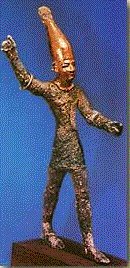
Baal was a Syrian deity of the sky and storms, a West Semitic import to Egypt. Late Bronze Age texts discovered at Ras Shamra (ancient Ugarit) on the Levantine coast, from which his cult spread, indicate that by 1400 B.C., Baal had displaced the god El to become the most important god in the local pantheon.
The Hebrew Bible records the ancient Israelites' interaction with this pagan god, and the remnants of his worship survive in the Jewish prayer book for late spring prayers for dew and late fall prayers for rain. Baal was usually shown in anthropomorphic form depicted as a powerful warrior with long hair and a full, slightly curved, pointed Syrian style beard. He would wear a conical helmet much like a funnel with two horns attached at its base. He is often represented with a straight-bladed sword that he wore on the belt of a short kilt. At other times, he was shown holding a cedar tree club or spear in his left hand while his raised right hand wielding a weapon or even a thunderbolt. This theme, which is common to many Near Eastern storm gods, may have inspired the iconography of the Greek god Zeus.
The meaning of Baal is "owner" or "lord" and it is questionable whether the word was used as a title for important local gods in general, or as a proper name to a specific god. At first, this name was probably given to completely different gods, but over time, the term seems to have been applied to agricultural gods in a variety of locations. There is a great confusion among scholars concerning the these deities called "Baal", or sometimes Bel, and their natures and origins resulting in considerable theological difficulties.
As to the Canaanite for Baal, Baalim as seen under Taurus Constellation Names and also Virgo Introduction under Marduk.
Hebrew Ba'al, bah'-al, the same as Heb. ba'al, bah'-al, from Heb. ba'al, baw-al', a primary root, to be master, hence to marry, a master, hence a husband, or (fig.) owner (often used with another noun in modifications of this latter sense), + archer, + babbler, captain, chief man, thus Baal, a Phoenician deity, plural Baalim.
The word Dominion is sometimes applied to Baal.
When the Hebrew Ba'al often used with another noun in modifications of this latter sense, + archer, + babbler, captain, chief man, thus Baal.
Hebrew memshalah, mem-shaw-law', feminine of Heb. mimshal, mim-shawl', from Heb. mashal, maw-shal', thus a ruler or (abstr.) rule, dominion, that ruled, thus rule, also (concr. in plural) a realm or a ruler, dominion, government, power, to rule.
His similarity to Osiris aided Baal's acceptance in Egypt along with his nature as a storm god which equated with the Egyptian god Seth, and perhaps with Montu. Ramesses II was said to appear at the Battle of Kadesh like "Seth great of strength and Baal himself". The war cry of Ramesses III was said to be like Baal in the sky, and therefore thunder which makes the mountains shake.
Of the many "Baals" the most important, as associated with Egypt, is the god who dwelt on Mount Sapan (hence Baal Saphon or Baal-Zaphon) in Northern Syria. The equivalent of the Amorite deity Adad, or Hadad (Egyptian Set), he was a centrally important deity of the Canaanites. He was considered the son of a less well attested god named Dagan (others have identified him as the son of El), who was himself a god of agriculture and storms. Baal was the source of the winter rain storms, spring mist and summer dew which nourished the crops.
As seen under the Cepheus Constellation Names the King of Ethiopia, or Joppa was the Latin Cepheus, a Phoenician constellation, the father of Andromeda, was also known as Baal-Khepeshef in Egypt: Baal's worship was in Men-Nefer (Gr. Memphis), in the New Kingdom's 18th Dynasty, and probably even earlier influenced by the Semitic Hyksos, as "Baal-Khepeshef," meaning "Baal-is-upon-his-sword." He also had influence near Tanis in the northern Delta E. A. Willis Budge tells us that here, his name was Bar or Balu worshipped as a primary god of war and battle, and a personification of the burning and destroying heat of the sun and blazing desert wind. In Egypt, he was most certainly a specific, identifiable god. Depicted with a pointed beard, wearing a horned helmet and with a cedar tree or a club or a sword in his raised hand. Baal Katsiu, "Lord of the Promontory." Promontory means to project, a peak of high land that juts out into a body of water; headland. Baal Tsephon, Baal-Zephon (ba"-al-ze'-fon) or Hebrew Ba'al Tsephown, bah'-al-tsef-one', was "Lord of the North," or "Lord of the North Wind," from Hebrew Baal, a Phoenician deity, Baalim (plural), usually meaning lord, and Hebrew tsaphown, tsaw-fone', or tsaphon, from Heb. tsaphan, tsaw-fan, to hide, thus properly hidden, i.e. dark, used only of the north as a quarter (gloomy and unknown) - north (-ern, side, -ward, wind), also (in the sense of cold) [according to others an Egyptian form of Typhon, the destroyer], Baal of winter, Baal Tse-phon, a place in Egypt. Baal was known to be a "rider of clouds," "He who rides the clouds", most active during storms but was also considered to be a "lord of heaven and earth", even controlling earth's fertility and was the son of Dagon. He was the god of thunderstorms, the most vigorous and aggressive of the gods and the one on whom mortals most depended.
Some of his other common epithets include: "Most High Prince/Master," "Conqueror of Warriors," "Mightiest, Most High, Supreme, Powerful, Puissant," "Warrior," and "Prince, Master of the Earth." He is also sometimes called Re'ammin, meaning "Thunderer," as well as Aleyin, meaning "Most High," "Mightiest," "Most Powerful," or "Supreme" and he has many, many other epithets.
However, Baal also became associated with the deity of other sites such as: Baal Hazor in Palestine, Baal-Sidon Baal of Tyre (Melkart) in Lebanon. Baal's cult animal was the bull, which symbolized his power and fertility, though in different places he was also associated with goats and even flies. He is sometimes shown in Near Eastern art standing on the back of a bull, and which contributed to his acceptance by the Pharaohs of Egypt, where bull cults in the New Kingdom were an important aspect of the ancient theology. Some other names may show this connection.
Hebrew Ba'al Zebuwb, bah'-al zeb-oob', means Baal of (the) Fly, this fly was one of a stinging nature, Baal-Zebub, a special deity of the Ekronites.
Hebrew Ba'al Peowr, bah'-al peh-ore', Baal of Peor, to yawn, gape, open, a gap, a Moabitish deity, Baal-Peor, a mountain East of Jordan where the deity was worshipped.
Baal-Gad (ba"-al-gad').
Hebrew Ba'al Gad, bah'-al gawd, whereas Gad, is a Babylonian deity, Fortune, that troop, thus Baal of Fortune, a place in Syria.
Other sources claim Baal was armed with magical weapons made by the craftsman god, Kothar, which allowed Baal to overcome Yam, who was the tyrannical god of the sea, according to Near Eastern myths. However, in another story, with the assistance Anat, Baal gets El's approval to build a house. It is Kothar who actually builds the house, and afterwards, Baal celebrates by inviting the gods to a feast. Baal himself was eventually overcome by Mot, a personification of death, after which he descended into the underworld. He then returned to life with the help of his sister and consort, Anat, in a tradition not unlike the death and resurrection of Osiris.