From The Alpha and the Omega - Volume III
by Jim A. Cornwell, Copyright © May 15, 2006, all rights reserved
"Volume III - Earliest Church in the Holy Land?"
MEGIDDO CHURCH


    The following article is presented in the May 2006 issue of Biblical Archaeology Review.

    Prisoners working on behalf of the Israel Antiquities Authority (IAA) inside a proposed new wing of the high security prison at Megiddo (Biblical Armageddon) have uncovered what may have been one of the earliest Christian places of worship in ancient Israel.    The structure may date to the third century A.D. and contains a floor with two mosaics and three inscriptions.    One of the mosaics depicts two fish, an early Christian symbol.    If the structure does not date to the third century, it would predate Emperor Constantine's 313 edict that allowed Christians to worship freely in the Roman Empire.
    The floor measures 30 by 15 feet and has a raised base at its center that may have supported a structure used in worship services.    A nearby inscription reads, "The God-loving Aketous has offered this table to the God Jesus Christ as a memorial."
    A second inscription mentions Gaianus, a Roman military officer, who "having sought honor, from his own money has made the mosaic."
    Some archaeologists were skeptical that the Megiddo structure dates as early as the third century or that it was used as a church.    Zeev Weiss, who is excavating Sepphoris, an imortant Jewish and early Christian site in Galilee, told the Washington Post, "To my mind, they don't really know what they have."


Who found it and when?

    The excavations were launched in April 2005 after construction workers preparing to expand the prison discovered artifacts that, according to the antiquities agency, warranted further investigation.    The discovery was sparked by prisoner Ramil Razilo, who was removing rubble when his shovel uncovered the edge of a large mosaic floor.
    The Israel Antiquities Authority announced November 3, 2005 that excavations at the high-security prison had unearthed "a rare Christian religious structure" from the third to fourth centuries.    The prison's 1,200-strong population of political prisoners, mainly Palestinian, were not allowed to take part in the dig but a few held for non-political crimes helped out.    The excavation is one of several at Megiddo, the site of numerous battles and the place some Christians believe Armageddon will occur.

What was found?

    A large and superbly preserved mosaic, which covers about 64 square yards, was found under the ruins of a later, Byzantine structure.    Antiquities officials said that a Greek inscription on the floor stated that a table there had been dedicated to "the God Jesus Christ."    Two other Greek inscriptions were discovered on the structure's elaborate mosaic floor, one which contains motifs of fish--a symbol of two fish, which looks like a reference to the Zodiac Pisces, which was often used by early Christians--and geometric patterns around it.
    The other bears the name of a man and four women who funded both it and an altar table that once stood on it.
    Professor Leah DiSegni of the Hebrew University in Jerusalem, who translated the inscriptions, said that one was dedicated by a military officer named Gaianus, who contributed to the construction of the mosaic floor from his own funds.    Another inscription memorializes four women: Primilia, Kiraka, Dorothea and Crista.    Another recalls "a certain god-loving Ekeptos [transliterated variously in news reports]," a woman who donated a centrally located table to "the God Jesus Christ as a memorial."    (The table was not found.)    Authorities say that using a table for the communion ritual predated the use of altars in the Byzantine churches of the region.

Who documented the find and when?

    Yotam (Jotham) Tepper, the dig's chief archaeologist, and excavation supervisor for the Israeli Antiquities Authority team, said at a news briefing November 6, 2005 that the find "is certainly the earliest church in Israel that we know of."    "This is a once in a lifetime find and the inscriptions are very rare."    "This is a very ancient structure, maybe the oldest in our area."
    Mr. Tepper said he believed it was possible the Megiddo church dated from before 300 A.D., although that will have to be confirmed by comparison with other inscribed mosaics found at other archaeological sites across the ancient world.    He continued that the discovery could help shed new light on an important period of Christianity.    "Normally we have from this period in our region historical evidence from literature, not archaeological evidence."    "There is no structure you can compare it to.    It is a unique find."    "This is a unique and important structure that expands our understanding of the early period of Christianity."    Tepper said that pottery shards dating back to the third century had been found atop the mosaic.    This, coupled with the inscriptions' wording and the style of their letters, strongly suggests that the mosaic is from this time period as well, he said.

What is the history of the area?

    Christianity was outlawed for the first three centuries after Christ.    The earliest churches in the Holy Land are all believed to date from after 300 A.D.    Megiddo is believed to be at the New Testament site where the final battle between good and evil will be fought before the return of the Messiah.
    The place has already witnessed conflict as it was the site of a huge bomb blast during the Second Intifada when a Palestinian suicide bomber rammed a car full of explosives into a bus carrying off-duty Israeli soldiers.    Seventeen Israelis were killed in the blast which took place on the main road outside the prison gates.

Other comments, pro and con.

    The Vatican's ambassador to Israel, Pietro Sambi, described the find as a "great discovery."
    While there appears to be no doubt that the structure is indeed ancient, some scholars wondered whether it had been built for another purpose and only later transformed into a church.
    "We do know that Judeo-Christian communities lived all over the region, and definitely in the Galilee," Yisca Harani, a Tel Aviv-based historian of Christian pilgrimage, said in an interview with Religion News Service.    "But how is it possible that a church with such a public, grand structure that was so ornate survived under the eyes of the Roman rulers?" Harani asked.    "There is no doubt that it was a church, but whether it predates the Church of the Nativity in Bethlehem or the Church of the Holy Sepulchre in Jerusalem, which both date from the time of Constantine the Great, is another matter."
    Stephen Pfann, a biblical scholar based in Jerusalem quoted by Associated Press, said that inscriptions and iconography found in Nazareth and Capernaum show that people found places to worship in the second and third centuries but most did so in secret.    "This was a time of persecution and in this way it is quite surprising that there would be such a blatant expression of Christ in a mosaic, but it may be the very reason why the church was destroyed," Pfann said.

What may be the outcome of this?

    The Israeli prison authorities were reported to have asked for the mosaic to be dug up and relocated so they could continue with plans to increase the capacity of the prison.


    The following information can be seen on http://www.mazzaroth.com/AlphaOmega/ChapterSix/BK1P1C6A.DOC or on the CD-ROM in the VolumeII folder select the file BK1P1C6A.DOC.
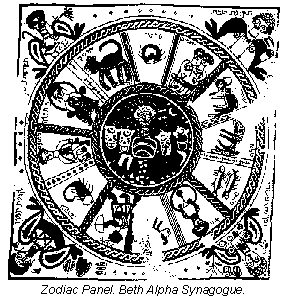
    This file is connected with the sixth century floor mosaic at the ruins of the Beth Alpha Synagogue near Galilee, discovered and excavated in 1929, which I present at "The Alpha and the Omega, Volume II" on Chapter Six Sect. A page 190, the image seen below to the left.
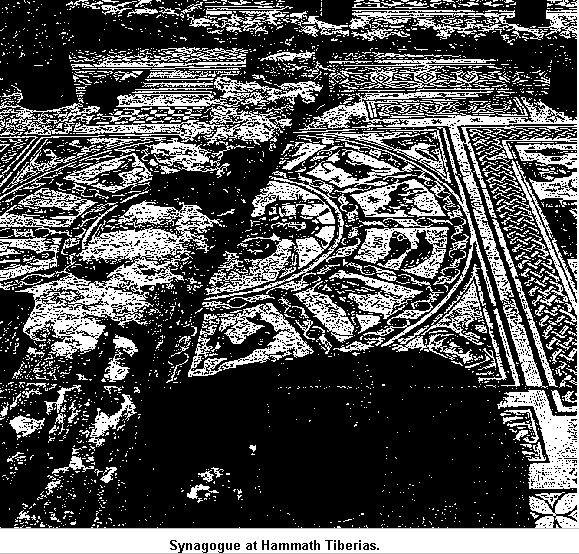
    The other is the Synagogue at Hammath Tiberias which shows elaborate mosaics decorating the floor of a synagogue at this site on the western shore of the Sea of Galilee dated in the fourth century A.D., as seen on "The Alpha and the Omega, Volume II" on Chapter Six Sect. A page 191, the image seen below on the right.
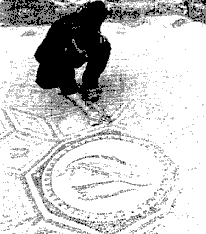
    Both the images below clearly show the image of the two fish represnting Pisces.    Jesus Christ came as the Messiah in the Age of Pisces, which began in 210 B.C.


    This file was created on May 15, 2006.

To return to the Volume III New Released Files.
Return to the Table of Contents or the Zodiac of Denderah