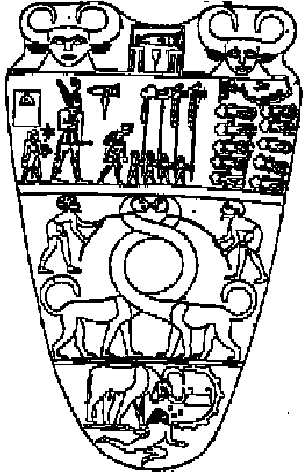
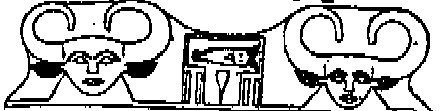
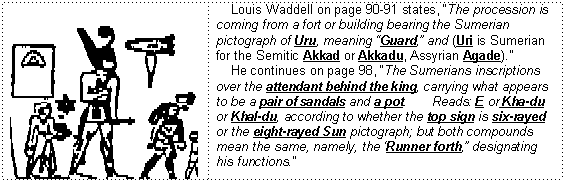
Michael Rice in his Chapter 3 page 107-108 comments on the first register of the reverse side: "Reverse: inverted saucepan-like object as the red crown of Lower Egypt. Surmounted by the Hathor heads and the royal name in its enclosure, the king walks forward, wearing the red crown of the northern kingdom and carrying his war mace. Behind him the same boyish sandal-bearer, carries a bolas (hunting device) for large game, or a rope for hobbling animals, as the hieroglyph ’tt’. The King and his two attendants have symbols or devices, the ancestors of hieroglyphs. The sandal-bearer is now identified by a throwing stick and a six-petalled rosette. His colleague is shaven headed, but could also be a child, but wears a full and heavy wig. He is marked by another version of the object he carries in his hand, suspended above an inverted closed semi-circle."
Rice continues in Chapter 6 page 271 about the dualism of Egypt, "The duality of the ruler is based on the primitive belief that the placenta is the brother of the new born child which as such often accompanies him throughout life in ghostly fashion, since it dies early and is ceremonially buried. The Ka is probably descendant of the placenta."
Also on page 272, "In the New Kingdom, for example it was believed that the Sphinx represented Harmachis, another manifestation of Horus in the Horizon."
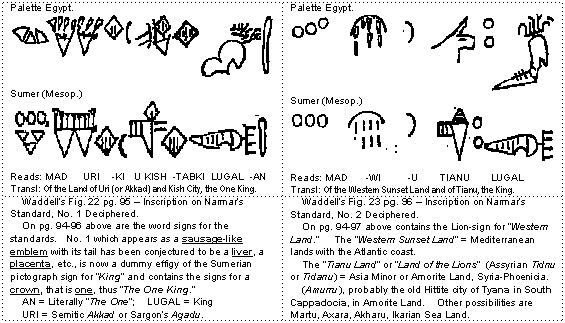
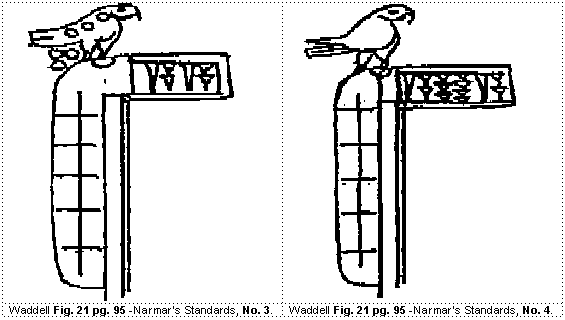
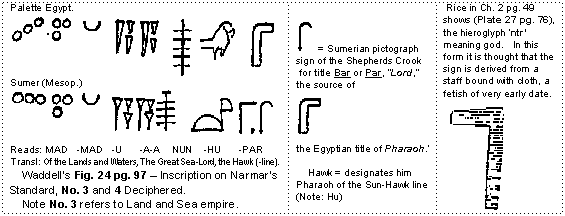
Also see the earlier section on The Warka Vase regarding its reed images as being similar to the Pharaoh staff.
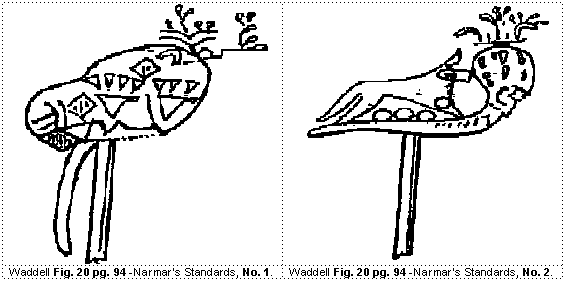
Waddell on page 97-98 adds that Standard No. 4 refers to his universal Sea empire. Urash was the First Phoenician Dynasty for "Sea Lord," the sign of "the great Fish" or "Sea Serpent of the Deep." In the fourth standard he call himself "The Great Sea Lord of the Lands of the Seven Seas."
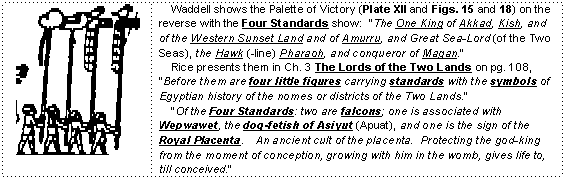
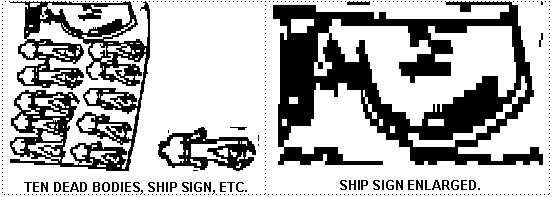
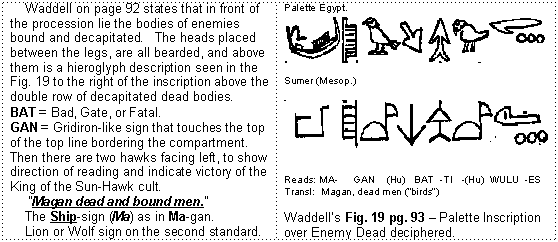
Rice claims in Chapter 3 page 110 that, "These four standards represent the chiefs who supported the King in his bid to unify the Two Kingdoms. They are leading the King to ten headless bodies, lying on their backs with their severed heads between their feet." See the following images.
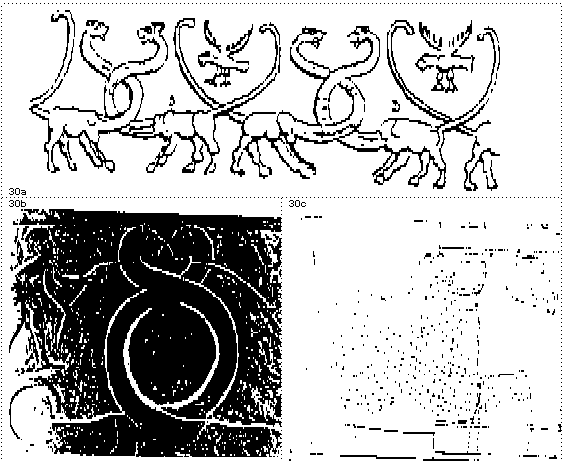
The intertwined serpopards (long-neck creatures on the reverse side with intertwined necks) are probably related to an Elamite design.
Rice claims in Chapter 2 page 58 that, "Among these influences are the appearance of strange saurian creatures with heavy bodies and long necks on which are carried feline heads (Plate 30a, 30b, 30c pg. 78). These are depicted on some of the decorated palettes produced in Egypt and on cylinder seals from Mesopotamia and Elam at the end of the fourth millennium."
He continues in Chapter 3 page 106, "…of ‘The Exotic Animals’ palette is a very remarkable artifact. The entire surface, except for the kohl-grinding area, is filled with animals, some of a very strange appearance. Dominating both sides are two great dogs. A good cross-section of the larger fauna of Egypt is represented but the strangest, most mysterious figure is that of a dog, or jackal-headed creature, reared up on its hind legs, playing a sort of flute. Did Orpheus have his origins in Predynastic Hierakonpolis or is this some masked Master of the Beast? There can surely be little doubt that it is the enigmatic Set who pipes who knows what strange melodies to the whirling animals (and monsters) which attend him."
Michael Rice in Chapter 3 page 106 states, "The long-necked beast can also be seen on ‘The Exotic Animals’ or ‘The Oxford’ and ‘The Two Dogs’ palette from Hierakonpolis, is one of the most complex and strange of this type of artifact."
The obverse shows two long saurian necks are surmounted by a bird and seen undulating to hold off two jackals, from the animal between them. The creatures are licking a prone caprid, and have claws on their feet.
On the reverse are more fantastic creatures, including a griffin and another long necked beast.
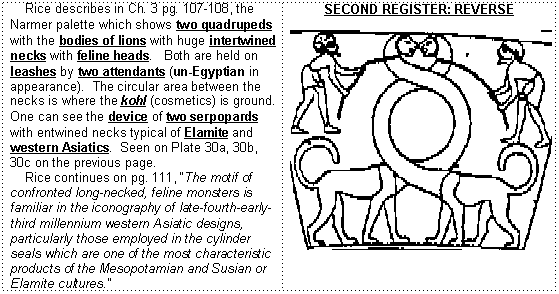
Some see the above creatures as two mythological camel-leopard-like animals, with their necks enclosing the pigment basin.
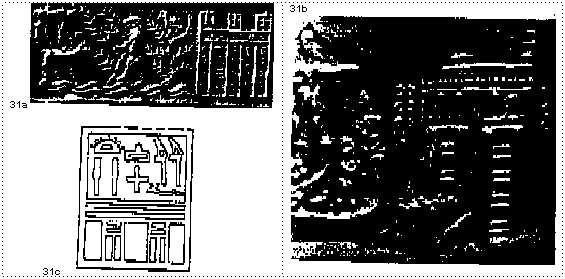
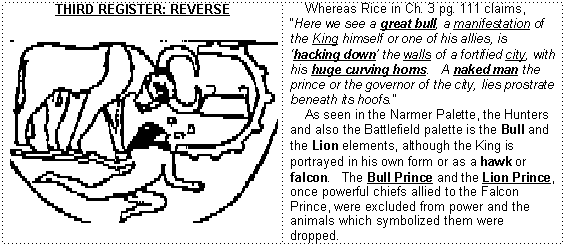
Waddell on page 92 upholds, "Here we see the Bull, symbolizing Naram breaking down a fort, scattering the bricks and trampling upon a fleeing foe. The picture inside the fort is possibly the hieroglyph of the towns name (Sumerian pictograph Pisan-mat or Gur-mat)."
The Great Bear or The Greater Sheepfold comes on the Meridian on April 20. There are seven bright stars that form the asterism known as the Big Dipper, the Plough, and the Wain, or Wagon. Like Ursa Minor, Ursa Major is neither a dipper nor a bear, rather a greater sheepfold as pictured in most ancient zodiacs [Middle English, from Latin Ursa Major : ursa, bear + maior, comparative of magnus, great]. Al Naish is the Arabic name of the constellation of Ursa Major meaning "The Assembled Together."
To the Egyptians the stars of the dipper were the thigh of a bull. A Star in Ursa Major  in Arabic is the name for the "thigh" of the bear. It is also called Phacda meaning "Visited," "Guarded," or "Number."
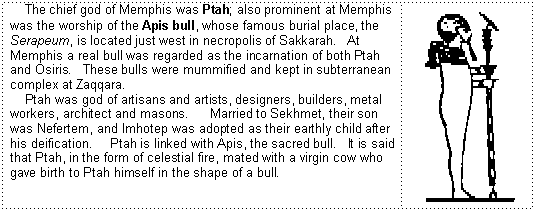
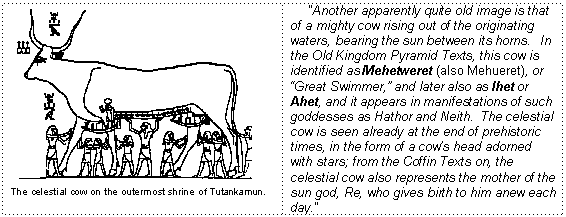
To the Egyptians the deity with the bull was Apis, the Bull of Memphis. Apis was an actual bull chosen to serve as the earthly vessel of the soul of Osiris, god of the Sun and of the Nile. On the death of each Apis, the spirit of Osiris transferred itself to a successor. The animal meant to inherit the divine duty was recognized by certain markings: when a bull fitting the description was found, he was called Apis and lived as an object of reverence and sacrifice. The living bulls were worshipped in Egypt.
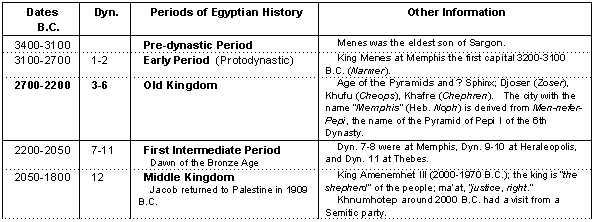
Memphis (Heb. noph, moph, Copt. menphe, memphi, Gr. Memphis). The first capital of united Egypt (c. 3200 B.C.) south of modern Cairo. Legend ascribes the founding of the city to Menes, the traditional first king. The original name of the city was "The White Wall." Later it was called Men-nefer-Pepi, after the name of the pyramid of Pepi I of the Sixth Dynasty; it is from this name that "Memphis" is derived.
Historians divide ancient Egyptian history into 30 dynasties. A dynasty is a series of rulers belonging to the same family. Egypt's pre-dynastic era lasted until 3,100 B.C., when the dynasties began to rule. Sometimes two dynasties ruled different parts of Egypt at the same time. Groups of dynasties make up periods. Egypt (Gr. Aigyptos, Heb. mitsrayim).
Menes around 3000 B.C., was the King of Egypt who founded the first dynasty uniting Upper and Lower Egypt.